
Kiev, located on the right bank of …
Years: 860 - 860
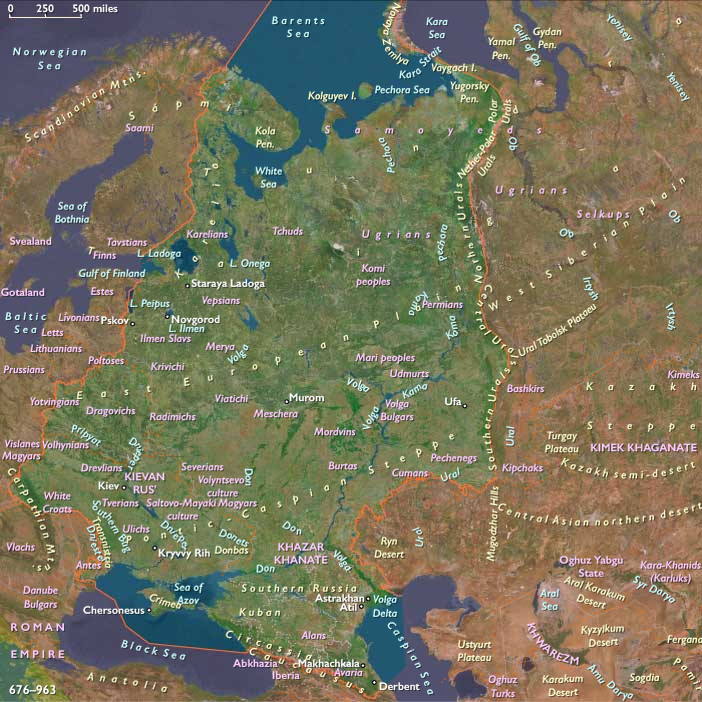
Kiev, located on the right bank of the Dnepr River, at the halfway point of its fourteen hundred-mile (two thousand two hundred and fifty-five -kilometer) route from northwest Russia to the Black Sea, is first mentioned in Russian chronicles in 860.
The eventual capital of Kievan Rus', its name supposedly derives from that of its legendary founder, Prince Kii.
Kiev’s location, above the Dnepr rapids where the open steppe meets with the belt of Slavic settlements in the forest-meadow region, endows the city with great strategic importance.
The legend of Kyi, Schek and Khoriv speaks of a founder-family consisting of a Slavic tribe leader Kyi, the eldest, his brothers Schek and Khoriv, and also their sister Lybid, who had founded the city.
Kyiv/Kiev is translated as "belonging to Kyi".
It is unclear when Kiev had fallen under the rule of the Khazar empire but, in an event attributed to the ninth century, the Primary Chronicle (a main source of information about the early history of the area) mentions Slavic Kievans telling Askold and Dir that they live without a local ruler and pay a tribute to Khazars.
At least during the eighth and ninth centuries Kiev functions as an outpost of the Khazar empire on its border with Levédia, an area settled by the Magyars in the ninth century, located in the territory of present-day eastern Ukraine.
They had moved to this area from Magna Hungaria situated on the western side of the Urals in the region today known as Bashkortostan.
A hill-fortress, called Sambat (Old Turkic for "High Place") is built to defend the area (although there is no evidence of an urban settlement on the site of Kiev prior to the 880s, and archaeological finds from the period in the vicinity of Kiev are almost nonexistent).
Locations
Groups
Subjects
Regions

Subregions
Related Events
Showing 10 events out of 54065 total
Years: 860 - 860
Locations
Groups
Subjects
Regions
Subregions