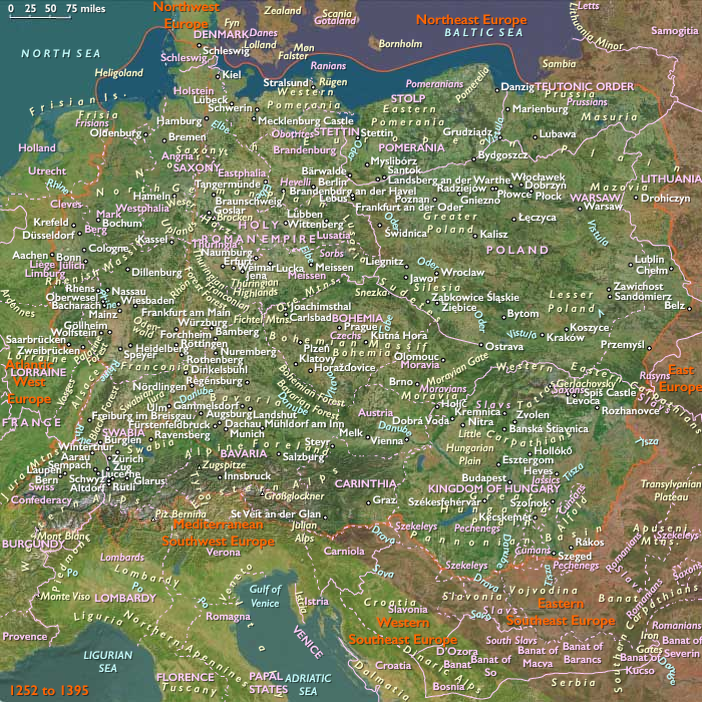
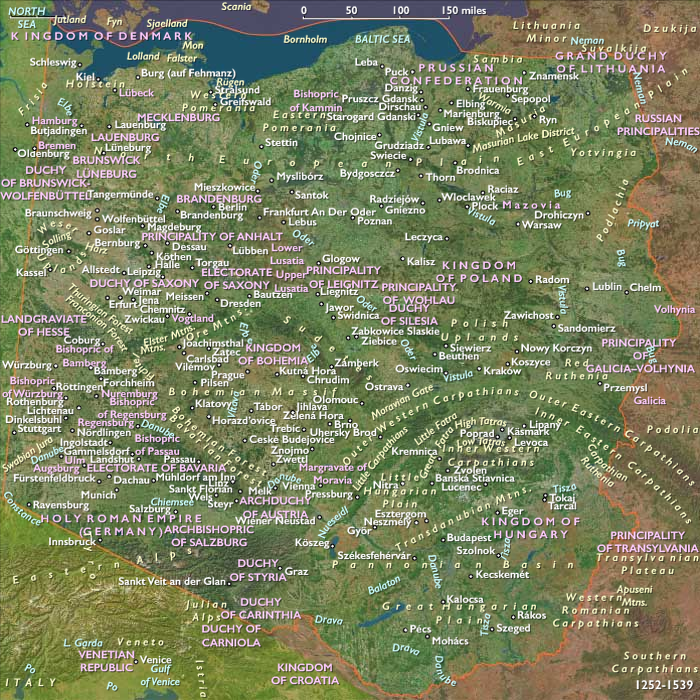
Kiel, the capital of the county (later …
Years: 1284 - 1284
Kiel, the capital of the county (later duchy) of Holstein, is a member of the Hanseatic League from 1284.
Locations
Groups
Subjects
Regions
Subregions
Related Events
Filter results
Showing 10 events out of 45457 total
The Mongol Golden Horde, led by Nogai Khan, attacks Hungary a second time.
King Stephen Dragutin of Serbia receives from Ladislaus IV of Hungary Belgrade, Syrmia, and other territories from Hungary, when his son Vladislav marries a cousin of the Hungarian king.
Dragutin will rule the area of Macva with Belgrade, and the Bosnian areas Soli and Usora, until 1316, establishing family relations with Bosnian ban Stephen I Kotromanić.
His new state is named the Kingdom of Srem.
The first capital of his state is Debrc (between Belgrade and Šabac); he soon moves his residence to Belgrade, to become the first of the Serb rulers to rule from this capital.
The Seljuqs had taken the imperial city of Tralles for the first time after the Battle of Manzikert in 1071, when the East Roman Empire was in civil chaos, but Alexios I Komnenos had recaptured the city for the Empire in the later half of the eleventh century.
The city lay in ruins by the thirteenth century, and Andronikos II Palaiologoshad decided in 1278 to rebuild and repopulate it, now to be renamed Andronikopolis or Palaiologopolis, with the aim of forming a bulwark against Turkish encroachment in the area.
The megas domestikos Michael Tarchaneiotes had been given the task: he has rebuilt the walls and settled thirty-six thousand people from the surrounding regions.
Thirteenth century Byzantine settlement policy along the Meander Valley notably involves the Turkic Cumans.
Turkish attacks nevertheless resume soon after.
The city is besieged and, lacking sufficient supplies and access to water, captured in 1284 by the beylik of Menteshe.
The city suffers extensive destruction and part of its inhabitants are massacred.
Moreover, over twenty thousand inhabitants are sold off as slaves.
Under the rule of Menteshe, whose lands extend towards the south, the city is renamed as Güzelhisar ("beautiful castle").
Qalawun signs a ten-year truce with the Crusader city of Acre; he will violate the truce on pretexts in 1290.
Milutin also gains control of northern Albania and the city of Dyrrachion (Durrës) in 1284.
There will be no territorial changes in the region for the next fifteen years.
Elne had been one of the first towns to be attacked when the Arabs crossed the Pyrenees in 719, and when the counts of Roussillon achieved independence, Perpignan became the capital of the county, with Elne remaining the Episcopal city.
The high altar of the present cathedral of Sainte-Eulalie-et-Sainte-Julie was consecrated in 1069.
Its Romanesque cloister was built in the twelfth to fourteenth centuries.
The conflict with France the Papacy over Aragon’s possession of Sicily quickly becomes a kind of civil war, as Peter's brother, King James II of Majorca, joins the French.
James has also inherited the County of Roussillon and thus stands between the dominions of the French and Aragonese monarchs.
Peter had opposed James' inheritance as a younger son and reaps the consequence of such rivalry in the crusade.
The first French armies under Philip and Charles enter Roussillon in 1284.
They include sixteen thousand cavalry, seventeen thousand crossbowmen, and one hundred thousand infantry, along with one hundred ships in south French ports.
Though they have James' support, the local populace rises against them.
The city of Elne is valiantly defended by the so-called Bâtard de Roussillon (Bastard of Roussillon), the illegitimate son of Nuño Sánchez, late count of Roussillon (1212–1242).
Eventually he is overcome and the cathedral is burnt, despite the presence of papal legates, while the population is massacred, all save the Bâtard.
He succeeds in negotiating his surrender and accompanies the advancing royal forces as a prisoner.
Pisa, one of the major maritime republics of Italy, has economically and militarily dominated the Ligurian Sea from the eleventh century.
Its principal rival, the Republic of Genoa, has in the thirteenth century conquered numerous settlements in Crimea, where the Genoese colony of Caffa had been established.
The alliance with the restored Roman Empire has increased the wealth and power of Genoa and simultaneously decreased Venetian and Pisan commerce.
The Empire had granted most of free trading rights to Genoa.
Pisa had tried to gain control of the commerce and administration of Corsica, in 1282, when Sinucello, the judge of Cinarca, revolted against Genoa and asked for Pisan support.
Part of the Genoese fleet had blockaded Pisan commerce near the River Arno in August 1282.
Both Genoa and Pisa had made war preparations during 1283.
Pisa has gathered soldiers from Tuscany and appointed captains from its noble families.
Genoa has built one hundred and twenty galleys; sixty of these belong to the Republic and the remainder are rented to individuals.
This fleet requires at least fifteen thousand to seventeen thousand rowers and seamen.
The Genoese fleet attempts in early 1284 to conquer Porto Torres and Sassari in Sardinia.
Part of the Genoese merchant fleet defeats a Pisan force while traveling to Constantinople.
The Genoese fleet blocks Porto Pisano and attacks Pisan ships traveling in the Mediterranean Sea.
A Genoese force of thirty ships led by Benedetto Zaccaria travels to Porto Torres to support the Genoese forces that are besieging Sassari.
The Pisans are lying in the Arno at the mouth of which lies Porto Pisano, the city's port, when the Genoese appear off Meloria, a rocky islet in the Ligurian Sea across from Livorno.
The Pisan fleet represents the whole power of the city, and carries members of every family of mark and most of the officers of state.
The Genoese, desiring to draw their enemy out to battle and to make the action decisive, arrange their fleet in two lines abreast.
According to Agostino Giustiniani, the first is composed of fifty-eight galleys, and eight panfili—a class of light galley of eastern origin named after the province of Pamphylia.
Oberto Doria, the Genoese admiral, is stationed in the center and in advance of his line.
To the right are the galleys of the Spinola family, among those of four of the eight companies into which Genoa is divided: Castello, Piazzalunga, Macagnana and San Lorenzo.
To the left are the galleys of the Doria family and the companies Porta, Soziglia, Porta Nuova and Il Borgo.
The second line of twenty galleys under the command of Benedetto Zaccaria is placed so far behind the first that the Pisans cannot see whether it is made up of war-vessels or of small craft meant to act as tenders to the others.
It is near enough to strike in and decide the battle when the action had begun.
The Pisans, commanded by the Podestà Morosini and his lieutenants Ugolino della Gherardesca and Andreotto Saraceno, come out in a single body.
The Pisan fleet advances in line abreast to meet the first line of the Genoese, fighting according to the medieval custom of ramming and boarding.
The victory is decided for Genoa by the squadron of Zaccaria, which falls on the flank of the Pisans.
Their fleet is nearly annihilated, the Podestà is captured and Ugolino flees with a few vessels.
Prisoners taken by the Genoese are in the order of thousands.
Among them is the poet Rustichello da Pisa, who will meet Marco Polo (captured during the Battle of Curzola) and write down the adventures of the Venetian explorer.
Pisa’s decisive defeat is a crippling blow to the maritime republic.