Khosrau, a patron of learning, invites to …
Years: 530 - 530
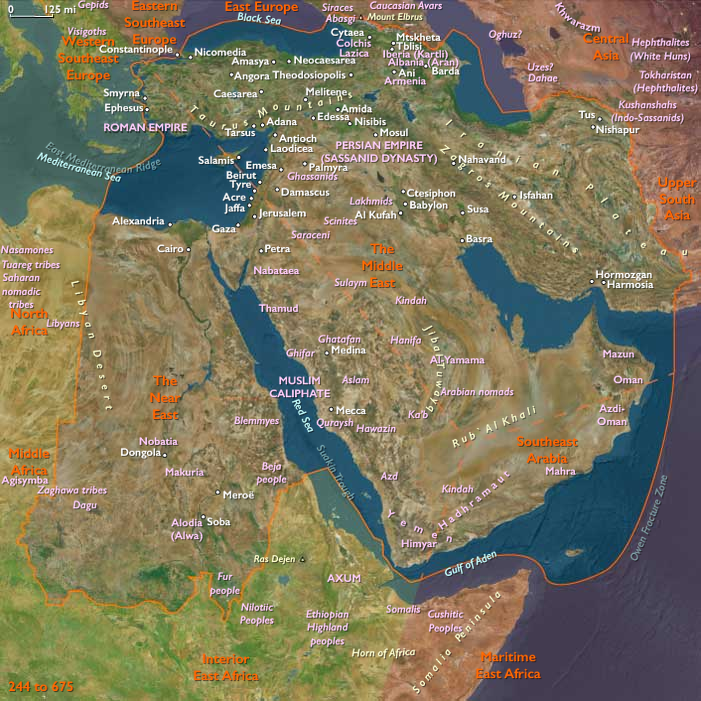
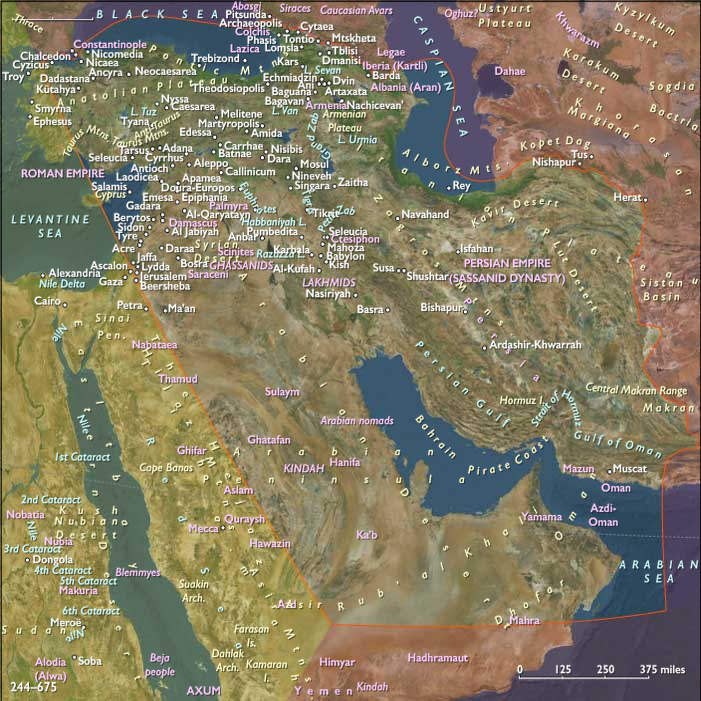
Khosrau, a patron of learning, invites to his court Greek philosophers, their Academy in Athens having been shut down by Justinian in 529.
Locations
People
Groups
- Persian people
- Greeks, Hellenistic
- Achaea (Roman province)
- Persian Empire, Sassanid, or Sasanid
- Roman Empire, Eastern: Justinian dynasty
Topics
Commodoties
Subjects
- Commerce
- Labor and Service
- Conflict
- Faith
- Government
- Scholarship
- Technology
- Movements
- Philosophy and logic
Regions
Subregions
Related Events
Filter results
Showing 10 events out of 58092 total
Justinian selects a second commission on December 15, 530, to collate and excises contradictions from the writings of the foremost Roman legal experts.
Tribonian becomes quaestor sacri palatii and chief editor of the compilation of the old Roman legal writings.
This becomes the Digest (Pandects), a distillation of legal expertise containing more than nine thousand extracts arranged in fifty books.
Belisarius, in response to a major Persian offensive in 530, leads the Romans to victory over a much larger Persian force under Mihran through his superior generalship in the Battle of Dara, brilliantly deploying offensive cavalry and defensive infantry to defeat a combined Persian-Arab army of forty thousand.
It is possible that Al-Harith took part with his men in the Roman victory at Daras in 530, although no source explicitly mentions him.
At the same time, …
…Sittas and Dorotheus, commanding a cavalry force of thirty thousand troops, defeat a second Persian thrust in the Caucasus under Mihr-Mihroe at Satala.
Axumite control of South Arabia continues until about 525 or 530, when Sumuafa' Ashawa' is deposed by Abraha, who proclaims himself king.
Abraha had aroused the wrath of Kaléb by withholding tribute; Kaleb had then sent his general 'Ariat to take over the governorship of Yemen.
'Abraha had rid himself of the latter by a subterfuge in a duel resulting in 'Ariat being killed and 'Abraha suffering the injury which earned him the sobriquet of al-Asräm, "scar-face."
According to Procopius (Histories 1.20), 'Abraha seized the control of Yemen from Esimiphaeus (Sumuafa' Ashawa'), the Christian Himyarite viceroy appointed by Kaléb, with the support of dissident elements within the Aksum occupation force who were eager to settle in the Yemen, at this time a rich and fertile land.
Stuart Munro-Hay, who proposes a 518 date for the rise of Dhu Nuwas, dates this event to 525, while by the later chronology (in which Dhu Nuwas comes to power in 523), this event would have happened about 530, although a date as late as 543 has been postulated by Jacques Ryckmans.
An army sent by Kaléb to subdue 'Abraha joins his ranks and kills the ruler sent to replace him (this is perhaps a reference to 'Ariat) and a second army is defeated.
After this Kaléb, has to accord Abraha de facto recognition; he will eventually earn recognition under Kaleb's successor for a nominal tribute.
An Imperial edict passed during the papacy of Felix IV grants that cases against clergy should be dealt with by the Pope.
He defines church teaching on grace and free will in response to a request of Faustus of Riez, in Gaul, on opposing Semi-Pelagianism.
Pope Felix had attempted to designate his own successor, who will eventually reign as Boniface II.
The reaction of the Senate had been to forbid the discussion of a pope’s successor during his lifetime or to accept such a nomination.
Pope Felix IV dies on September 22, 530, and is succeeded by Boniface II, an archdeacon of German descent who becomes the fifty-fifth pope.
By birth an Ostrogoth, the first Germanic pope, he owes his appointment to the influence of the Gothic king Athalaric.
The majority of the clergy had reacted to Felix's activity by nominating Dioscorus as Pope; only a minority supported Boniface.
Dioscorus is elected as antipope in the Lateran Palace but he dies within a month, thus ending the brief schism.
Hilderic's reign is noteworthy for the kingdom's excellent relations with the Eastern Roman Empire.
Procopius writes that he was "a very particular friend and guest-friend of Justinian, who had not yet come to the throne", noting that Hilderic and Justinian exchanged large presents of money to each other.
Hilderic had allowed a new Catholic bishop to take office in the Vandal capital of Carthage, and many Vandals began to convert to Catholicism, to the alarm of the Vandal nobility.
By the time he assumed the crown, he was quite old, at least into his fifties and possibly over sixty.
For this reason, according to Procopius, he was uninterested in the military operations of the Vandals and left them to other family members, of whom Procopius singles out for mention his nephew Hoamer.
After seven years on the throne, Hilderic falls victim to a revolt led by his cousin twice removed, Gelimer, an Arian, who leads the people in a religious rebellion.
The staunchly anti-Roman Gelimer now becomes King of the Vandals and Alans, and restores Arianism as the official religion of the kingdom, greatly worsening relations between Constantinople and Carthage.
He imprisons Hilderic, along with Hoamer and his brother Euagees, but does not kill him.
Justinian protests Gelimer's actions, demanding that Gelimer return the kingdom to Hilderic.
Gelimer sends away the envoys who bring him this message, replying: “nothing is more desirable than that a monarch should mind his own business.” He blinds Hoamer and puts both Hilderic and Euagees under closer confinement, claiming that they had planned a coup against him.
Al-Harith leads a five thousand-strong Arab contingent in the Battle of Callinicum, in which twenty thousand men under command of Belisarius are defeated by Persian and Lakhmid forces in 531.
Belisarius withdraws his exhausted army to Sura on the Euphrates, where he holds his ground against repeated Persian assaults.
During the summer of the same year, the Romans capture some forts in Armenia, and effectively repulse a Persian offensive, while the Persian capture two forts in eastern Lazica.
Immediately after the failure at Callinicum, the Persians and Romans negotiate without success.
The Roman failure at Callinicum is followed by a commission of inquiry, the result of which is the dismissal of Belisarius from his post.
Procopius, a source hostile to the Ghassanid ruler, states that the Arabs, stationed on the Roman right, betrayed the Romans and fled, costing them the battle.
John Malalas, however, whose record is generally more reliable, reports that while some Arabs indeed fled, Harith stood firm.
The charge of treason leveled by Procopius against Harith seems to be further undermined by the fact that, unlike Belisarius, he is retained in command and is active in operations around Martyropolis later in the year.
The Franks, ruled by Clovis’s sons, take Septimania from the Goths in 531.
Theudis, during his governorship over the Kingdom of the Visigoths, had married a Spanish woman who, according to Procopius, "belonged to the house of one of the wealthy inhabitants of that land, and not only possessed great wealth but also a great estate in Spain."
With this wealth, he has been able to muster a private army of two thousand men, effectively making him independent of Theodoric's authority.
Theodoric had not taken any action against Theudis.
One reason is that doing so would give the Franks, who had killed the Visigothic king Alaric in the Battle of Vouillé, an excuse to take to the field once again.
Another is that Theudis had been careful to obey the commands of his king, and had never failed to send the annual tribute.
The young Amalaric had been proclaimed king of the Visigoths in 522, and had assumed full royal power four years later on the death of his grandfather, Theoderic.
His kingdom faces a threat from the north from the Franks; according to Peter Heather, this had been Amalaric’s motivation for marrying Clotilde, the daughter of Clovis, in 511.
However, this was not successful, for according to Gregory of Tours, Amalaric pressured her to forsake her Roman Catholic faith and convert to Arian Christianity, at one point beating her until she bled; she sent to her brother Childebert I, king of Paris a towel stained with her own blood.
Childebert defeats the Visigothic army at Barcelona, where Amalaric is assassinated by his own men.
According to Peter Heather, Theoderic's former governor Theudis was implicated in Amalaric's murder, "and was certainly its prime beneficiary."
Clotilde returns to Francia with the Frankish army, but dies on the journey and is buried at Paris.
Following the death of Amalaric, last of the Balti dynasty, Theudis is elected king.
Herwig Wolfram believes one factor that led to his selection was support of fellow Ostrogoths who had gone west with him.
Peter Heather posits a second, noting that several of Theudis' Italian relatives—Ildibad and Totila—became kings of the Ostrogoths following the fall of the House of Theodoric in the Gothic Wars: "They probably represent, therefore, a particularly powerful non-royal clan."

Justinian sends a second embassy to Carthage protesting the developments in the Vandal kingdom, and Gelimer replies, in effect, that Justinian has no authority to make such demands.
Years: 530 - 530
Locations
People
Groups
- Persian people
- Greeks, Hellenistic
- Achaea (Roman province)
- Persian Empire, Sassanid, or Sasanid
- Roman Empire, Eastern: Justinian dynasty
Topics
Commodoties
Subjects
- Commerce
- Labor and Service
- Conflict
- Faith
- Government
- Scholarship
- Technology
- Movements
- Philosophy and logic