Kamehameha is now ruler of all the …
Years: 1796 - 1796
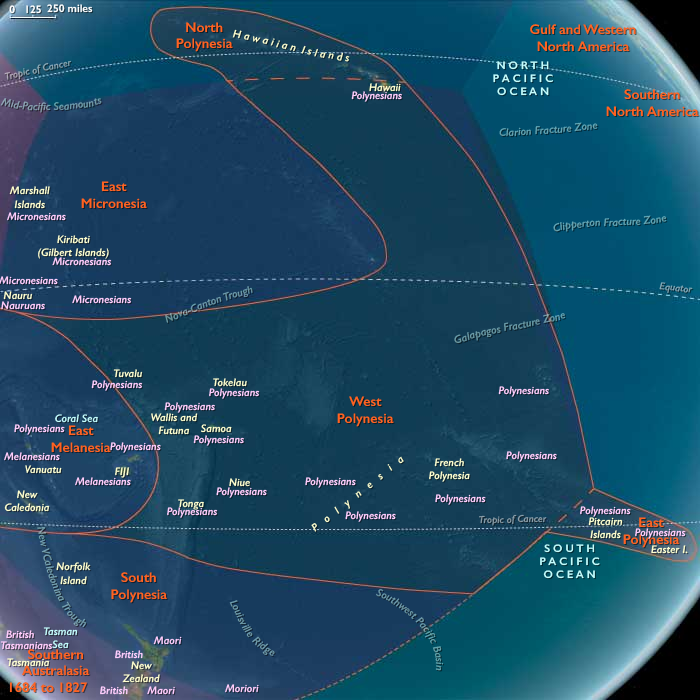
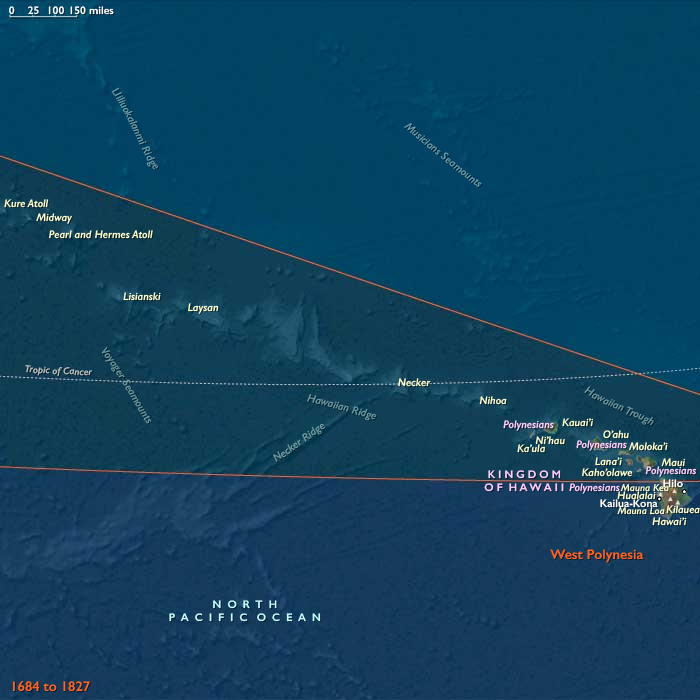
Kamehameha is now ruler of all the Hawaiian Islands from Oʻahu to the east, but the western islands of Kauaʻi and Niʻihau continue to elude him.
Using Honolulu as a base, he has a forty-ton ship built.
When he attempts to invade the western islands in 1796, Kaʻiana's brother Namakeha leads a rebellion on Hawaiʻi island against his rule, and Kamehameha is forced to return and put down the insurrection.
Locations
People
Groups
Topics
Commodoties
Subjects
Regions
Subregions
Related Events
Filter results
Showing 10 events out of 23235 total
The Qianlong Emperor of China abdicates at age eighty-four on February 9 to make way for his son, the Jiaqing Emperor.
The Qing government had seen a return of rampant corruption during the late years of Qianlong's reign.
Heshen, arguably one of the most corrupt officials in the entire history of the Qing Dynasty, is eventually forced into committing suicide in 1799 by the Jiaqing Emperor.
Martin Klaproth, who has continued the chemical investigations of Müller von Reichenstein, names the newly discovered metal tellurium, from Latin tellus, “the Earth”, in 1796.
The Qajar dynasty (who will rule Persia until the 1920s) makes Tehran its capital.
Albanian governor Kara Mahmud Bushati overestimates the strength of his relationship with the Porte: when, in 1796, he attempts to wrest land from Montenegro, he is defeated and beheaded.
The three armies are to link up in Tyrol and march on Vienna.
In the Rhine Campaign of 1796, Jourdan and Moreau cross the Rhine River and advance into Germany.
Jourdan advances as far as Amberg in late August while Moreau reaches Bavaria and the edge of Tyrol by September.
However, Jourdan is defeated by Archduke Charles, Duke of Teschen and both armies are forced to retreat back across the Rhine.
Napoleon, on the other hand, is successful in a daring invasion of Italy.
In the Montenotte Campaign, he separates the armies of Sardinia and Austria, defeating each one in turn, then forces a peace on Sardinia.
Following this, his army captures Milan and starts the Siege of Mantua.
Bonaparte defeats successive Austrian armies sends against him under Johann Peter Beaulieu, Dagobert Sigmund von Wurmser and József Alvinczi while continuing the siege.
The rebellion in the Vendée is also crushed in 1796 by Louis Lazare Hoche.
Hoche's subsequent attempt to land a large invasion force in Munster to aid the United Irishmen is unsuccessful.
The Spanish government lifts the restrictions against neutrals trading with the colonies, thus acknowledging Spain's inability to supply the colonies with needed goods and markets.
Now virtually a French dependency forced to subsidize France’s military adventures, Spain suffers from British attacks on its empire and shipping.
Spain had declared war on the newly formed French Republic in the War of the First Coalition, joined the Coalition in attempting to restore the Bourbon Monarchy.
The main Spanish general, Antonio Ricardos, had failed to secure a decisive victory, despite initial successes.
French forces elsewhere had quickly overrun the Austrian Netherlands after the Battle of Fleurus, and the Dutch Republic had collapsed under huge pressure.
The Spanish were having similarly bad times.
The Spanish navy had done little, with the exception of combining with the British and participating in the Siege of Toulon.
The French Republic had gained a huge advantage following the Battle of the Black Mountain, and by 1795, the Peace of Basel had been signed, forcing the Kingdom of Spain and Kingdom of Prussia to exit the Coalition.
In 1796, Manuel Godoy, encouraged by massive French gains in the Rhine Campaign and Italian Campaign, signs the Second Treaty of San Ildefonso, establishing a Franco-Spanish alliance and common war against Great Britain.
The hope is that victorious France will also win over land and money for Spain.
Jean Léopold Nicolas Frédéric, Baron Cuvier, known as Georges Cuvier, was born in Montbéliard, France, where his Protestant ancestors had lived since the time of the Reformation.
His father, Jean George Cuvier, was a lieutenant in the Swiss Guards and a bourgeois of the town of Montbéliard; his mother was Anne Clémence Chatel.
At the time, the town, which was annexed to France on October 10, 1793, had belonged to the Duchy of Württemberg.
His mother, who was much younger than his father, had tutored him diligently throughout his early years so that he easily surpassed the other children at school.
During his gymnasium years, he had little trouble acquiring Latin and Greek, and was always at the head of his class in mathematics, history, and geography.
Soon after entering the gymnasium, at age ten, he had encountered a copy of Conrad Gesner's Historiae Animalium, the work that first sparked his interest in natural history.
He then began frequent visits to the home of a relation where he could borrow volumes of Buffon's massive Histoire Naturelle.
All of these he read and reread.
He remained at the gymnasium for four years, then spent an additional four years at the Caroline Academy in Stuttgart, where he excelled in all of his coursework.
Although he knew no German on his arrival, after only nine months study he managed to win the school prize for that language.
Upon graduation, he had no money to await appointment to academic office, so in July 1788 he took a job at Fiquainville chateau in Normandy as tutor to the only son of the Comte d'Héricy, a Protestant noble.
It was here during the early 1790s that he began his comparisons of fossils with extant forms.
Cuvier regularly attended meetings held at the nearby town of Valmont for the discussion of agricultural topics.
There, he became acquainted with Henri Alexandre Tessier (1741–1837), a physician and well-known agronomist who had fled the Terror in Paris and assumed a false identity.
After hearing Tessier speak on agricultural matters, Cuvier recognized him as the author of certain articles on agriculture in the Encyclopédie Méthodique and addressed him as M. Tessier.
Tessier replied in dismay, "I am known, then, and consequently lost."
— " Lost!" replied M. Cuvier; "no; you are henceforth the object of our most anxious care."
"They soon became intimate and Tessier introduced Cuvier to his colleagues in Paris — "I have just found a pearl in the dunghill of Normandy", he wrote his friend Antoine-Augustin Parmentier.
As a result, Cuvier entered into correspondence with several leading naturalists of the day and was invited to Paris.
Arriving in the spring of 1795, at the age of twenty-six, he soon became the assistant of Jean-Claude Mertrud (1728–1802), who had been appointed to the newly created chair of comparative anatomy at the Jardin des Plantes.
The Institut de France was founded in the same year, and he was elected a member of its Academy of Sciences.
In 1796, he begins to lecture at the École Centrale du Pantheon, and at the opening of the National Institute in April, he reads his first paleontological paper, which will subsequently be published in 1800 under the title Mémoires sur les espèces d'éléphants vivants et fossiles.
In this paper, he analyzes skeletal remains of Indian and African elephants as well as mammoth fossils, and a fossil skeleton known at that time as the 'Ohio animal'.
Cuvier's analysis establishes, for the first time, the fact that African and Indian elephants are different species and that mammoths are not the same species as either African or Indian elephants and therefore must be extinct.
He further states that the 'Ohio animal' represents a distinct extinct species that is even more different from living elephants than mammoths are.
Years later, in 1806, he will return to the 'Ohio animal' in another paper and give it the name Mastodon.
In his second paper in the year 1796, he describes and analyzes a large skeleton found in Paraguay, which he names Megatherium.
He concludes that this skeleton represents yet another extinct animal and, by comparing its skull with living species of tree dwelling sloths, that it is a kind of ground dwelling giant sloth.
Together these two 1796 papers are a landmark event in the history of paleontology and in the development of comparative anatomy as well.
They also greatly enhance Cuvier's personal reputation, and they essentially end what had been a long running debate about the reality of extinction.

The year 1796 is most productive for both Johann Carl Friedrich Gauss and number theory.
He discovers a construction of the heptadecagon on March 30.
He further advances modular arithmetic, greatly simplifying manipulations in number theory.
On April 8 he becomes the first to prove the quadratic reciprocity law.
This remarkably general law allows mathematicians to determine the solvability of any quadratic equation in modular arithmetic.
The prime number theorem, conjectured on 31 May, gives a good understanding of how the prime numbers are distributed among the integers.
Gauss also discovers on July 10 that every positive integer is representable as a sum of at most three triangular numbers; he then then jots down in his diary the note: "ΕΥΡΗΚΑ! num = Δ + Δ' + Δ".
On October 1 he publishes a result on the number of solutions of polynomials with coefficients in finite fields, which one hundred and fifty years later will lead to the Weil conjectures.
Gauss was born on April 30, 1777 in Brunswick (Braunschweig), in the Duchy of Brunswick-Wolfenbüttel (now part of Lower Saxony, Germany), to poor, working-class parents.
His mother was illiterate and never recorded the date of his birth, remembering only that he had been born on a Wednesday, eight days before the Feast of the Ascension (which occurs thirty-nine days after Easter).
Gauss later solved this puzzle about his birthdate in the context of finding the date of Easter, deriving methods to compute the date in both past and future years.
He had been christened and confirmed in a church near the school he attended as a child.
Gauss was a child prodigy.
A contested story relates that, when he was eight, he figured out how to add up all the numbers from 1 to 100.
There are many other anecdotes about his precocity while a toddler, and he made his first ground-breaking mathematical discoveries while still a teenager.
He completed his magnum opus, Disquisitiones Arithmeticae, in 1798, at the age of twenty-one—though it will not be published until 1801.
This work is fundamental in consolidating number theory as a discipline and will shape the field to the present day.
Gauss's intellectual abilities had attracted the attention of the Duke of Brunswick, who sent him to the Collegium Carolinum (now Braunschweig University of Technology), which he had attended from 1792 to 1795, and to the University of Göttingen from 1795 to 1798.
While at university, Gauss independently rediscovers several important theorems.
His breakthrough occurs in 1796 when he shows that a regular polygon can be constructed by compass and straightedge if the number of its sides is the product of distinct Fermat primes and a power of 2.
This is a major discovery in an important field of mathematics; construction problems have occupied mathematicians since the days of the Ancient Greeks, and the discovery ultimately leads Gauss to choose mathematics instead of philology as a career.
Gauss is so pleased with this result that he requests that a regular heptadecagon be inscribed on his tombstone.
The stonemason declines, stating that the difficult construction would essentially look like a circle.
The events are organized as a carnival and have seen crowds of tens of thousands traveling five miles (eight kilometers) from London to take part.
The elections, which have been held for at least fifty years, decline after the death of Mayor "Sir" Harry Dimsdale in 1796.
The festival loses its drive and innkeepers no longer agree to pay the expenses.