Kamarupa’s King Sthiha-varman dies in 585, having …
Years: 585 - 585
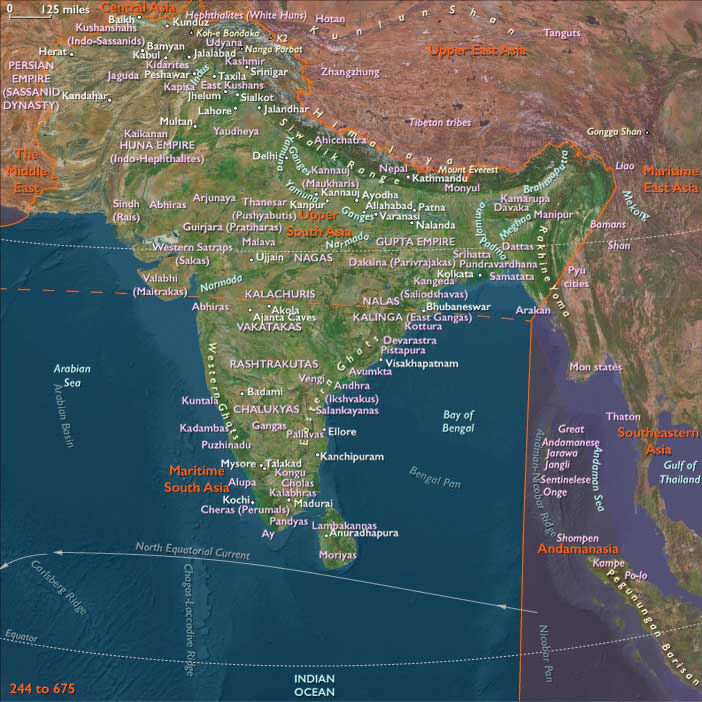
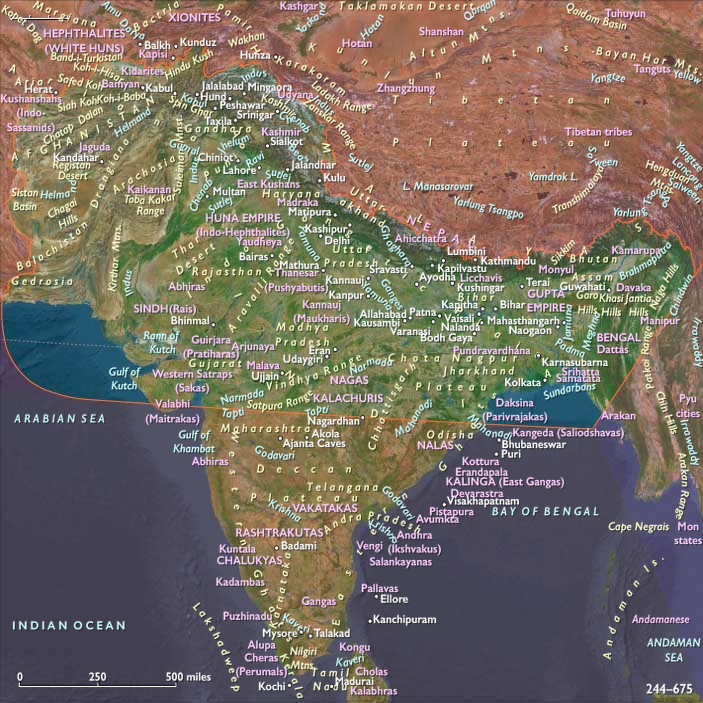
Kamarupa’s King Sthiha-varman dies in 585, having successfully resisted efforts by the Later Gupta rulers of Magadha to dislodge him.
His son succeeds him as Susthita-varman.
Locations
People
Groups
Topics
Subjects
Regions
Subregions
Related Events
Filter results
Showing 10 events out of 57288 total
Emperor Jing of Western Liang sends his general Qi Xin to attack the Chen Dynasty's city of Gong'an (in modern Jingzhou, Hubei) in 585, but Qi is unable to capture Gong'an and forced to withdraw.
Also in 585, Sui's Emperor Wen, upon hearing that Emperor Jing's uncle Xiao Cen, the Prince of Wu Prefecture, is relying on his honored position and difficult to control, summons Xiao Cen to Daxing and detains him there, although creating him the Duke of Huaiyi.
Thereafter, Emperor Wen also reestablishes the post of the Commandant of Jiangling (Liang's capital) and posts troops at Jiangling, effectively reasserting control over Liang.
(Sui had withdrawn troops from Jiangling in 582, giving Emperor Ming more autonomy than before.)
Perhaps because of this, Emperor Jing's general Xu Shiwu secretly offers to submit to the Chen general Chen Huiji, the Marquess of Yihuang (the cousin to Chen's emperor Chen Shubao), but Emperor Jing discovers Xu's plot and executes him.
King Wideok of Baekje sends an official escort bearing tribute along with a master of Buddhist meditation, a reciter of Buddhist magic spells, a temple architect, and a sculptor of Buddhist images, to the Chinese court of the Sui Dynasty around 585.
Kardarigan had first appeared as commander of the Persian forces in northern Mesopotamia in late 582, when he opposed a Byzantine invasion of Arzanene under John Mystacon and defeated him at a battle at the river Nymphius.
In the campaign of 583, he laid siege to the fort of Aphumon, but had abandoned the siege to help repel an imperial attack on the newly constructed fort of Akbas.
While he was preparing an incursion into Byzantine territory in autumn 584, he had been forced to turn east to counter an imperial invasion under Philippicus.
In 585, while Philippicus falls ill, Kardarigan goes on the offensive, besieging the imperial base of Monocarton.
The siege fails, and he then marches north to …
…Martyropolis, Philippicus's base; after sacking a monastery near the city, however, he returns to Persian territory.
Gundoald, or Gundovald, a Merovingian usurper king in the area of southern Gaul in either 584 or 585, claims to be an illegitimate son of Clothar I and, with the financial support of the Emperor Maurice, takes some major cities in southern Gaul, such as Poitiers and Toulouse, which belong to Guntram, king of Burgundy, a legitimate son of Clothar.
Guntram marches against him, calling him nothing more than a miller's son and names him 'Ballomer'.
Gundowald flees to Comminges and Guntram's army sets down to besiege the citadel (now known as Saint-Bertrand-de-Comminges).
The siege is successful, Gundovald's support drains away quickly and he is handed over by the besieged to be executed.
The Burgundians entirely raze the site; it will remain deserted for nearly five centuries.
The sole source for Gundovald is Gregory of Tours, who wrote about the events in his 'Histories', books 6 and 7.
While his main backers were magnates of Austrasia, the imperial support consisted of treasure to buy followers and it is probable that Gundovald spent time in Constantinople before setting off to conquer parts of Gaul.
The usage of 'ballomer', a Frankish (possibly offensive) word of which the meaning is not known, is one of the first instances of the mentioning of a Germanic word in a literary source.

Authari’s first major test is the quashing of the rebel duke Droctulf of Brescello, who has allied with the Romans and is ruling the Po valley.
After expelling him, Authari will spends most of the rest of his six years on the throne fighting Smaragdus, the exarch of Ravenna, or the Merovingian kings.
Cassiodorus, now probably in his mid-nineties, dies at Vivarium around 585.
He leaves a number of literary works include the (now vanished) De origine actibusque Getarum, a history of the Goths; a world history; Variae epistolae, orthographic models of correspondence; a commentary on the psalms; and a set of intellectual guidelines for his monks, the Institutiones divinarum et humanarum lectionum.
The Visigoths, under King Liuvigild, devastate the Suebic Kingdom in Gallaecia, bringing it under Visigothic control.
Following the conquest, Liuvigild reintroduces the Arian Church among the Suebi, reversing their previous conversion to Catholicism and aligning them with the dominant Arian faith of the Visigothic kingdom.
The Famine of 585 CE in Gaul: A Crisis Recorded by Gregory of Tours
In 585 CE, Gaul is struck by a severe famine, as recorded by Gregory of Tours in his Historia Francorum (History of the Franks). The famine causes widespread suffering, while opportunistic traders exploit the desperate population, selling scant amounts of grain and wine at exorbitant prices.
1. The Economic Devastation of the Famine
- Food shortages lead to extreme price inflation, making basic necessities unaffordable for most people.
- Gregory of Tours describes grain traders as plundering the people, selling:
- Only a peck of grain (approximately 9 liters) for one-third of a gold piece.
- Only a half measure of wine for the same exorbitant price.
- The high cost of food exacerbates starvation, as the poorest members of society suffer the most.
2. Possible Causes of the Famine
- Climate anomalies – The sixth century had already seen episodes of unusual cold and erratic weather, including the volcanic winter of 536 CE and subsequent crop failures.
- War and political instability – The ongoing Merovingian civil wars between Fredegund, Brunhilda, and Guntram disrupt agriculture and food supply chains.
- Epidemics – The plague outbreaks of the Justinianic era (541–590s CE) may have weakened the workforce, reducing food production.
3. Social Consequences of the Famine
- Hoarding and speculation – Wealthy traders exploit the scarcity of resources, making survival even more difficult for common people.
- Rural depopulation – Starvation leads to mass migrations, with many fleeing the countryside for cities and monasteries in search of aid.
- Breakdown of law and order – Social unrest increases as desperate people loot grain stores or flee to monasteries for protection and charity.
4. Impact on Frankish Society and the Church’s Role
- The Catholic Church emerges as the primary relief provider, as monasteries and bishops distribute what little food they can.
- Gregory of Tours’ account condemns traders for their greed, reinforcing the idea that the Church was a protector of the poor in times of crisis.
- The famine weakens Frankish society, making the kingdom more vulnerable to political turmoil and external threats.
Conclusion: A Devastating Blow to Merovingian Gaul
The famine of 585 CE is one of the many crises that weaken the Frankish realm during the Merovingian period, reinforcing social inequality and destabilizing local economies. Gregory of Tours’ vivid account underscores the harsh realities of medieval food shortages, in which the wealthy profited while the poor perished, highlighting the fragility of early medieval society in the face of natural disasters and human greed.