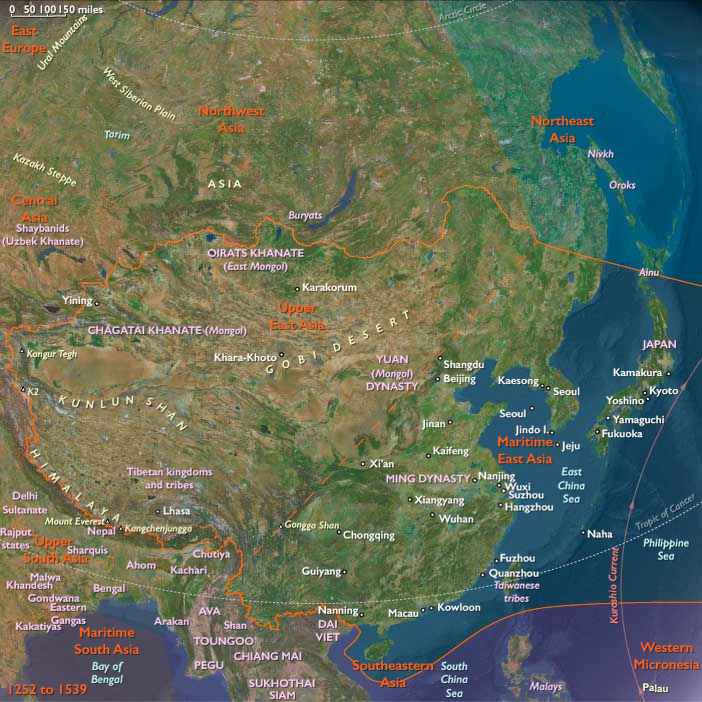
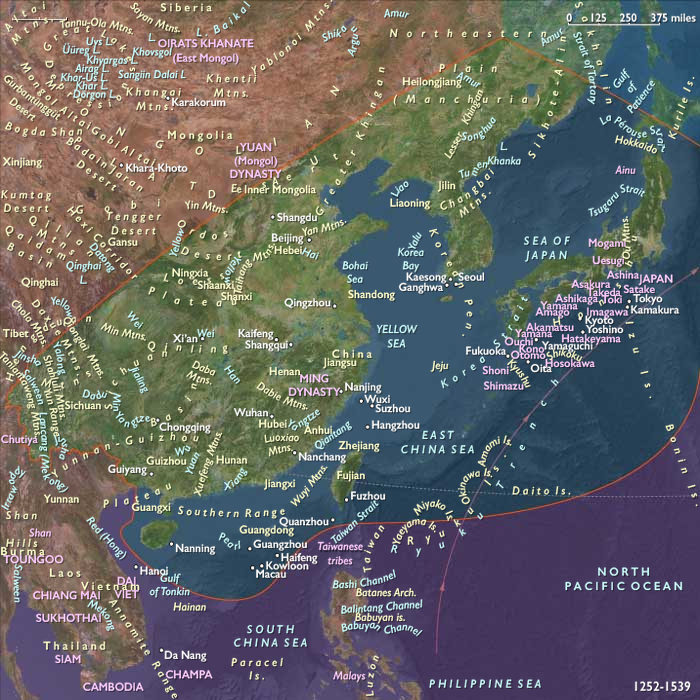
Kaifeng becomes the capital of Henan province …
Years: 1368 - 1368
Kaifeng becomes the capital of Henan province fom 1368.
Locations
Groups
Topics
Commodoties
Subjects
Regions
Subregions
Related Events
Filter results
Showing 10 events out of 43897 total
The Mongol Yüan Dynasty of Kublai Khan and his successors lasts until 1368, when massive peasant uprisings, led by a lowborn Buddhist monk turned warlord, Zhu Yuanzhang, topple Mongol rule; the Chinese use gunpowder to expel their overlords.
The successful peasant revolt spawns the indigenous Ming dynasty, whose first emperor, Zhu, takes the reign title of Hongwu (Hung-wu) and rules from Nanjing in the south.
Ming emperor Hongwu takes the Mongol capital of Beijing in 1368 and institutes despotic rule on a scale unprecedented in China.
Many of China’s Mongol inhabitants, never having assimilated into the population during the century of Mongol rule, return first driving the Mongols first to Shang-to and then to Outer Mongolia.
Wallachia and ...
…Severin again acknowledge Hungarian sovereignty in about 1368, as do parts of Serbia and northern Bulgaria.
Peter of Cyprus attempts to again raise a force in Europe in 1368, but is unsuccessful.
Urban V again counsels peace, and Peter is compelled to join the Pope and the Venetians in making a treaty with Egypt.
While in Rome, he receives an appeal from the barons of Armenia, nominating him as King and imploring him to deliver their country from the Turks.
French historian and poet Jean Froissart is twenty-three-years old in 1360 when he begins work on his “Chronicles,” an account of European affairs beginning in 1325.
Borrowed from the work of his elder contemporary Jean Le Bel for the period up to 1356; he bases his account of subsequent events on eyewitness reports.
A writer of lyric poetry as well as a historian, Froissart expresses the courtly view of life in “Meliador,” a long Arthurian verse romance.
What little is known of Froissart's life comes mainly from his historical writings and from archival sources which mention him in the service of aristocrats or receiving gifts from them.
Although his poems have also been used in the past to reconstruct aspects of his biography, this approach is in fact flawed, as the 'I' persona which appears in many of the poems should not be construed as a reliable reference to the historical author.
Froissart comes from Valenciennes in the County of Hainaut, situated in the western tip of the Holy Roman Empire, bordering France.
Earlier scholars have suggested that his father was a painter of armorial bearings, but there is actually little evidence for this.
Other suggestions include that he began working as a merchant but soon gave that up to become a cleric.
For this conclusion there is also no real evidence, as the poems which have been cited to support these interpretations are not really autobiographical.
By about age twenty-four, Froissart leaves Hainault and enters the service of Philippa of Hainault, queen consort of Edward III of England, in 1361 or 1362.
This service, which will have lasted until the queen's death in 1369, has often been presented as including a position of court poet and/or official historiographer.
Based on surviving archives of the English court, Croenen has concluded instead that this service did not entail an official position at court, and probably was more a literary construction, in which a courtly poet dedicated poems to his 'lady' and in return received occasional gifts as remuneration.
Froissart takes a serious approach to his work.
He travels in England, Scotland, Wales, France, Flanders and Spain gathering material and firsthand accounts for his Chronicles.
He travels with Lionel, Duke of Clarence, to Milan to attend and chronicle the duke's wedding to Violante, the thirteen-year-old daughter of Galeazzo Visconti, in May 1368.
At this wedding, two other significant writers of the Middle Ages are present: Chaucer and Petrarch.

The Moors retake Algeciras from Castile in 1368.
The city is destroyed on the orders of Muhammed V of Granada and will subsequently be abandoned.
The Black Prince’s Taxation Crisis and the Renewal of the Hundred Years’ War (1367–1369)
Following his victory at the Battle of Nájera (1367) during the Castilian Civil War, Edward, the Black Prince, found himself deeply in debt due to the failure of his Castilian ally, King Peter I ("the Cruel"), to provide the promised financial support. Suffering from ill health, Edward returned to Aquitaine, where he imposed a hearth tax to cover his expenses. This unpopular taxation policy alienated his Gascon vassals, leading them to appeal to King Charles V of France, ultimately sparking the renewal of the Hundred Years’ War in 1369.
The Black Prince’s Governance and Financial Troubles
- Since 1362, Edward had ruled Aquitaine in grand style, treating it as an English royal principality rather than a French fief.
- His lavish court and military campaigns placed a severe financial burden on the province.
- The Castilian expedition (1367), though militarily successful, had left him heavily in debt, as King Peter I of Castile had failed to provide the promised funds.
The Hearth Tax and Gascon Resistance
- To pay off his war debts, Edward instituted a hearth tax, requiring every household in Aquitaine to pay a fixed sum.
- This tax was highly unpopular, as it fell heavily on the lower nobility and peasantry, who had already suffered years of war-related hardship.
- Among those who resisted was Arnaud-Amanieu VIII, Lord of Albret, a former supporter of the Black Prince who had grown resentful of the influx of English administrators into Aquitaine.
The Gascon Lords Appeal to Charles V (1368–1369)
- Albret and other discontented Gascon lords refused to allow tax collection in their lands and sought relief from King Charles V of France.
- Charles, known for his legalistic approach to statecraft, declared that:
- The Treaty of Brétigny (1360) was invalid, as mutual renunciations of suzerainty had never been carried out.
- Therefore, Aquitaine was still legally a French fief, and Edward was still bound to obey the French Crown.
- Charles V summoned one of the Gascon lords and the Black Prince to Paris to appear before the Parlementand justify their actions.
The Black Prince’s Defiant Response
- In a famous reply, Edward rejected Charles V’s authority, stating that:
- He would go to Paris with 60,000 men behind him, implying war rather than submission.
- This response gave Charles the pretext he needed to declare Edward a rebellious vassal and to reignite the war.
The Renewal of the Hundred Years’ War (1369)
- Charles V declared war on England, leading to a new phase of the Hundred Years’ War.
- The Gascon lords who had once supported Edward now rebelled, forcing the English to defend their territories in France.
- This conflict would reverse many of England’s territorial gains, marking the beginning of a major French resurgence under Charles V and his military commander Bertrand du Guesclin.
The Black Prince’s harsh taxation policies and defiance of Charles V reignited the war in 1369, leading to the gradual collapse of English rule in Aquitaine and a major turning point in the Hundred Years’ War.
John of Gaunt, English king Edward III’s fourth son, secures the large holdings of his wife, Blanche, heiress of Lancaster, at her death in 1368 and becomes duke of Lancaster.
The town of Pegu, which had declined when the Burmese conquered the area in the eleventh century, becomes the capital of the revived Mon kingdom in 1369.