
The Destruction of the Eburones and the …
Years: 53BCE - 53BCE
The Destruction of the Eburones and the Collapse of the First Triumvirate (53 BCE)
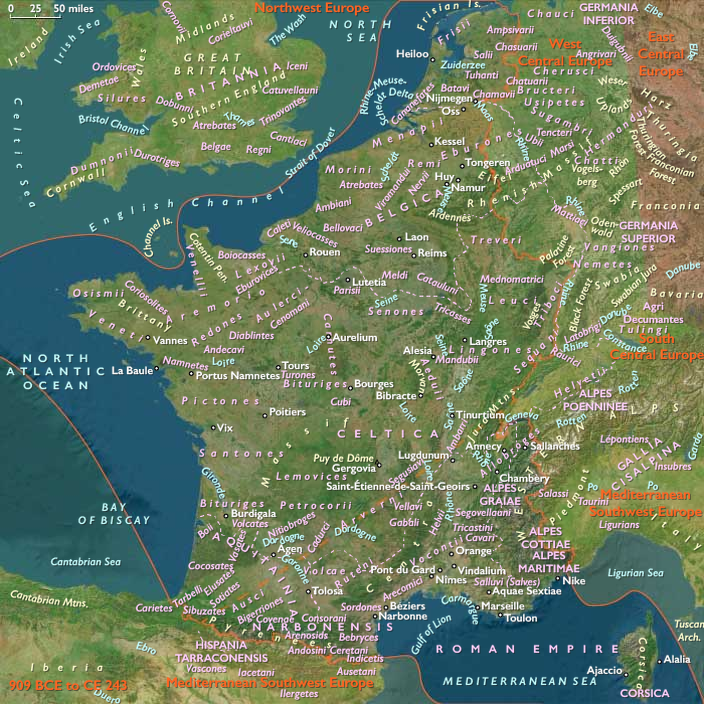
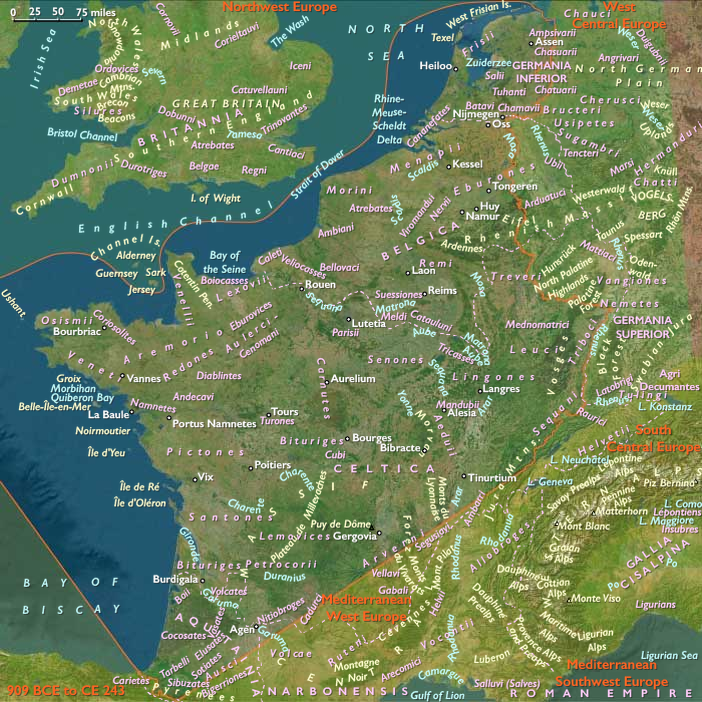
By 53 BCE, Julius Caesar was determined to eliminate the Eburones as punishment for their role in the Belgic revolt of 54 BCE, in which Quintus Titurius Sabinus and Lucius Aurunculeius Cotta were killed, along with nearly 6,000 Roman soldiers. Caesar’s response was ruthless and systematic, ensuring that the Eburones and their name disappeared from history.
The Eburones: Germani Cisrhenani or Belgic Gauls?
- Caesar wrote that the Eburones, Condrusi, Caeraesi, Paemani, and Segni, despite being considered Belgae (a type of Gaul), were actually called by the one name of Germani.
- He described them as Germani Cisrhenani, meaning "Germans on this side of the Rhine"—peoples who had migrated from east of the Rhine and settled in northern Gaul generations before.
- This classification suggests that the Belgae were a cultural mix of Celtic and Germanic influences, though their exact language and identity remain uncertain.
Caesar’s Campaign of Annihilation Against the Eburones
-
In 53 BCE, Caesar invaded the territory of the Eburones, forcing Ambiorix to flee, while King Cativolcus poisoned himself with yew.
-
Caesar’s legions struggled in the wooded and swampy terrain, making it difficult to pursue the scattered remnants of the Eburones.
-
To ensure their total destruction, Caesar invited neighboring tribes to plunder and slaughter the Eburones, writing:
"In order that the life of the Gauls might be hazarded in the woods rather than the legionary soldiers; at the same time, in order that a large force being drawn around them, the race and name of that state may be annihilated for such a crime."
(Gallic Wars VI.34) -
The Sicambri, a powerful Germanic tribe, were among the main raiders, seizing cattle, slaves, and plunder.
-
Caesar remarked that the Sicambri were:
"Born for war and raids... No swamp or marsh will stop them."
The Sicambri’s Betrayal and the Attack on the Roman Garrison at Aduatuca
- While Caesar was campaigning against the Eburones, he left Quintus Tullius Cicero with a legion to guard supplies at Aduatuca—the same location where Sabinus and Cotta had been killed.
- However, Ambiorix convinced the Sicambri that the Roman supplies and loot were far more valuable than hunting refugees.
- After raiding the Eburones, the Sicambri turned on the Romans, ambushing some of Caesar’s units.
- The remains of the legion withdrew into Aduatuca, and the Sicambri, satisfied with their plunder, returned across the Rhine.
The Fate of the Eburones and the Rise of the Tungri
- Caesar burned every village and building in Eburonian territory, drove off all cattle, and his men consumed or destroyed all remaining grain.
- He left any survivors to die of starvation in the winter.
- The Eburones disappeared from history, their lands later occupied by the Tungri, a new Germanic tribe.
- However, Tacitus later suggested that the Tungri were the original "Germani" who had first crossed the Rhine, leading some historians to believe that the Eburones survived under a new name.
The Collapse of the First Triumvirate and Rome on the Brink of Civil War
- While Caesar was in Britain, his daughter Julia, Pompey’s wife, died in childbirth, weakening the alliance between Caesar and Pompey.
- Shortly afterward, Crassus was killed during his disastrous invasion of Parthia at the Battle of Carrhae (53 BCE).
- Without Julia or Crassus to maintain balance, tensions between Caesar and Pompey escalated.
- In an emergency measure, the Senate appointed Pompey as sole consul, effectively siding with the optimates against Caesar.
- Pompey sealed his break with Caesar by marrying the daughter of a political opponent.
With Crassus dead and Pompey turning against him, the First Triumvirate collapsed, bringing Rome to the edge of civil war.
Significance of These Events
- The destruction of the Eburones demonstrated the brutality of Roman reprisals, setting a precedent for how Rome dealt with rebellious provinces.
- The rise of the Tungri suggests that Rome’s conquest of Gaul was not as absolute as Caesar claimed, with tribal identities shifting rather than being erased.
- The collapse of the First Triumvirate meant that Rome’s next great war would not be against foreign enemies, but against itself.
By 53 BCE, Caesar had conquered Gaul, but the price was political instability in Rome—the final step toward the Great Roman Civil War (49–45 BCE)
Locations
People
Groups
- Gauls
- Roman Republic
- Nervii (Belgic tribe)
- Menapii (Gaulish tribe)
- Condrusi (Germanic tribe)
- Ubii (Germanic tribe)
- Sicambri (Germanic tribe)
- Aduatuci (Gallic Germanic tribe)
- Eburones (Gaulish tribe)
- Suebi (Germanic tribe)
- Tencteri and Usipetes (Germanic tribe or tribes)
Topics
- Classical antiquity
- Pre-Roman Iron Age of Northern Europe
- Roman Age Optimum
- Roman Republic, Crisis of the
- Gallic Wars
Commodoties
Subjects
Regions
Subregions
Years: 53BCE - 53BCE
Locations
People
Groups
- Gauls
- Roman Republic
- Nervii (Belgic tribe)
- Menapii (Gaulish tribe)
- Condrusi (Germanic tribe)
- Ubii (Germanic tribe)
- Sicambri (Germanic tribe)
- Aduatuci (Gallic Germanic tribe)
- Eburones (Gaulish tribe)
- Suebi (Germanic tribe)
- Tencteri and Usipetes (Germanic tribe or tribes)
Topics
- Classical antiquity
- Pre-Roman Iron Age of Northern Europe
- Roman Age Optimum
- Roman Republic, Crisis of the
- Gallic Wars
Commodoties
Subjects
Regions
Subregions