
Julianus immediately devalues the Roman currency upon …
Years: 193 - 193
April
Julianus immediately devalues the Roman currency upon his accession, decreasing the silver purity of the denarius from 87% to 81.5%—the actual silver weight dropping from 2.75 grams to 2.40 grams.
After the initial confusion subsides, the population does not tamely submit to the dishonor brought upon Rome.
Whenever Julianus appears in public he is saluted with groans, imprecations, and shouts of "robber and parricide."
The mob tries to obstruct his progress to the Capitol, and even throws stones.
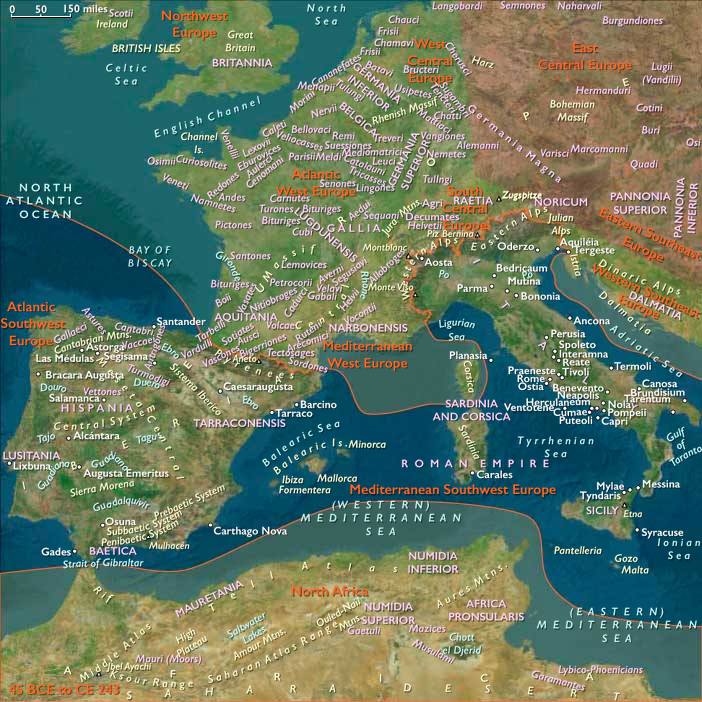
When news of the public anger in Rome spreads across the Empire, the generals Pescennius Niger in Syria, Septimius Severus in Pannonia, and Clodius Albinus in Britain and Gaul, each having three legions under his command, refuses to recognize the authority of Julianus.
Clodius Albinus, born into an aristocratic family at Hadrumetum in Africa had, according to his father, received the name of Albinus because of the extraordinary whiteness of his body.
Showing great disposition for a military life, he had entered the army at an early age and served with great distinction, especially during the rebellion of Avidius Cassius against the Emperor Marcus Aurelius in 175.
His merits were acknowledged by the Emperor in two letters in which he calls Albinus an African, who resembled his countrymen but little, and who was praiseworthy for his military experience and the gravity of his character.
The Emperor likewise declared that without Albinus the legions (in Bithynia) would have gone over to Avidius Cassius, and that he intended to have him chosen consul.
Commodus had given Albinus a command in Gallia Belgica and afterwards in Britain.
A false rumor having been spread that Commodus had died, Albinus denounced the man before his soldiers in Britain, calling Commodus a tyrant, and maintaining that it would be useful to the Roman Empire to restore to the senate its ancient dignity and power.
The Senate was very pleased with these sentiments, but not so the Emperor, who sent Junius Severus to relieve Albinus of his command.
Some time before, Commodus had offered him the title of Caesar, which he declined.
Notwithstanding the appointment of Junius Severus as his successor, Albinus has kept his command.
Although Pescennius Niger had been born into an old Italian equestrian family, he is the first member of his family to achieve the rank of Roman senator.
Not much is known of his early career; it is possible that he held an administrative position in Egypt, and that he served in a military campaign in Dacia early in Commodus’ reign.
During the late 180s, Niger was elected as a Suffect consul, after which Commodus made him imperial legate of Syria in 191.
He is still serving in Syria when news comes through firstly of the murder of Pertinax, followed by the auctioning off of the imperial title to Didius Julianus.
Niger is a well regarded public figure in Rome and soon a popular demonstration against Didius Julianus breaks out, during which the citizens call out for Niger to come to Rome and claim the imperial title for himself.
As a consequence, it is alleged that Julianus dispatched a centurion to the east with orders to assassinate Niger at Antioch.
The result of the unrest in Rome sees Niger proclaimed Emperor by the eastern legions by the end of April 193.
On his accession, Niger takes the additional cognomen Justus, or "the Just".
Although imperial propaganda issued on behalf of Septimius Severus later claims that Niger was the first to rebel against Didius Julianus, it is Severus who beats Niger to it, claiming the imperial title on April 9.
Although Niger sends envoys to Rome to announce his elevation to the imperial throne, his messengers are intercepted by Severus.
Septimius Severus, whose Romanized North African family is not politically prominent, has nevertheless held a number of important posts, and had received from the Emperor Commodus the command of the legions in Pannonia.
In response to the murder of Pertinax, Severus' soldiers proclaim him Emperor at Carnuntum, whereupon he hurries to Italy.
Locations
People
Groups
Topics
- Classical antiquity
- Roman Age Optimum
- Roman Civil War of 193-97
- Year of the Five Emperors, or Roman Civil War of 193
Commodoties
Subjects
Regions
Subregions
Years: 193 - 193
April
Locations
People
Groups
Topics
- Classical antiquity
- Roman Age Optimum
- Roman Civil War of 193-97
- Year of the Five Emperors, or Roman Civil War of 193
Commodoties
Subjects
Regions
Subregions