
Julian's Bold March to Alsace and the …
Years: 356 - 356
Julian's Bold March to Alsace and the Ambush at Decem Pagi (356 CE)
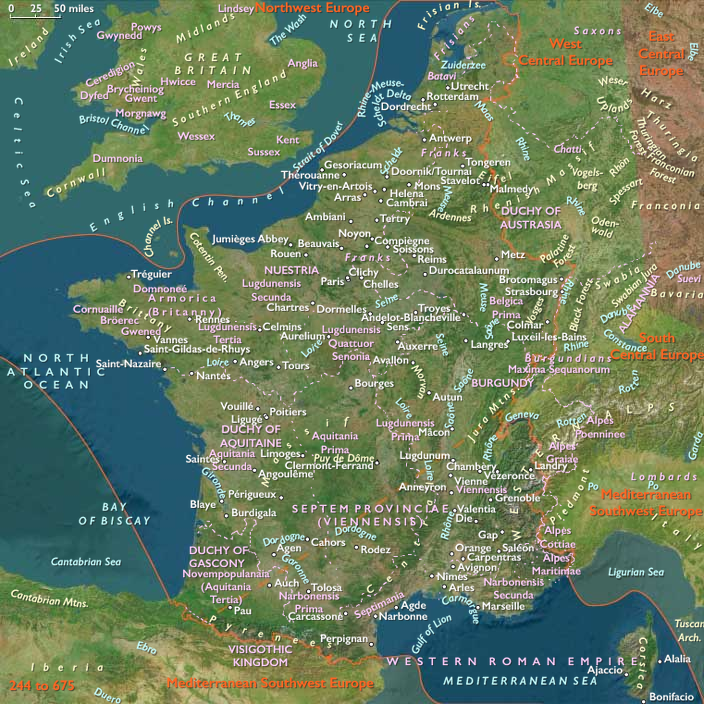
After linking up with his main army at Reims in 356 CE, Julian demonstrated his characteristic boldness by deciding, in consultation with his senior commanders, to directly confront the Alamanni threat at its source. Instead of adopting a defensive strategy, he planned to march into Alsace and restore Roman control over the region, which had largely fallen under Alamannic domination following the collapse of the Rhine frontier.
However, this aggressive maneuver nearly ended in disaster when Julian’s army was ambushed by the Alamanninear Decem Pagi (modern Dieuze, France).
1. The Ambush at Decem Pagi
- As Julian’s army advanced through dense mist, two rearguard legions lost contact with the rest of the column.
- A large Germanic war band seized the opportunity to launch a sudden and devastating assault on the isolated Roman units.
- The two legions suffered heavy casualties, nearly being wiped out before Julian's main force could react.
2. The Roman Counterattack: Auxilia Palatina to the Rescue
- The uproar of the battle was heard by Roman auxilia palatina regiments, elite light infantry units that rushed to the scene.
- These highly mobile troops launched a counterattack, breaking the momentum of the Alamanni and rescuing the trapped legions.
- Julian quickly reorganized his column, avoiding further pursuit and ensuring that his march to Alsace continued.
3. Significance of the Battle
- The ambush at Decem Pagi revealed the tactical skill and coordination of the Alamanni, demonstrating their ability to exploit Roman weaknesses.
- Julian’s decisive response and the discipline of his auxilia palatina prevented a total disaster, solidifying his leadership under pressure.
- The battle underscored the dangers of campaigning in enemy-held territory, as Roman forces had to adapt to guerrilla-style warfare in Germanic lands.
4. Julian’s Campaign Continues
- Despite this near-defeat, Julian pressed forward into Alsace, determined to break the power of the Alamanni.
- His bold strategy would soon culminate in a major Roman victory at the Battle of Argentorate (Strasbourg) in 357 CE, a decisive engagement that would restore Roman dominance in Gaul.
The ambush at Decem Pagi was one of Julian’s earliest military trials, and his ability to survive and recover from near catastrophe only further proved that he was not just a scholar-emperor, but a capable and determined military leader.
Locations
People
Groups
- Franks
- Gallia Lugdunensis (Roman province)
- Germans
- Alamanni (Germanic tribal alliance)
- Gaul, Diocese of
- Roman Empire: Constantinian dynasty (Constantinople)
- Gaul, Praetorian prefecture of
Topics
- Roman Age Optimum
- Late Antiquity
- Migration Period
- Durocortorum, Battle of
- Brumath, Battle of
- Senonae, Siege of
- Autun, Siege of
Subjects
- Writing
- Performing Arts
- Environment
- Mayhem
- Faith
- Government
- Movements
- Theology
- Philosophy and logic
- History
- Christology
Regions
Subregions

Years: 356 - 356
Locations
People
Groups
- Franks
- Gallia Lugdunensis (Roman province)
- Germans
- Alamanni (Germanic tribal alliance)
- Gaul, Diocese of
- Roman Empire: Constantinian dynasty (Constantinople)
- Gaul, Praetorian prefecture of
Topics
- Roman Age Optimum
- Late Antiquity
- Migration Period
- Durocortorum, Battle of
- Brumath, Battle of
- Senonae, Siege of
- Autun, Siege of
Subjects
- Writing
- Performing Arts
- Environment
- Mayhem
- Faith
- Government
- Movements
- Theology
- Philosophy and logic
- History
- Christology
Regions
Subregions