
Judah ha-Nasi promulgates the Mishnah, a collection …
Years: 203 - 203
Judah ha-Nasi promulgates the Mishnah, a collection of the most reliable rabbinical traditions in Mishnaic Hebrew, or the "Language of the Sages,” in about 200.
Spoken Hebrew has by this time virtually disappeared from everyday use, superseded by Aramaic and Hellenistic Greek.
Six orders (sedarim), divided into sixty-three treatises, comprise the Mishnah: Zeraim ("Seeds"), concerning agricultural laws; Moed ("Seasons"), Sabbath and festivals; Nashim ("Women"), marriage, divorce, and family law; Neziqin ("Damages"), criminal and civil jurisprudence; Qodashim ("Holy Things"), sacrificial cult and dietary laws; and Tohorot ("Purifications"), ritual defilement and purification.
Included among the Mishnah’s nonlegal material is the Pirke Avot ("Chapters of the Fathers"), a collection of wisdom that forms the final treatise of the Neziqin.
The Mishnah soon becomes the official text out of which further Jewish legal development occurs.
Judah ha-Nasi in 203, mainly for health reasons, moves the seat of learning from Beth Shearim to Sepphoris.
Locations
People
Groups
- Jews
- Syria Palæstina, Roman province of (Judea, Samaria, and Idumea)
- Roman Empire (Rome): Severan dynasty
Topics
Subjects
Regions
Subregions
Related Events
Filter results
Showing 10 events out of 60768 total
Cao has eliminated most of Yuan Shao's force by 203, affording him more attention on construction within his realm.
In autumn of this year, Cao passes an order decreeing the promotion of education throughout the counties and cities within his jurisdiction.
An official in charge of education is assigned to each county with at least five hundred households.
Youngsters with potential and talents are selected for schooling.
This prevents a lapse in the output of intellectuals in these warring years and, in Cao's words, will benefit the people.
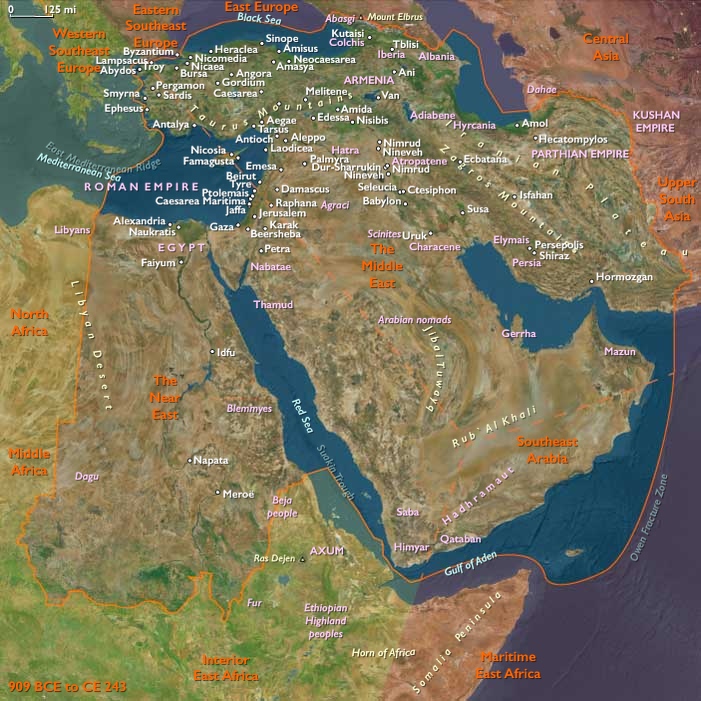
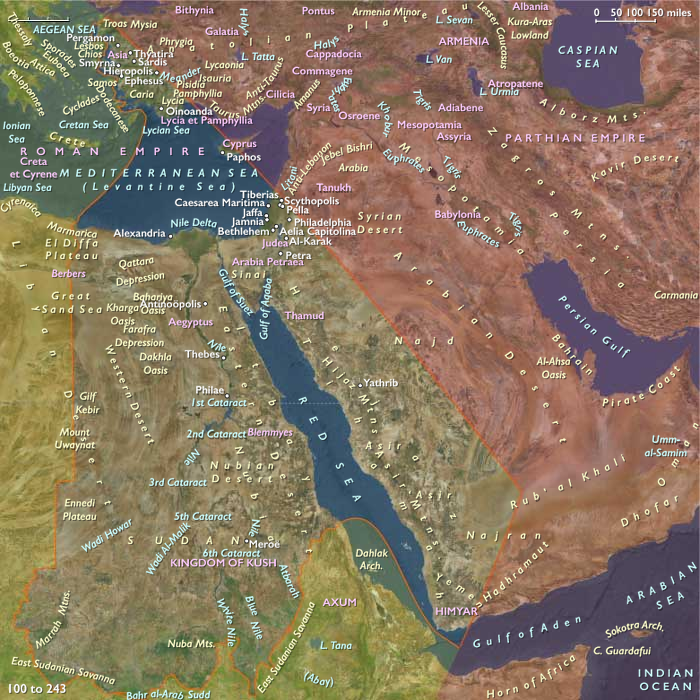
Osroene, a kingdom established in 132 BCE by the Nabataeans or Arab tribes from North Arabia, is arguably the first state to have a Christian king when Abgar IX is thought to have accepted Christianity under the guidance of Bardaisan.
Bardaisan had been born in Edessa, a metropolis of Osroene in Assuristan (Assyria).
To indicate the city of his birth his parents called him "Son of the Daisan", the river on which Edessa is situated.
On account of his foreign extraction he is sometimes referred to as "the Parthian" (by Sextus Julius Africanus), or "the Babylonian" (by Porphyrius); and, on account of his later important activity in Armenia, "the Armenian", (by Hippolytus of Rome), while Ephrem the Syrian calls him "philosopher of the Arameans".
His parents, Nuhama and Nah 'siram, must have been people of rank, for their son had been educated with the crown-prince of the Osrhoenic kingdom, at the court of Abgar VIII bar Manu.
Sextus Julius Africanus says that he saw Bardaisan, with bow and arrow, mark the outline of a boy's face with his arrows on a shield which the boy held.
Owing to political disturbances in Edessa, Bardaisan and his parents had moved for a while to Hierapolis (Mabug), a strong center of Babylonianism.
Here the boy had been brought up in the house of a priest, Anuduzbar, learning in this school all the intricacies of Babylonian astrology, a training that will permanently influence his mind and prove the bane of his later life.
At the age of twenty-five, he had happened to hear the homilies of Hystaspes, the Bishop of Edessa, received instruction, was baptized, and even admitted to the dioconate or the priesthood.
"Priesthood", however, may merely imply that he ranked as one of the college of presbyters, for he had remained in the world, had a son called Harmonius, and when Abgar IX, the friend of his youth, ascended the throne in 179, he took his place at court.
He was clearly no ascetic, but dressed in finery "with berylls and caftan", according to Ephrem the Syrian.
According to Michael the Syrian, Bardaisan had besides Harmonius two other sons, called Abgarun and Hasdu.
According to tradition, during his youth he shared the education of a royal prince who afterwards became King of Edessa, perhaps Abgar X bar Manu (reigned Osroene 202-217).
He is said to have converted the prince to Christianity, and may have had an important share in Christianizing the city.
Epiphanius of Salamis and Barhebraeus assert that he was first an orthodox Christian and afterwards an adherent of Valentinus.
His acceptance of Christianity was perfectly sincere; and later stories, that he left the Catholic Church and joined the Valentinian Gnostics out of disappointed ambition, do not deserve much credit.
His royal friend becomes (probably after 202, i.e.
after his visit and honorable reception at Rome) the first Christian king; and both king and philosopher labor to create the first Christian State.
Eighteen-year-old Origen, one of Clement’s young students, whose father had died in the persecution of 202, and who himself narrowly had escaped the same fate, is in 203 appointed to succeed Clement as head of the school.
Severus’s relations with the Roman Senate are never good.
He is unpopular with them from the outset, having seized power with the help of the military, and he returns the sentiment.
Severus has ordered the execution of dozens of Senators on charges of corruption and conspiracy against him, replacing them with his own favorites.
Although his actions have turned Rome into a military dictatorship, he is popular with the citizens of Rome, having stamped out the rampant corruption of Commodus's reign.
When he returned from his victory over the Parthians, he erected the Arch of Septimius Severus (Italian: Arco di Settimio Severo) in Rome.
The elaborate white marble arch, situated at the northwest end of the Roman Forum, is a triumphal arch dedicated in 203 to commemorate the victories of the Emperor and his two sons, Caracalla and Geta, in the two campaigns against the Parthians of 194/195 and 197-199.
The arch is raised on a travertine base originally approached by steps from the Forum's ancient level.
The central archway, spanned by a richly coffered semicircular vault, has lateral openings to each side archway, a feature that will copied in many Early Modern triumphal arches.
The three archways rest on piers, in front of which are detached composite columns on pedestals.
Winged Victories are carved in relief in the spandrels.
A staircase in the south pier leads to the top of the monument, on which are statues of the emperor and his two sons in a four-horse chariot (quadriga), accompanied by soldiers.
Severus begins an ambitious public works project in Rome, laying the foundation for the largest and most richly decorated public baths ever built.
Plans call for a massive (702 x 360 feet/211 x 108 meters) central building and an enormous square enclosure (1,500 x 1,500 feet/450 x 450 meters) lined with art galleries, gymnasia, nymphaea (wall fountains), shops, and two libraries.
The greater part of the Flavian Palace overlooking the Circus Maximus is undertaken in Severus’s reign, as is the Septizodium, located at the place where the Via Appia leads to the Palatine.
The origin of the name "Septizodium" is unclear; the Septicozium was probably named for the seven planetary deities (Saturn, Sun, Moon, Mars, Mercury, Jupiter, Venus or for the fact that it was originally divided into seven parts.
The building has no known practical purpose and was probably meant to be a decorative façade.
Other examples of septizodium are known, all from Africa.
Ammianus Marcellinus, writing in the fourth century, refers to the building in an ambiguous passage: "The plebs...had come together at the Septemzodium, a popular place, where Marcus Aurelius built a Nymphaeum in a rather ostentatious style."
Perpetua (born in 181) is a twenty-two year old married noble and a nursing mother.
Her co-martyr Felicity, an expectant mother, is her slave.
The Passion of St. Perpetua, St. Felicitas, and their Companions is said to preserve the actual words of the martyrs and their friends.
According to this Passion, in the year 203 during the persecutions of the emperor Septimius Severus, five catechumens, Perpetua and Felicity among them, are arrested for their faith and executed.
The group consists of a slave named Revocatus, his fellow slave Felicitas, two free men (Saturninus and Secundulus), and Perpetua.
Perpetua's father is a pagan, her mother and two brothers Christians, one of the brothers being a catechumen.
These five prisoners are soon joined by Saturus, who seems to have been their catechist and who now chooses to share their punishment.
Initially, they are all kept under strict guard in a private house.
Perpetua writes a vivid account of what happened.
Their sufferings while in prison, the angry and increasingly desperate attempts of Perpetua's father to induce her to renounce Christianity, the vicissitudes of the martyrs before their execution, the visions of Saturus and Perpetua in their dungeons, are all committed to writing by the last two, in a genre of text called a "Passion".
The text as recorded in the Passio SS Perpetuae et Felicitatis claims to contain the autobiographical account of Perpetua, edited and commented on by Tertullian.
Their date of their martyrdom is traditionally given as 203.
The association of the martyrdom with a birthday festival of the Emperor Geta, however, might seem to place it after 209, when Geta was made "Augustus" (having held the junior title Caesar since 198 when his elder brother had been made "Augustus"), though before 211, when he was assassinated.
The Acta notes that the martyrdom occurred in the year when Minucius Timinianus was proconsul in the Roman province of Africa, but as Timinianus is not otherwise attested in history, this information does not clarify the date.
The thirteenth-century Golden Legend, however, places the martyrdom in 256, under the emperors Valerian and Gallienus.
Severus enriches greatly his native city of Leptis Magna.
Favoring his hometown above all other provincial cities, the buildings and wealth he lavished on it make Leptis Magna the third-most important city in Africa, rivaling Carthage and Alexandria.
In 205, he and the imperial family visit the city and receive great honors.
He dedicates another triumphal arch on the occasion of his visit.
Among the changes that Severus has introduced are the creation of a magnificent new forum and the reconstruction of the docks.
The natural harbor has a tendency to silt up, but the Severan changes make this worse, and the eastern wharves are today extremely well preserved, since they were hardly used.
Han imperial forces have by 204 succeeded in crushing the Yellow Turban rebellion in Shandong and …
…Shanxi provinces, although they have been severely weakened by the effort.
Yuan Shao had maintained good relations with the Wuhuan beyond the imperial borders during his campaign against rival warlord Gongsun Zan, their common enemy, in the 190s.
Yuan Shao had given the chieftains of his Wuhuan allies seals and insignia as chanyu after the final destruction of Gongsun Zan in the Battle of Yijing in 199, and has reinforced the alliance by marrying the daughters of his subordinates to the Wuhuan leaders, pretending as though the daughters were his own.
The Wuhuan war leader Tadun was especially powerful and was thus very well-treated by Yuan Shao.
The Wuhuan have continued to support the Yuan clan after Yuan Shao's defeat at the Battle of Guandu against Cao Cao.
Subsequently, Yuan Shao's oldest and youngest son, Yuan Tan and Yuan Shang respectively, fought among themselves in a succession feud, which Cao Cao had exploited for himself.
Soon Yuan Tan was killed in a battle against Cao Cao and Yuan Shang had to flee to his second brother, Yuan Xi, in You Province.
The Yuan brothers in You Province had then been the targets of a mutiny against them, and had fled further north to seek protection from the Wuhuan, who have been united under the military leadership of Tadun, whose apparent strength prompts rumurs that he is seeking to emulate Modu Chanyu of the Xiongnu and Tanshihuai of the Xianbei in creating a hegemony over the northern nomadic tribes.
With the arrival of the Yuan brothers, accompanied by a considerable number of their followers, Tadun has gained command of a combined Wuhuan and Chinese force that is said to have numbered up to three hundred thousand.
In the name of helping Yuan Shang regain his territories, the Wuhuan make several raids across the imperial border, and are said to have kidnapped over one hundred thousand Chinese families.
Posed with such danger in the north, Cao Cao contemplates the elimination of the Wuhuan threat.
Severus had fallen heavily under the influence of his Praetorian Prefect, Gaius Fulvius Plautianus, who after 197, according to Cassius Dio, comes to have almost total control of most branches of the imperial administration.
Plautianus's daughter, Publia Fulvia Plautilla, had been married in 202 to Severus's son, Caracalla.
Plautianus has become so powerful that Roman Empress Julia Domna and Caracalla have begun to be concerned.
The marriage between Caracalla and Fulvia Plautilla is not a happy one.
In fact, Caracalla loathes both her and her father, threatening to kill them after becoming sole emperor.
When Plautianus discovers this, he begins to plot to overthrow Severus' family.
His excessive power comes to an end on January 22, 205, after the emperor’s dying elder brother, Publius Septimius Geta, states to Severus that he hates Plautianus and warns him of Plautianus' treachery.
The imperial family summons him to the palace and orders his death.
After his death, Plautianus’ property is confiscated, his son of the same name, daughter and granddaughter are exiled to Sicily and then later to Lipari and his name is erased from public monuments.
Seven years later, his son, daughter and granddaughter will be strangled on Caracalla's orders.
However, the two following praefecti, including the jurist Aemilius Papinianus, will receive even larger powers.
Years: 203 - 203
Locations
People
Groups
- Jews
- Syria Palæstina, Roman province of (Judea, Samaria, and Idumea)
- Roman Empire (Rome): Severan dynasty
