
Filters:
The Austrian Netherlands, a territory with its …
Years: 1781 - 1781
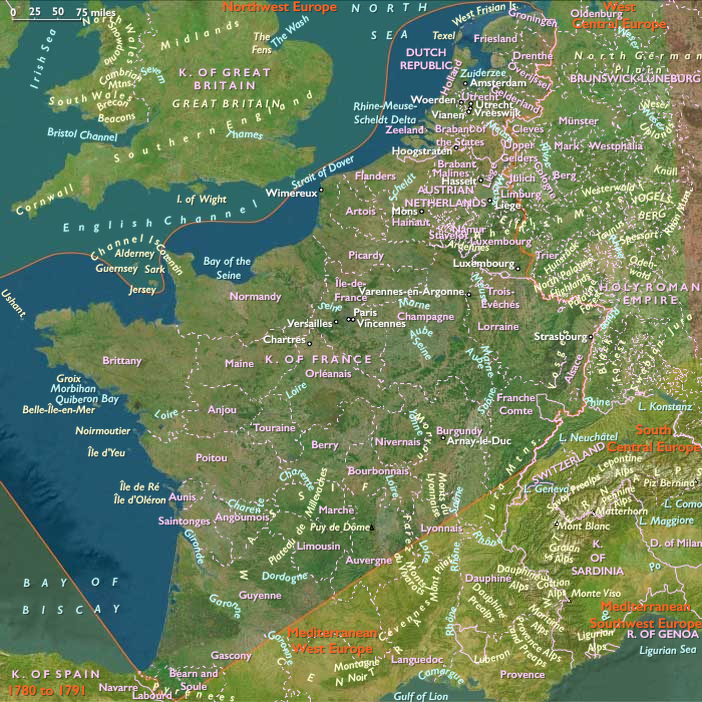
The Austrian Netherlands, a territory with its capital at Brussels, covers much of what is today Belgium and Luxembourg during the Early and High Modern periods.
In 1714, the territory, which had been ruled by Spain, had been ceded to Austria as part of the Treaty of Rastatt that ended the War of the Spanish Succession.
The Dutch Revolt in the 1580s had separated the independent Dutch Republic from the rest of the territory, leaving the Austrian Netherlands with a staunchly Catholic population.
The clergy maintained substantial power.
The Austrian Netherlands are both a province of Habsburg Austria and a part of the Holy Roman Empire.
In 1764, Joseph II had been elected as Holy Roman Emperor, ruling over a loosely unified federation of autonomous territories within Central Europe roughly equivalent to modern-day Germany, the Czech Republic and Austria.
Joseph's mother, Maria Theresa, had appointed her favorite daughter, Maria Christina, and her husband, Albert Casimir, as joint Governors of the Austrian Netherlands in 1780.
Both Joseph and Maria Theresa are considered reformists and are particularly interested in the idea of enlightened absolutism.
Joseph II, who is known as the philosopher-emperor (empereur philosophe), has a particular interest in Enlightenment thought and has his own ideology, which has sometimes been termed "Josephinism" after him.
Joseph particularly dislikes institutions that he considers "outdated", such as the established ultramontane Church, whose allegiance to the papacy prevents the Emperor from having total control, which restricts efficient and centralist rule.
Soon after taking power, in 1781, Joseph launches a low-key tour of inspection of the Austrian Netherlands, during which he concludes reform in the territory is badly needed.
Politically, the Austrian Netherlands comprised a number of federated and autonomous territories, inherited from the Spanish, which could trace their lineage to the Middle Ages. These territories, known collectively as the Provincial States, retained much of their traditional power over their own internal affairs.[6] The states were dominated by the wealthy and prominent Estates of Brabant and Flanders. The Austrian Governors-General were forced to respect the autonomy of the provincial states and could only act only with some degree of consent. Within the states themselves, the "traditional" independence was considered extremely important and figures such as Jan-Baptist Verlooy had even begun to claim the linguistic unity of Flemish dialects as a sign of national identity in Flanders
In 1714, the territory, which had been ruled by Spain, had been ceded to Austria as part of the Treaty of Rastatt that ended the War of the Spanish Succession.
The Dutch Revolt in the 1580s had separated the independent Dutch Republic from the rest of the territory, leaving the Austrian Netherlands with a staunchly Catholic population.
The clergy maintained substantial power.
The Austrian Netherlands are both a province of Habsburg Austria and a part of the Holy Roman Empire.
In 1764, Joseph II had been elected as Holy Roman Emperor, ruling over a loosely unified federation of autonomous territories within Central Europe roughly equivalent to modern-day Germany, the Czech Republic and Austria.
Joseph's mother, Maria Theresa, had appointed her favorite daughter, Maria Christina, and her husband, Albert Casimir, as joint Governors of the Austrian Netherlands in 1780.
Both Joseph and Maria Theresa are considered reformists and are particularly interested in the idea of enlightened absolutism.
Joseph II, who is known as the philosopher-emperor (empereur philosophe), has a particular interest in Enlightenment thought and has his own ideology, which has sometimes been termed "Josephinism" after him.
Joseph particularly dislikes institutions that he considers "outdated", such as the established ultramontane Church, whose allegiance to the papacy prevents the Emperor from having total control, which restricts efficient and centralist rule.
Soon after taking power, in 1781, Joseph launches a low-key tour of inspection of the Austrian Netherlands, during which he concludes reform in the territory is badly needed.
Politically, the Austrian Netherlands comprised a number of federated and autonomous territories, inherited from the Spanish, which could trace their lineage to the Middle Ages. These territories, known collectively as the Provincial States, retained much of their traditional power over their own internal affairs.[6] The states were dominated by the wealthy and prominent Estates of Brabant and Flanders. The Austrian Governors-General were forced to respect the autonomy of the provincial states and could only act only with some degree of consent. Within the states themselves, the "traditional" independence was considered extremely important and figures such as Jan-Baptist Verlooy had even begun to claim the linguistic unity of Flemish dialects as a sign of national identity in Flanders
Locations
People
Groups
- Papal States (Republic of St. Peter)
- Christians, Roman Catholic
- Austria, Archduchy of
- Holy Roman Empire
- Habsburg Monarchy, or Empire
- Netherlands, Southern (Austrian)
Topics
Subjects
Regions
Subregions
Years: 1781 - 1781
Locations
People
Groups
- Papal States (Republic of St. Peter)
- Christians, Roman Catholic
- Austria, Archduchy of
- Holy Roman Empire
- Habsburg Monarchy, or Empire
- Netherlands, Southern (Austrian)
Topics
Subjects
Regions
Subregions