
Joseph ben Matthias, through the patronage of …
Years: 75 - 75
Joseph ben Matthias, through the patronage of Vespasian, becomes a Roman citizen and changes his name to Flavius Josephus.
In 75, Josephus begins work on a firsthand account of the tragic events of the Jewish revolt.
The Jewish War, a description of Jewish history from the capture of Jerusalem by the Seleucid ruler Antiochus IV Epiphanes in 164 BCE to the fall and destruction of Jerusalem in the First Jewish–Roman War in CE 70, is an invaluable, if biased, eyewitness history of the failed rebellion.
The book was written originally in Josephus's "paternal tongue", probably Aramaic, though this version has not survived.
It will later be translated into Greek, probably under the supervision of Josephus himself.
During the Jewish war, Titus had begun a love affair with Berenice, sister of Agrippa II.
The Herodians had collaborated with the Romans during the rebellion, and Berenice herself had supported Vespasian upon his campaign to become emperor.
In 75, she returns to Titus and openly lives with him in the palace as his promised wife.
The Romans are wary of the Eastern Queen and disapprove of their relationship.
When the pair is publicly denounced by Cynics in the theater, Titus caves in to the pressure and sends her away, but his reputation further suffers.
Between 71 and 79, much of Vespasian's reign is a mystery.
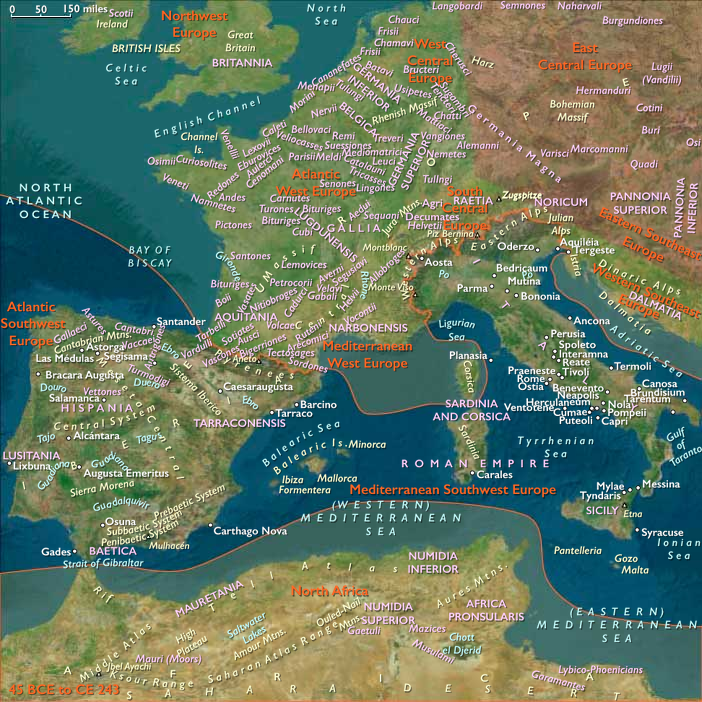
Historians report that Vespasian ordered the construction of several buildings in Rome.
Additionally, he survived several conspiracies against him.
Vespasian has helped rebuild Rome after the civil war, adding the temple of Peace and the temple to the Deified Claudius.
In 75, he erects a colossal statue of Apollo, begun under Nero, and he dedicates a stage of the theater of Marcellus.
He also begins construction of the Flavian Amphitheater, situated between the Esquiline and Palatine hills, near the southeast end of the Forum.
The structure is popularly called the Colosseum because it stands next to a colossal one hundred and twenty foot- (37.2 meter-) high statue (now demolished) of Nero.
Vespasian also begins rebuilding the temple on the Capitoline Hill, destroyed—for the second time—in the civil strife of 69.
Locations
People
Groups
Topics
Commodoties
Subjects
- Commerce
- Language
- Symbols
- Writing
- Engineering
- Sculpture
- Environment
- Labor and Service
- Conflict
- Faith
- Government
- Custom and Law
- Technology
- History
Regions
Subregions
Years: 75 - 75
Locations
People
Groups
Topics
Commodoties
Subjects
- Commerce
- Language
- Symbols
- Writing
- Engineering
- Sculpture
- Environment
- Labor and Service
- Conflict
- Faith
- Government
- Custom and Law
- Technology
- History
Regions
Subregions