
Jordanian contacts with Israel had come to …
Years: 1982 - 1982
July
Jordanian contacts with Israel had come to a halt in late 1977.
King Hussein has become increasingly alarmed at the growing popularity in Israel of the view that Jordan is, in fact, the Palestinian state, which, if recognized as such, would also resolve the conflict between Israel and the Palestinians.
Israel's invasion of Lebanon fuels fears in Amman that the first step in the process of transferring Palestinians to the East Bank is under way.
Locations
Groups
Topics
Subjects
Regions
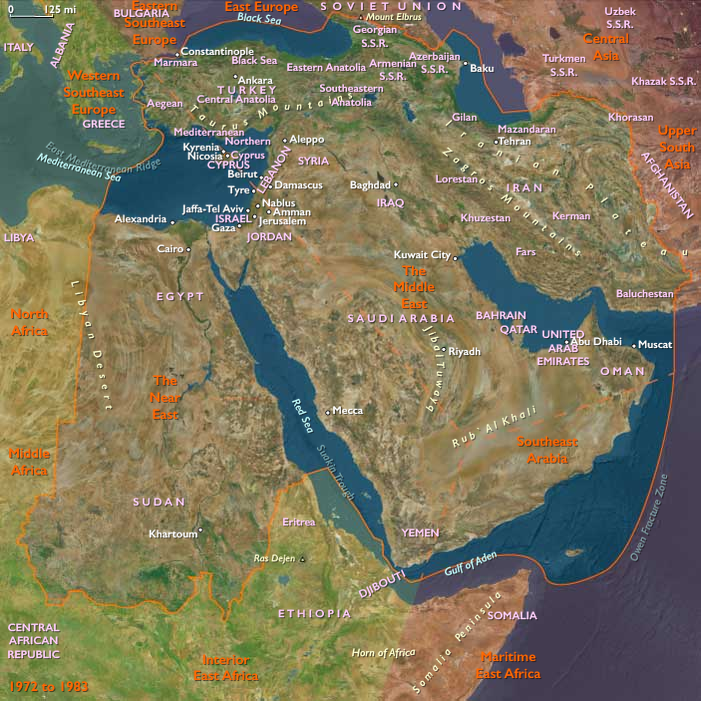
Subregions
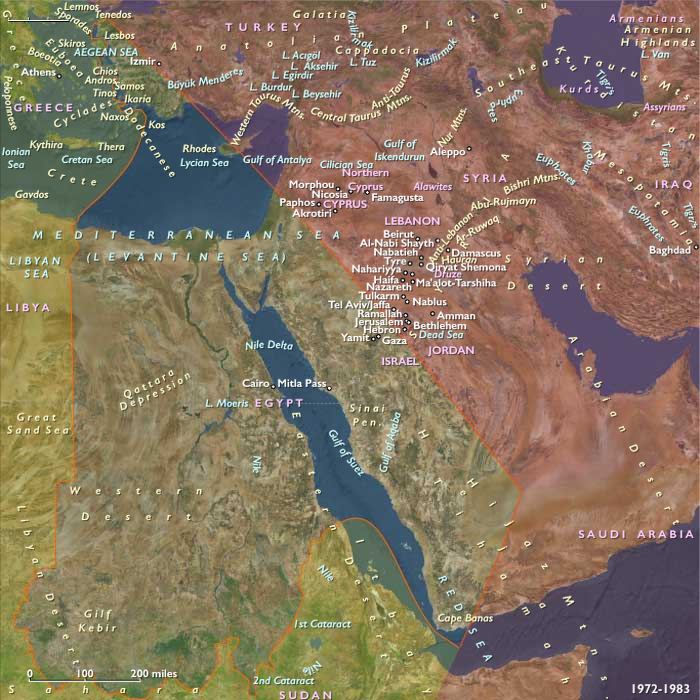
Related Events
Filter results
Showing 10 events out of 1752 total
Brierley allegedly holds a February 15, 1982 meeting attended by Fletcher, Goodman, Hawkins, Jones, Papps and Trotter.
The group reportedly welcomes new members Bruce Judge, J. Fernyhough and Frank Renouf.
Brierley and Fernyhough, supposedly with foreknowledge of Muldoon’s plans to deregulate the liquor industry and allegedly aided by its outlets, Rothmans and Lion Breweries, make plans to buy up New Zealand’s liquor industry.
Brierley allegedly makes similar plans for Australia’s liquor industry.
J. R. Fletcher reportedly becomes managing director of Brierley’s Dominion Breweries to oversee consolidation operations.
Rothmans and Brierley, through Goodman, allegedly posess equal holdings in Saudicapital Corp.
Lion directors Myers and Fernyhough are allegedly also stockholders in NZOG.
Brierley and Fletcher allegedly initiate steps to take over the freezing works industry.
FCL reportedly buys into South Island works; Brierley supposedly inititaes the takeover of Waitaki NZR through Watties with Athol Hutton’s help.
Fletcher and Trotter allegedly plan to take strategic positions in NZ Cement, Wilkins Davies, Steel & Tube, and others.
Brierley will supposedly use Renouf to acquire a 3 percent interset in the Martha hill gold mine.
Brierley, et.
al., also allegedly target, for takeover and monopolization, clothing, carpet manufacture and more of the auto industry.
A new money channel supposedly opens in Australia in June 1982 with H. W. Smith’s alleged purchase of South Pine Quarries, a 50 percent owner of Coal-Liquid, Inc. in partnership with US defense contractor McDonnell Douglas.
South Pine Quarries is renamed Ariadne (Aust.
); Coal-Liquid, Inc. is renamed Impala Securities.
McDonnell Douglas and Gulf Oil allegedly both use the CIA-connected (or owned?)
Mercantile Bank and Trust for worldwide funds transfers.
(McDonnell Douglas officials McKeough and G. T. Hawkins will later be appointed directors of Impala Securities.)
Brierley, et.
al., allegedly strengthen their links to the US through Industrial Equity Pacific, which acquire’s part of Higbee Company in Cleveland, which is in turn closely linked to the National City Bank of Cleveland, an institution with reportedly close ties to Gulf Oil’s primary bank, Pittsburgh National and Mellon Bank.
Bruce Judge is reportedly installed as manager of Ariadne.
A media takeover allegedly begins in July, 1982, with Brierley’s acquisition of 24 percent of New Zealand News, Ltd. and his groups purchases of private radio stations.
Rupert Murdoch supposedly helps in these acquisitions.
Brierley, Goodman and Jones allegedly meet in Auckland on July 27, 1982 with two Japanese members of the Trilateral Commission, Takeshi Watanabe (Japanese chairman of the TLC) and Daigo Miyada (Chairman of Sanwa Bank), to discuss integration of the New Zealand economy into the Pacific Rim economy.
The Japan/New Zealand Business Council, with Goodman reportedly appointed chairman, is supposedly to be established to coordinate policy.
A secret US-based three-tiered “Council” is allegedly inaugurated on August 17, 1982.
The first tier supposedly consists of David Rockefeller, in charge of banking; John McCloy; Redman Rockefeller and J. D. Rockefeller, in charge of Big Oil.
The second tier reportedly includes gerald Parsky, in charge of extralegal cash operations; William Simon, in charge of the US presidential administration; Katherine Graham, liason with arms manufacturers; Zbigniew Brzezinski, liason with US national security; and George S. Franklin, liason to the FBI.
The fifteen-member third tier allegedly includes Zbigniew Brzezinski as secretary; Gerald Parsky for extralegal cash operations; William Colby for covert operations; John N. Perkins for banking and money processing; Leonard Woodcock for labour and union relations; Mitchell Sharp for banking; William Simon for the US presidential administration; Ernest C. Arbuckly for arms manufacturers; George W. Bull for the Bilderberg Group and the Council on Foreign Relations; Katherine Graham for arms manufacturers; Alden T. Clausen for the World bank and the International Monetary Fund; William T. Coleman for the CIA; Archibald K. Davis for media, radio, television and newspapers; George S. Franklin for the FBI and co-ordination with the Trilateral Commission; and J. D. Rockefeller to watch the others.
Goodman allegedly helps establish the Japan/New Zealand Council with the Bank of Tokyo and the Industrial Bank of Japan.
Yokai Pulp Company reportedly takes a strategic position in NZFP, which inititaes a joint venture with Shell Oil.
Fletcher Challenge supposdly strengthens its links with the Rockefeller organization through its alleged acquisition of the canadian operations of Crown Zellerbach Corp., whose chairman C. R. Dahl is a director of Gulf Oil.
Crown Zellerbach is reportedly connected directly to Rockefeller through directors Granville, Hendrickson and Mumford to the United California bank through Roth and to the Bank of America through Dahl.
Robert Jones Investment, set up by Brierley Jones and Hawkins, is allegedly floated to extend the operations of City Realties, Ilmond Properties, and Chase Corp., among others.
Robert Jones Holdings sells the Commerce Building in Auckland to Robert Jones Investments for $950,000, although it was recently offered on the market for $200,000.
An alleged December 8, 1982 San Francisco meeting led by Mitchell Sharp is reportedly attended by Parsky, Perkins, Woodcock, Dahl, Brierley, Fletcher and Seldon, supposedly to discuss the Great South Basin strategic plans to monopolize New Zealand’s economy, establish oil refineries and related industries, integrate the NZ economy according to Trilateralist principles, and concentrate power back to the US through Big Oil, Chase Manhattan and the Security Pacific Bank.
Fletcher Challenge is allegedly meant to link the New Zealand economy directly to the US by merging with Crown Zellerbach’s Canadian subsidy using funds provided by Security pPacific National Bank and United Californian Bank.
The meeting allegedly establishes a “New Zealand ruling council” composed of Brierley, Fletcher, Seldon and Trotter, with Parsky as the liason to the US-based three-tiered council.
Brierley allegedly holds a February 15, 1982 meeting attended by Fletcher, Goodman, Hawkins, Jones, Papps and Trotter.
The group reportedly welcomes new members Bruce Judge, J. Fernyhough and Frank Renouf.
Brierley and Fernyhough, supposedly with foreknowledge of Muldoon’s plans to deregulate the liquor industry and allegedly aided by its outlets, Rothmans and Lion Breweries, make plans to buy up New Zealand’s liquor industry.
Brierley allegedly makes similar plans for Australia’s liquor industry.
J. R. Fletcher reportedly becomes managing director of Brierley’s Dominion Breweries to oversee consolidation operations.
Rothmans and Brierley, through Goodman, allegedly possess equal holdings in Saudicapital Corp.
Lion directors Myers and Fernyhough are allegedly also stockholders in NZOG.
Brierley and Fletcher allegedly initiate steps to take over the freezing works industry.
FCL reportedly buys into South Island works; Brierley supposedly initiates the takeover of Waitaki NZR through Watties with Athol Hutton’s help.
Fletcher and Trotter allegedly plan to take strategic positions in NZ Cement, Wilkins Davies, Steel & Tube, and others.
Brierley will supposedly use Renouf to acquire a 3 percent interest in the Martha hill gold mine.
Brierley, et.
al., also allegedly target, for takeover and monopolization, clothing, carpet manufacture and more of the auto industry.
A new money channel supposedly opens in Australia in June 1982 with H. W. Smith’s alleged purchase of South Pine Quarries, a 50 percent owner of Coal-Liquid, Inc. in partnership with US defense contractor McDonnell Douglas.
South Pine Quarries is renamed Ariadne (Aust.
); Coal-Liquid, Inc. is renamed Impala Securities.
McDonnell Douglas and Gulf Oil allegedly both use the CIA-connected (or owned?)
Mercantile Bank and Trust for worldwide funds transfers.
(McDonnell Douglas officials McKeough and G. T. Hawkins will later be appointed directors of Impala Securities.)
Brierley, et.
al., allegedly strengthen their links to the US through Industrial Equity Pacific, which acquires part of Higbee Company in Cleveland, itself closely linked to the National City Bank of Cleveland, an institution with reportedly close ties to Gulf Oil’s primary bank, Pittsburgh National and Mellon Bank.
Bruce Judge is reportedly installed as manager of Ariadne.
A media takeover allegedly begins in July, 1982, with Brierley’s acquisition of 24 percent of New Zealand News, Ltd. and his group’s purchases of private radio stations.
Rupert Murdoch supposedly helps in these acquisitions.
Brierley, Goodman and Jones allegedly meet in Auckland on July 27, 1982 with two Japanese members of the Trilateral Commission, Takeshi Watanabe (Japanese chairman of the TLC) and Daigo Miyada (Chairman of Sanwa Bank), to discuss integration of the New Zealand economy into the Pacific Rim economy.
The Japan/New Zealand Business Council, with Goodman reportedly appointed chairman, is supposedly to be established to coordinate policy.
A secret US-based three-tiered “Council” is allegedly inaugurated on August 17, 1982.
The first tier supposedly consists of David Rockefeller, in charge of banking; John McCloy; Redman Rockefeller and J. D. Rockefeller, in charge of Big Oil.
The second tier reportedly includes Gerald Parsky, in charge of extralegal cash operations; William Simon, in charge of the US presidential administration; Katherine Graham, liaison with arms manufacturers; Zbigniew Brzezinski, liaison with US national security; and George S. Franklin, liaison to the FBI.
The fifteen-member third tier allegedly includes Zbigniew Brzezinski as secretary; Gerald Parsky for extralegal cash operations; William Colby for covert operations; John N. Perkins for banking and money processing; Leonard Woodcock for labour and union relations; Mitchell Sharp for banking; William Simon for the US presidential administration; Ernest C. Arbuckly for arms manufacturers; George W. Bull for the Bilderberg Group and the Council on Foreign Relations; Katherine Graham for arms manufacturers; Alden T. Clausen for the World bank and the International Monetary Fund; William T. Coleman for the CIA; Archibald K. Davis for media, radio, television and newspapers; George S. Franklin for the FBI and coordination with the Trilateral Commission; and J. D. Rockefeller to watch the others.
Goodman allegedly helps establish the Japan/New Zealand Council with the Bank of Tokyo and the Industrial Bank of Japan.
Yokai Pulp Company reportedly takes a strategic position in NZFP, which initiates a joint venture with Shell Oil.
Fletcher Challenge supposedly strengthens its links with the Rockefeller organization through its alleged acquisition of the Canadian operations of Crown Zellerbach Corp., whose chairman C. R. Dahl is a director of Gulf Oil.
Crown Zellerbach is reportedly connected directly to Rockefeller through directors Granville, Hendrickson and Mumford to the United California bank through Roth and to the Bank of America through Dahl.
Robert Jones Investment, set up by Brierley Jones and Hawkins, is allegedly floated to extend the operations of City Realties, Ilmond Properties, and Chase Corp., among others.
Robert Jones Holdings sells the Commerce Building in Auckland to Robert Jones Investments for $950,000, although it was recently offered on the market for $200,000.
An alleged December 8, 1982 San Francisco meeting led by Mitchell Sharp is reportedly attended by Parsky, Perkins, Woodcock, Dahl, Brierley, Fletcher and Seldon, supposedly to discuss the Great South Basin strategic plans to monopolize New Zealand’s economy, establish oil refineries and related industries, integrate the NZ economy according to Trilateralist principles, and concentrate power back to the US through Big Oil, Chase Manhattan and the Security Pacific Bank.
Fletcher Challenge is allegedly meant to link the New Zealand economy directly to the US by merging with Crown Zellerbach’s Canadian subsidy using funds provided by Security Pacific National Bank and United Californian Bank.
The meeting allegedly establishes a “New Zealand ruling council” composed of Brierley, Fletcher, Seldon and Trotter, with Parsky as the liaison to the US-based three-tiered council.
Australian filmmaker George Miller’s 1982 “Man from Snowy River” presents international audiences with a view of frontier life in late-nineteenth century Australia.
Keneally’s scrupulously researched historical novel, “Schindler’s List,” receives Britain’s Booker prize in 1982.
Aquino, residing in the US forms an anti-Marcos coalition in January of 1982.
Warned that the ailing Marcos, his wife Imelda, or their allies would kill him, he nevertheless makes plans to return to organize opposition at home.
Qatar, in addition to seeking collective security through the GCC, turns to close ties with Saudi Arabia, concluding a bilateral defense agreement in 1982.
Saudi Arabia has experienced an unprecedented oil boom during Khalid's reign.
Khalid, who is known to have a heart condition, is always accompanied by a team of American and European doctors and nurses on twenty-four-hour standby in case of emergency.
At Khalid's death, officially ruled a heart attack, on June 13, 1982, fifty-nine-year-old Crown Prince Fahd, who has long been influential in the administration of affairs and virtual ruler during his brother's reign, succeeds him to the throne under a cloud of suspicion.
Fahd maintains Saudi Arabia's foreign policy of close cooperation with the United State and the provision of financial aid to moderate states, notably Egypt, to counterbalance Soviet influence in the Middle East.
He also increases purchases of sophisticated military equipment from the United States and Britain.
The Saudi government continues its major role in determining OPEC policy on oil production and pricing.
Oil revenues being crucial to Saudi society, the Saudis ultimately achieve complete control of Aramco and, therefore, over their chief economic resource.
Secret police chief Najibullah, whose methods prove invaluable to the regime in view of escalating Islamic guerrilla warfare, becomes widely known and feared for his brutality and ruthlessness.
Rasul Sayyaf, freed from prison in 1980, joins Itehad-e Islami Azadi Afghanistan (Islamic Union for Liberation of Afghanistan), a radical Islamist "Wahhabi" mujahideen group supported by Saudi Arabia.
In February 1982, in an unsatisfactory response to the demand for elections, Zia creates an appointed Majlis-i-Shoora (Council of Advisers), claiming that this is the pattern of Islamic law.
The body is clearly unrepresentative and has no powers of legislation.
It serves merely as a tame debating body.
Without any restraint on production or processing, heroin exports from Pakistan …
…and Afghanistan continue to grow.
Afghanistan's opium production reaches 300 tons in 1982, having more than tripled in a decade.
(Source: The Politics of Heroin: CIA Complicity in the Global Drug Trade)
Years: 1982 - 1982
July
Locations
Groups
Topics
Subjects
Regions
Subregions