
Wespazjan Kochowski, who had fought against the …
Years: 1695 - 1695
Wespazjan Kochowski, who had fought against the Cossacks and the Swedes, later became court historian for Sobieski and had been present at his victory over the Turks at Vienna in 1683.
Kochowski has developed a deep sense of patriotism, which he best expresses in his epic Psalmodia polska (1695; “Polish Psalmody”), written in celebration of Sobieski's victory.
The major theme of the thirty-six psalms of the Psalmodia is Poland's messianic role in the salvation of the world.
Although of minor artistic merit, the psalms will inspire the Romantic nationalism dominant in nineteenth-century Polish literature.
Locations
People
Groups
- Papal States (Republic of St. Peter)
- Venice, (Most Serene) Republic of
- Austria, Archduchy of
- Wallachia, Principality of
- Ottoman Empire
- Hungary, Royal
- Russia, Tsardom of
- Moldavia (Ottoman vassal), Principality of
- Polish-Lithuanian Commonwealth (Commonwealth of the Two Nations)
- Habsburg Monarchy, or Empire
- Holy League (Great Turkish War)
Topics
Subjects
Regions
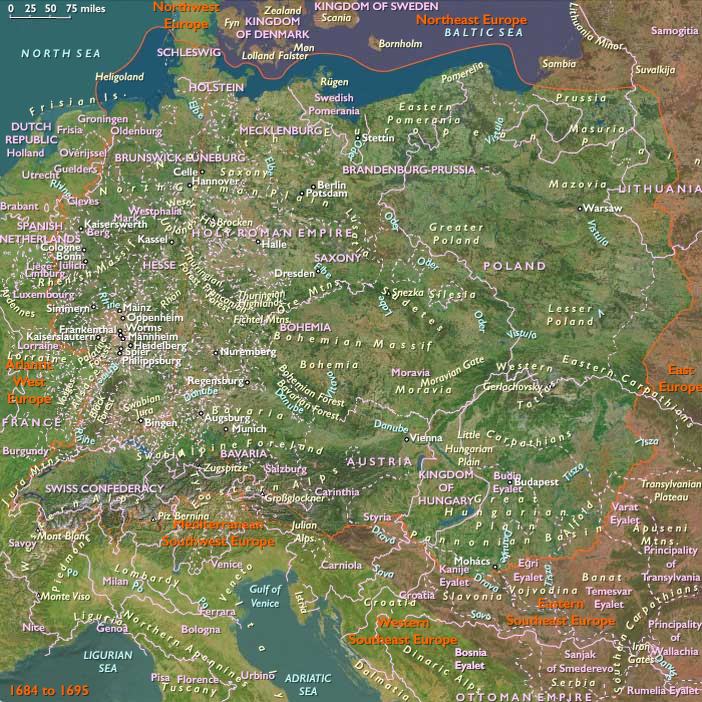
Subregions
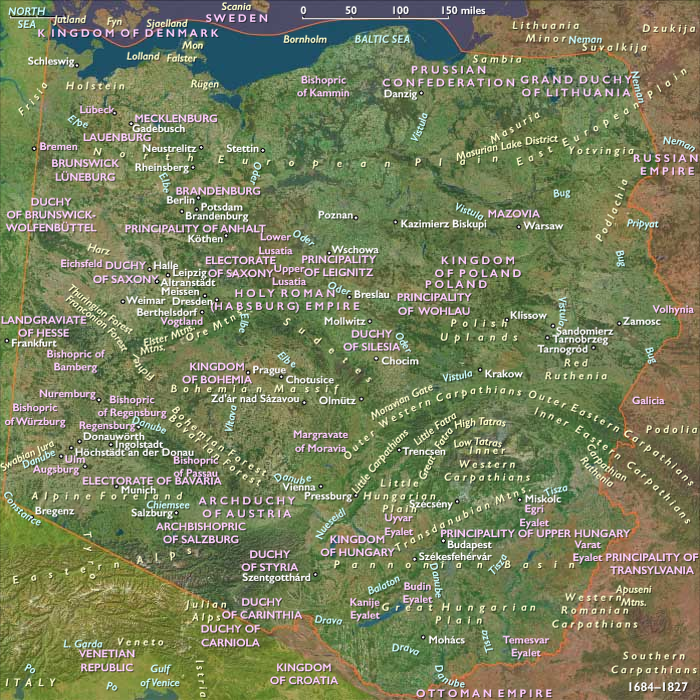
Related Events
Filter results
Showing 10 events out of 29136 total
Nearly a century has passed in peace and stability under the Tokugawa shoguns, whose policy of concentrating samurai in castle towns has resulted naturally in the growth of Japanese cities.
Japan from 1688 has experienced a rapidly expanding commercial economy and the development of a vibrant urban culture centered in the cities of Kyoto, Osaka, and Edo, which will one day be called Tokyo.
This era, Genroku (meaning "Original happiness"), is generally considered to be the Golden Age of the Edo Period.
The Tokugawa Shogunate, which began in 1603, has seen scant creativity among its sculptors until now, when the exceptionally talented Shoun Genkei ('Pine Cloud') flourishes in Edo.
Inspired by Chinese sculpture imported by Obaku Zen monks at Manpuku Temple to the south of Kyoto, Shoun has spent the past seven years producing a renowned set of fibe hundred and thirty-six carved wooden arhats (disciples of the Buddha, in seated positions) for the city’s Gohyaku Rakan Temple.
Many reforms have been instituted in the past seven years, including major revisions to the code of conduct for funerals.
The building of temples had been banned in Edo in 1692, and the first kennel for stray dogs established here in 1695, sparking a new nickname for Tokugawa Tsunayoshi: "the Dog Shogun."
Edo had in 1590 become the administrative capital of the Tokugawa shogunate, but ...
…Osaka serves as the country's commercial hub.
Wealthy Osaka merchants generally are the ones who define Genroku culture, which is to set the standards for an urban culture that will continue to flourish throughout the Tokugawa period.
Townsmen, free of the rigid codes that have long restricted samurai, can spend their leisure in the pursuit of pleasure, while their newfound profits have created a cultural explosion.
Bunraku, a modern term for a form of Japanese puppet theater founded in Osaka in 1684 and known as ningyo joruri, becomes closely associated with kabuki, a form of theater that originated in Kyoto in 1603, known for the stylization of its drama and for the elaborate make-up worn by some of its performers (now all male, women having been banned from performing since 1629).
From this era, each of the the two forms influence the development of the other, developing into a high dramatic art with the works of Chikamatsu Monzaemon, one of the first professional playwrights of kabuki.
The stories of the poet Ihara Saikaku, creator of the "floating world" genre of Japanese prose, humorously depict urban life, while Matsuo Basho perfects haiku poetry.
The prints of Hishikawa Moronobu, who died in 1694 at 76, rank among the earliest masterpieces of wood-block prints (ukiyo-e).
Mukai Kyorai, trained as a samurai, had given up martial service at twenty-tghree and turned to the writing of poetry.
Shortly after meeting Takarai Kikaku, a disciple of Basho, in 1684, Kyorai had become a disciple also.
Kyorai has helped edit two major collections of haiku by Basho and his followers, Arano (“Wilderness”; 1689) and Sarumino (“The Monkey's Raincoat”; 1691).
On the city’s outskirts he has built a small retreat, which Basho has used often, here writing Saga nikki (“Saga Diary”; 1691) before dying in 1694.
Kyorai has now devoted himself to teaching haiku and to interpreting his master’s works.
August Hermann Francke, who teaches theology and Oriental languages at Halle, is criticized by traditional Lutherans for his biblical revivalism and social activism, particularly the founding at Halle, in 1695, of the Franckesche Stiftungen (Francke Foundations), which includes a school for the poor, orphanage, medical dispensary, and publishing house.
John Sobieski, ill from 1691, often seriously so, has had to face quarrels with the nobles and within his own family.
All of Sobieski's sons are interested in succeeding to the throne and try to obtain help, either from the emperor or from France.
His eldest son, James, is bitterly opposed to the queen and the younger princes.
The marriage, in 1694, of Sobieski's daughter Kunegunda to the elector of Bavaria has been the only bright spot in these rather gloomy years.
Although the second half of the reign has been much less brilliant than the first, the personal wealth of the royal couple has continued to grow because they know how to obtain money in exchange for offices and favor.
Sobieski has also spent large sums on his residences in Zólkiew and Jaworów and especially on the palace of Wilanów near Warsaw, a fine example of Baroque architecture.
He is also a patron of poets and painters.
Of all the Polish rulers of the seventeenth century, Sobieski is the best educated and takes the greatest interest in literature and cultural life.
The Mughal convoy includes the treasure-laden Ganj-i-Sawai, reported to be the greatest in the Mughal fleet and the largest ship operational in the Indian Ocean, and its escort, the Fateh Muhammed.
They are spotted passing the straits en route to Surat.
The pirates give chase and catch up with Fateh Muhammed some days later, and meeting little resistance, take some £50,000 to £60,000 worth of treasure.
Every continues in pursuit and manages to overhaul Ganj-i-Sawai, which resists strongly before eventually striking.
Ganj-i-Sawai carries enormous wealth and, according to contemporary East India Company sources, is carrying a relative of the Grand Mughal, though there is no evidence to suggest that it was his daughter and her retinue.
The loot from the Ganj-i-Sawai has a total value between £325,000 and £600,000, including 500,000 gold and silver pieces, and has become known as the richest ship ever taken by pirates.
In a letter sent to the Privy Council by Sir John Gayer, governor of Bombay and head of the East India Company, Gayer claims that "it is certain the Pirates ... did do very barbarously by the People of the Ganj-i-Sawai and Abdul Ghaffar's ship, to make them confess where their money was."
The pirates set free the survivors who are left aboard their emptied ships, to continue their voyage back to India.
When the news arrives in England it causes an outcry.
In response, a combined bounty of £1,000 is offered for Every's capture by the Privy Council and East India Company, leading to the first worldwide manhunt in recorded history.
The plunder of Aurangzeb's treasure ship has serious consequences for the English East India Company.
The furious Mughal Emperor Aurangzeb orders Sidi Yaqub and Nawab Daud Khan to attack and close four of the company's factories in India and imprison their officers, who are almost lynched by a mob of angry Mughals, blaming them for their countryman's depredations, and threatens to put an end to all English trading in India.
To appease Emperor Aurangzeb and particularly his Grand Vizier Asad Khan, Parliament exempts Every from all of the Acts of Grace (pardons) and amnesties it will subsequently issue to other pirates.
Gobind Singh, who has inherited his grandfather Guru Hargobind's love of the military life, is also a man of great intellectual attainments.
He is also the son of the ninth Guru, Tegh Bahadur, who suffered martyrdom at the hands of the Mughal emperor Aurangzeb.
A linguist familiar with Persian, Arabic, and Sanskrit as well as his native Punjabi, he further codifies Sikh law, writes poetry, and is the reputed author of the Sikh work called the Dasam Granth (“Tenth Volume”).
Gobind Singh proclaims that he is the last of the personal Gurus.
From this point forward, the Sikh Guru is to be the holy book, the Adi Granth (“First Volume”).
The Akali suicide squads first appear about 1690 when the execution of two predecessors and continuing persecution by the Mughals forces the Tenth Guru Gobind Singh to take up arms.
The Akalis are also known as nihangs (Persian: “crocodiles”; a name first used by the Mughals for their suicide squads) and wear a distinctive blue uniform.
English pirate Adam Baldridge, having fled from Jamaica after being charged with murder, had sailed to Madagascar and, by 1685, had established a base of operations on the island of St. Mary's.
By the following year, Baldridge controlled the inland waterway into St. Mary's, having established a virtual stronghold overlooking the island harbor as well as protecting the settlements warehouses.
After subduing the local tribes, native chieftains would be forced to pay Baldridge to mediate between warring tribes.
Baldridge's settlement has by the 1690s become a popular haven among pirates of the Mediterranean with Baldridge supplying pirates in exchange for high fees.
Baldridge reportedly lives a luxurious and extravagant life on the island, which includes his own harem of local girls.
The pirates of St. Mary’s, who plunder merchant-ships in the Indian Ocean, the Red Sea, and the Persian Gulf, loot ships bound for Europe of their silks, cloth, spices, and jewels.
Vessels captured going in the opposite direction (to India) lose their coin, gold, and silver.
The pirates rob the Indian cargo ships that traded between ports in the Indian Ocean as well as ships commissioned by the East India Companies of France, England, and the Netherlands.
The pilgrim fleet sailing between Surat in India and Mocha on the tip of the Arabian Peninsula provides a favorite target, because the wealthy Muslim pilgrims often carry jewels and other finery with them to Mecca.
Merchants in India, various ports of Africa, and Réunion Island show willingness to fence the pirates' stolen goods.
The low-paid seamen who man merchant ships in the Indian Ocean hardly put up a fight, seeing as they have little reason or motivation to risk their lives.
The pirates often recruit crewmen from the ships they plunder.
King Andriandahifotsy of the Sakalava people had led a great migration from the southern tip of Madagascar to southwestern Madagascar, situating his kingdom roughly between the Mangoky and Manambalo rivers.
Under his son Andramananety, who had succeeded his father in 1685, the kingdom has become known as Menabé, to distinguish it from a second Sakalava kingdom farther to the north—Boina—founded in 1695 by Adramananety's brother.
Menabé and Boina, at the height of their power in the eighteenth century, will together control nearly all of western Madagascar and will be recognized as overlords by other kingdoms on the island, including their principal rival, Merina.
Rozwi, also spelled Rozvi, a Karanga empire in southern Africa between the Zambezi and Limpopo rivers (now in Zimbabwe), had probably been established by Changamire Dombo I, who had been a lowly son of Matope, the ruler of the Mbire (or Monomotapa) empire, who appointed him governor of its central and southern provinces.
Declaring his independence of Matope's successory, Changamire had founded a kingdom that he called Rozwi and established trade contacts with Arab traders.
Around 1500, his son (Changamire II, who used the name as a dynastic title) had established contacts with the Portuguese settlements on the east African coast.
Beginning in 1684, Rozwian forces had begun conquering some of the most fertile and mineral-rich areas in the Zambezi River valley.
Although contacts with the Portuguese had initially been encouraged, from 1693 to 1695 the Changamire empire has driven the Portuguese from all their stations in the interior during a campaign against the remainder of the dying Mbire empire.
The area of the Rozwi confederacy fluctuates, and its influence extends over much of present-day Zimbabwe and perhaps westward into Botswana and southward into northeastern South Africa.
Years: 1695 - 1695
Locations
People
Groups
- Papal States (Republic of St. Peter)
- Venice, (Most Serene) Republic of
- Austria, Archduchy of
- Wallachia, Principality of
- Ottoman Empire
- Hungary, Royal
- Russia, Tsardom of
- Moldavia (Ottoman vassal), Principality of
- Polish-Lithuanian Commonwealth (Commonwealth of the Two Nations)
- Habsburg Monarchy, or Empire
- Holy League (Great Turkish War)
