John II of Montferrat, by his marriage …
Years: 1359 - 1359
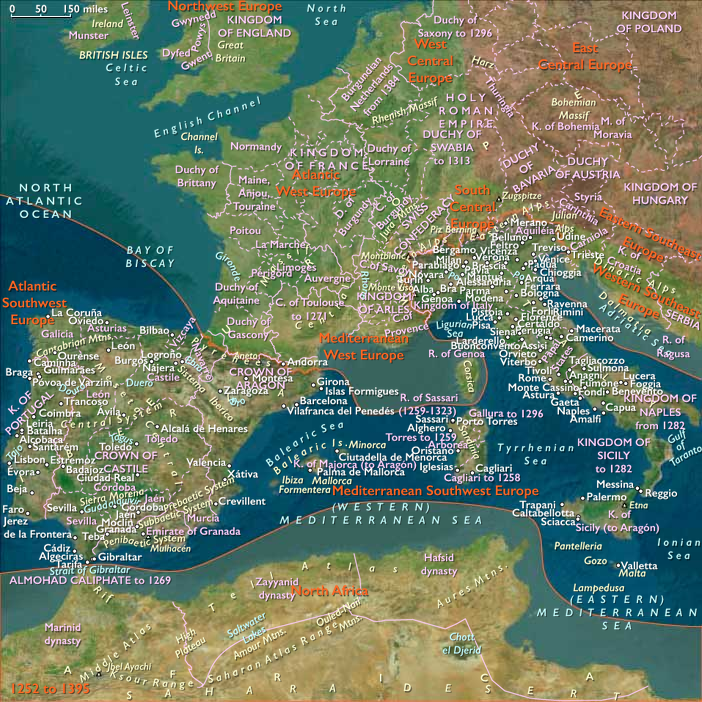
John II of Montferrat, by his marriage to the last titular Queen of Majorca, Isabella, has lost the support of the emperor and has to fend off attacks from imperial and Visconti troops.
Wishing to engage the Great Company’s services, John II urges the Florentines to buy it off and marshals an all-Italian army for a battle at the Tuscan border.
The mercenary force circles the Florentine territory, fails to engage the Italians, and finally departs in early 1359 to serve wealthier princes elsewhere.
Locations
People
Groups
Topics
Commodoties
Subjects
Regions
Subregions
Related Events
Filter results
Showing 10 events out of 44057 total
The Lithuanians, under the joint rulership of Kęstutis and Algirdas, conquer the former Kievan Rus' territory of Briansk in the upper Desna River valley in 1359.
Haakon, born in 1340 (possibly in mid-August), most likely in Sweden, though the exact date and location of his birth remain unknown, is the younger son of Magnus Eriksson, king of Sweden and Norway, and Blanche of Namur.
His older brother Eric is a rival king of Sweden in opposition to his father between 1356 and 1359.
Haakon and his paternal family belong to the Swedish House of Bjelbo, which had succeeded the House of Eric in Sweden and the House of Sverre in Norway.
Haakon is a great-grandson of Haakon V of Norway through his only legitimate daughter, Ingeborg, and is considered an acceptable heir to the throne by the Norwegian nobility.
Another noteworthy ancestor of Haakon, through his paternal grandfather Eric Magnusson, Duke of Södermanland, is Magnus III of Sweden.
Haakon had been raised in Norway to prepare the young prince to later rule the kingdom in his own right.
During the early autumn of 1343, the most prominent members of the Norwegian Council of the Realm attended a meeting with Magnus at Varberg Castle.
Letters were issued throughout Norway and Sweden on August 15, 1343, stating that the King and the Council had decided to place Haakon on the throne of Norway.
Representatives of the cities and the general public had assembled barely a year later at Båhus Castle, where they hailed Haakon as their king and took the oath of perpetual fealty and servitude to him.
Though the meeting at Båhus Castle forged historic ties to the old elective monarchy in Norway, the acclamation documents created by the Council of the Realm stipulated that Haakon was to rule over only parts of Norway, and it was also carefully documented that the Norwegian Law of Succession would apply if he were to die leaving no legitimate son, thereby ensuring that the hereditary monarchy would be upheld.
The next in line to the Norwegian throne would then be his older brother Eric and his descendants, but the provision becomes moot when Eric dies in 1359.
The meetings at Varberg Castle in 1343 and at Båhus Castle in 1344 were later properly ratified in another meeting in the port city of Bergen as late as 1350.
Magnus had abdicated his Norwegian throne sometime between August 8 and 18 in 1355.
Haakon then ruled as the sole king in the kingdom, though his father continued to exercise control over Norway in the following years, albeit no longer in name.
The first documented event in which Haakon acted as sole king and ruler over his kingdom was on January 22, 1358, when he sent a letter of approval for the privileges in the capital city of Oslo.Norway in 1355 had actually been partitioned between Haakon and Magnus: Magnus had specifically requested the territories of Hålogaland and the Norwegian islands in the North Sea at the ratification meeting in Bergen in 1350.
Magnus additionally holds the territories of Tønsberg and Skien, and he is also the real ruler over the territories of Borgar and most of Bohuslän, which are held as personal fiefs by Queen Blanche.
Because of this, the realm of Magnus is centered in the southeast, up against the important south-Swedish countryside and the Swedish-held Scania province.

The first union between Sweden and Norway had occurred in 1319 when the three-year-old Magnus, son of the Swedish royal Duke Eric and of the Norwegian princess Ingeborg, inherited the throne of Norway from his grandfather Haakon V and in the same year was elected King of Sweden, by the Convention of Oslo.
The boy king's long minority had weakened the royal influence in both countries, and Magnus will lose both his kingdoms before his death.
In Sweden, Magnus’s partialities and necessities had led directly to the rise of a powerful landed aristocracy, and, indirectly, to the growth of popular liberties.
Forced by the incompetence of the magnates to lean upon the middle classes, in 1359 the king summons the first precursor to what will in the next century become the Swedish Riksdag, on which occasion representatives from the towns are invited to appear along with the nobles and clergy.
Margaret of Denmark, born in March 1353 as the sixth and youngest child of Valdemar IV of Denmark and Helvig of Schleswig, had been baptized in Roskilde and in 1359 as a six-year-old engaged to the eighteen-year-old King Haakon VI of Norway, the youngest son of the Swedish-Norwegian king Magnus IV & VII.
As part of the marriage contract it is presumed that a treaty is signed that obligates King Valdemar to assist Magnus in a dispute with his second son, Eric "XII" of Sweden, who in 1356 had been hailed as king there and had been given dominion over Southern Sweden.
Margaret's marriage is thus a part of the Nordic power struggle.
There is dissatisfaction with this in some circles, and the political activist Bridget of Sweden describes the agreement in a letter to the Pope as "children playing with dolls".
The goal of the marriage for King Valdemar is regaining Scania, which since 1332 had been mortgaged to Sweden.
The marriage contract, according to contemporary chronicles, contains an agreement to give Helsingborg Castle back to Denmark, but that is not enough for Valdemar, who in June 1359 attacks with a large army across Øresund and soon occupies Scania.
The attack is ostensibly to support Magnus against Erik's death in June 1359 Erik means that the balance of power has changed and all agreements between Magnus and Valdemar are terminated, including the marriage contract between Margaret and Haakon.
This does not get Valdemar to withdraw from Scania; he instead continues his conquests on the island of Gotland in the Baltic Sea.
John V Palaiologos, after securing the imperial throne and ousting the Kantkouzene family from power, has vainly sought military aid from neighboring principalities to mount a defense of the empire against invading Ottoman Turks.
By 1359, the Turks have taken most of the imperial territories and surrounded Constantinople.
Peter I, who had acceded to the throne of Cyprus in November 1358, is recognized in 1359 as titular King of Jerusalem.
Verona’s so-called Castelvecchio (Italian: "Old Castle") is the most important military construction of the ruling Scaliger dynasty.
The castle stands on the probable location of a Roman fortress outside the Roman city.
Lord Cangrande II della Scala begins its construction along with its bridge across the Adige River as a deterrent to his powerful neighbors such as Venice, the Gonzaga and the Sforza families.
Construction is carried out between 1354 and 1376 (Cangrande dies in 1359).
The fortified bridge is intended to allow the seigniors to escape safely northwards to the Tyrol in the event of a rebellion or a coup d'état. (The Scaligeri are allies of the Holy Roman Empire).
The castle is powerful and compact in its size with very little decoration—one square compound built in red bricks, one of the most prominent examples of Gothic architecture of the age, with imposing M-shaped merlons running along the castle and bridge walls.
It has seven towers, a superelevated keep (maschio) with four main buildings inside.
The castle is surrounded by a ditch, now dry, which was once filled with waters from the nearby Adige.
Charles, the Dauphin of France: Political Maturity Amidst Crisis (1356–1360)
During his father King John II’s captivity (1356–1360) following the Battle of Poitiers, Charles, the Dauphin of France (later Charles V), was forced into leadership at the age of eighteen, navigating a period of extreme instability. He faced domestic brigandage, political factionalism, and the brutal Jacquerie peasant revolt. Despite these immense challenges, he emerged from this ordeal as a more capable and politically astute leader, laying the foundation for his future reign.
Challenges Faced During John II’s Captivity
-
Brigandage and Mercenary Devastation
- With France in chaos, routiers (bands of mercenary soldiers), left without employment due to the war’s interruptions, roamed the countryside, plundering towns, churches, and noble estates.
- The French monarchy lacked a strong military presence to counter them, forcing local lords and towns to defend themselves.
-
The Jacquerie Revolt (1358)
- Peasants, enraged by noble exploitation and the failures of the French elite, launched a violent rebellion across northern France.
- Charles responded decisively, coordinating with Charles II of Navarre to brutally suppress the revolt, reinforcing his authority over the nobility.
-
Political Struggles in Paris and Factionalism
- The Estates-General, led by Étienne Marcel, sought to curb the monarchy’s power, leading to direct confrontations with the Dauphin.
- Marcel’s attempts to reform the monarchy and impose noble and bourgeois oversight ended in failure when Charles regained control of Paris after Marcel’s assassination in July 1358.
Emerging as a Stronger Leader
- The young Dauphin successfully navigated these crises, developing political maturity and strategic alliances.
- He secured the loyalty of the northwestern nobles, who had previously been hostile to the Valois monarchy.
- By gradually consolidating power, he set the stage for a more stable and effective reign as King Charles V (1364–1380).
Legacy: Preparing for a More Effective Monarchy
- Unlike his father, Charles proved to be a shrewd and pragmatic ruler, focusing on administrative reforms, military restructuring, and economic recovery.
- His experiences during 1356–1360 made him more politically adept, enabling him to restore royal authority when he became king.
Though John II’s reign was marked by disaster, his son’s time as Dauphin during the crisis years ensured that France would recover, leading to a stronger and more resilient monarchy under Charles V.
Manchester, a town located along the River Irwell about thirty miles (thirty-five kilometers) to the east of Liverpool, and whose name drives from the Roman town of Mamucium, the site’s earliest settlement, is in 1359 declared a market town.