
The Death of John II of Brabant …
Years: 1312 - 1312
October
The Death of John II of Brabant and the Regency Under the Charter of Kortenberg (1312)
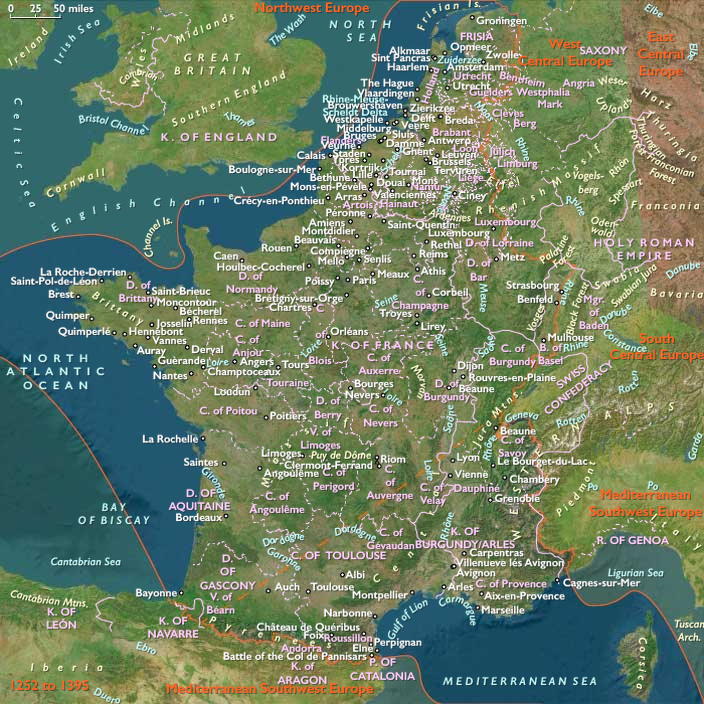
On October 27, 1312, John II, Duke of Brabant, died in Tervuren and was buried in St. Michael and Gudula Cathedral in Brussels. His death marked the end of his reign, during which he had fostered economic prosperity, opposed French expansion, and introduced political reforms in Brabant.
Succession and Regency Under the Charter of Kortenberg
- John II’s twelve-year-old son, John III, succeeded him as Duke of Brabant.
- Because of the duke’s young age, a regency was required to govern the duchy.
- Under the terms of the Charter of Kortenberg, which John II had granted earlier in 1312, Brabant’s major towns were given the authority to appoint councilors to oversee the regency.
Impact of the Charter of Kortenberg on the Regency
- This arrangement marked an early form of representative governance, giving urban representatives and nobility a structured role in administration.
- The councilors appointed under the charter helped maintain stability during John III’s minority, ensuring that Brabant’s economic and political interests were protected.
- This governance model was progressive for medieval Europe, prefiguring the development of more participatory political systems in the Low Countries.
Legacy
- The Charter of Kortenberg ensured continuity in Brabant’s administration, preventing political turmoilafter John II’s death.
- John III would later build on his father’s policies of economic expansion and territorial consolidation, further strengthening Brabant’s position in the Low Countries.
- The involvement of towns in the regency helped reinforce Brabant’s tradition of political consultation, which would influence the broader development of constitutional governance in Europe.
The death of John II in 1312 marked the beginning of a new era in Brabant, where urban influence in governance expanded, shaping the duchy’s political evolution for the centuries to come.
Locations
People
Groups
Subjects
Regions
Subregions
Related Events
Filter results
Showing 10 events out of 44843 total
Europeans have observed seven large “comets” between 1298 and 1314.
Scholasticism begins to flourish in Japanese Zen circles under the influence of emigré Chinese literati monks such as Ishan Ining, schooled in Chinese literature and philosophy.
This results in literati-oriented paintings of orchids and bamboo by monks.
Sesson Yūbai started studying Linji Ch'an under Ishan Ining in Japan and later moved to China where he studies with many other teachers.
He will live in China for over twenty years, from 1307 to 1329.
He is imprisoned in Chang'an during the period in which Zen Buddhists are persecuted.
Many of the poems created during or about this period survive; they form the basis of his reputation.
Sesson Yūbai started studying Linji Ch'an under Ishan Ining in Japan and later moved to China where he studies with many other teachers.
He will live in China for over twenty years, from 1307 to 1329.
He is imprisoned in Chang'an during the period in which Zen Buddhists are persecuted.
Many of the poems created during or about this period survive; they form the basis of his reputation.
Overpopulation, Agricultural Decline, and the Limits of Medieval Resilience
During the Medieval Warm Period (which lasted until the mid-14th century), Europe’s population surged, reaching historic highs that in some regions would not be matched again until the 19th century. Even today, parts of France remain less populous than they were at the beginning of the 14th century, underscoring the sheer demographic impact of later medieval crises.
Agricultural Pressures and Declining Wheat Yields
Despite population growth, agricultural productivity had already begun to decline by the late 13th century. Wheat yield ratios—the number of seeds harvested per seed planted—had been steadily dropping since 1280, reducing the surplus available for consumption.
- In favorable conditions, yields could reach 7:1 (seven seeds harvested for every one planted).
- In difficult years, yields fell to as low as 2:1—barely sustainable, as one seed was needed for the next planting, leaving only one for consumption.
- By contrast, modern farming achieves ratios of 200:1 or more, highlighting the extreme vulnerability of medieval agriculture to climatic fluctuations.
The Catastrophic Weather Shift of 1315
Although the Medieval Warm Period had brought centuries of relatively stable climatic conditions, it ended abruptly with a major weather shift coinciding with the onset of the Great Famine of 1315–1317.
The combination of:
- Unpredictable climate changes,
- The inability of medieval governments to implement effective relief measures, and
- A population at its historical peak,
left Europe with little margin for error. When cold, torrential rains struck in the spring of 1315, causing widespread crop failures, the existing agricultural and demographic pressures rapidly escalated into full-scale famine.
A Society on the Brink
The population crisis of the early 14th century exposed the limits of medieval resilience. Lacking the means for large-scale grain storage, effective transport networks, or coordinated governmental intervention, societies were left vulnerable to even temporary disruptions. This fragile system collapsed further when disease and warfare followed, culminating in the Black Death (1347–1351), which would decimate Europe’s population and permanently alter its economic and social landscape.
The Great Famine of 1315–1322: A Catastrophe in Northern Europe
Between 1310 and 1330, Northern Europe endured some of the worst and most sustained periods of bad weatherin the entire Middle Ages. Characterized by severe winters, prolonged rainfall, and unseasonably cold summers, this climatic shift devastated agriculture, leading to widespread famine and social unrest.
The Onset and Duration of the Crisis
The Great Famine—which affected Northern Europe from Russia to Ireland and from Scandinavia to the Alps and Pyrenees—began with unrelenting rains in the spring of 1315. These conditions led to universal crop failures, which persisted through 1316 and only saw partial recovery by the summer of 1317. Europe, however, did not fully recover until 1322, as successive failed harvests, disease outbreaks, and economic strain prolonged the crisis.
The Consequences: Crime, Death, and Social Breakdown
The famine triggered a period of extreme hardship, marked by:
- Mass starvation, as food supplies dwindled and prices soared beyond affordability.
- Increased criminal activity, including banditry and grain theft, as desperation fueled lawlessness.
- Outbreaks of disease, exacerbated by malnutrition and weakened immune systems.
- Infanticide and cannibalism, recorded in both chronicles and legal accounts as the most extreme expressions of human suffering.
Long-Term Impact on Church, State, and Society
The Great Famine shook the foundations of medieval European society, undermining faith in both secular and ecclesiastical leadership:
- The Church’s moral authority was weakened, as its prayers and processions failed to alleviate the crisis, leading to growing disillusionment and religious anxieties.
- Monarchical and feudal governments struggled to maintain order, as taxes, grain requisitions, and failed relief efforts deepened popular resentment.
- Demographic decline and economic stagnation weakened labor markets, trade networks, and feudal obligations.
A Prelude to Greater Calamities
The famine’s lasting effects primed Europe for future disasters in the 14th century. With a weakened population and economy, societies were left more vulnerable to subsequent crises, including the Black Death (1347–1351), which would further transform medieval Europe’s social and economic landscape.
East Europe (1312–1323 CE): Mongol Stability and Muscovite Consolidation
Political and Military Developments
Maintained Golden Horde Dominance
Between 1312 and 1323 CE, the Golden Horde continued to exert control over East Europe, ensuring stability through tributary and administrative mechanisms. The established system remained relatively unchallenged during this period, allowing the Horde to maintain regional influence effectively.
Muscovite Political Consolidation
Moscow solidified its position, further consolidating territorial control and centralizing governance. Its rulers strengthened administrative structures and increased political influence, laying foundations for greater regional autonomy.
Integration of Peripheral Ethnic Groups
Communities such as the Mari, Mordvins, Udmurts, Komi, and Vepsians continued integration processes within the Muscovite and broader Rus' political spheres. Their incorporation contributed to the demographic and political diversity of Muscovy.
Economic and Technological Developments
Continued Prosperity from Trade
Trade routes across Eurasia continued to thrive, facilitating sustained economic prosperity for cities like Moscow and Novgorod. The trade in commodities such as luxury goods, textiles, precious metals, and local resources persisted robustly.
Refinement of Military Strategies
Muscovite principalities continued adopting and refining Mongol military techniques. Enhanced cavalry tactics, fortified defensive measures, and improved siege technologies provided Muscovy and neighboring principalities with strengthened military capabilities.
Cultural and Artistic Developments
Synthesis of Cultural Traditions
The blending of Mongol, Rus', and ethnic artistic traditions deepened, resulting in unique regional styles evident in architecture, iconography, and material culture. Ethnic integration fostered distinctive cultural and artistic syntheses.
Literary and Intellectual Continuity
Literary and scholarly activities persisted actively, with chroniclers maintaining extensive documentation of historical, religious, and genealogical narratives. This intellectual continuity preserved cultural identity amidst external dominance.
Settlement Patterns and Urban Development
Growth and Stability of Urban Centers
Urban centers such as Moscow, Vladimir, and Novgorod experienced ongoing growth, reflecting stable economic conditions and successful integration within Mongol administrative frameworks. Urban infrastructure expanded significantly, supporting demographic increases.
Enhanced Defensive Infrastructure
Continuous expansion and improvement of fortifications characterized urban development, emphasizing regional defense against potential threats and securing economic prosperity.
Social and Religious Developments
Increasingly Diverse Social Fabric
Social integration among various ethnic communities intensified, contributing to diverse social hierarchies within Muscovy and surrounding regions. Aristocratic families expanded their influence, incorporating new ethnic groups into established structures.
Role of Orthodox Christianity
The Orthodox Church maintained its significant role in social cohesion and governance, offering spiritual guidance and cultural continuity. The church’s influence extended to education, community affairs, and diplomatic relations.
Long-Term Consequences and Historical Significance
The period from 1312 to 1323 CE was essential for continued Mongol stability, Muscovite political consolidation, and increased ethnic integration. These developments set vital precedents for the region’s future governance structures, social cohesion, and cultural identity.
East Central Europe (1312–1323 CE): Consolidation of Angevin Hungary, Habsburg-Bavarian Rivalries, Polish Fragmentation, Bohemian Stabilization, and Urban Expansion
Between 1312 and 1323 CE, East Central Europe underwent significant realignments marked by the decisive establishment of Angevin rule in Hungary under Charles Robert of Anjou, sustained political consolidation of Austria under the Habsburg dynasty, continued fragmentation and local autonomy in Poland, and the gradual stabilization of Bohemia under the House of Luxembourg. Meanwhile, urban and economic expansion persisted, notably within flourishing Hanseatic cities and principalities such as Brunswick-Wolfenbüttel, enhancing regional prosperity and laying critical foundations for subsequent geopolitical developments.
Political and Military Developments
Establishment of Angevin Rule in Hungary
-
After prolonged internal struggles, Charles Robert of Anjou (Charles I of Hungary, r. 1308–1342) decisively secured his authority with his victory at the Battle of Rozgony (1312) against rebellious oligarchic magnates.
-
Charles Robert significantly consolidated royal authority, initiated administrative and economic reforms, and stabilized Hungary after decades of fragmentation and internal unrest.
Continued Habsburg Dominance and Bavarian Rivalries
-
In Austria, the Habsburg dukes Frederick the Fair (r. 1308–1330) and his brother Leopold I maintained stable rule, consolidating their family's political authority and territorial control, especially in Lower Austria, Styria, and Carinthia.
-
Intense dynastic rivalries developed with neighboring Bavarian Wittelsbachs, particularly with Duke Louis IV of Bavaria (later Emperor Louis IV), leading to increased political tension within the Holy Roman Empire.
Polish Duchies: Fragmentation and Local Autonomy
-
Poland remained politically fragmented into several independent Piast duchies, notably in Greater Poland, Lesser Poland, Silesia, and Mazovia. Despite continued internal divisions, these duchies maintained substantial local autonomy, economic prosperity, and urban growth through regional trade networks.
Bohemian Stabilization under the House of Luxembourg
-
Following Přemyslid extinction, Bohemia gradually stabilized under the House of Luxembourg when John of Luxembourg (r. 1310–1346) ascended the throne in 1310.
-
King John secured his authority through strategic marriages, military alliances, and regional diplomacy, laying foundations for future Bohemian prosperity and influence within Central Europe.
Growth of the Principality of Brunswick-Wolfenbüttel
-
Under Henry I of Brunswick-Wolfenbüttel (r. 1279–1322), the principality strengthened politically and economically. Its influential position was enhanced through strategic alliances, marriages, and economic growth, significantly raising its regional profile within East Central Europe.
Economic and Technological Developments
Continued Urban Expansion and Hanseatic Prosperity
-
Hanseatic League cities, notably Lübeck, Rostock, Toruń, Gdańsk, Wrocław, and Kraków, experienced sustained economic prosperity through extensive Baltic and inland trade.
-
Urban centers invested in improved infrastructure, expanded fortifications, and enhanced marketplaces, contributing significantly to regional prosperity and stability.
Agricultural Advances and Technological Improvements
-
Continued adoption of improved agricultural methods, including advanced plowing techniques, enhanced irrigation, and systematic crop rotation, significantly increased agricultural productivity and supported urban population growth and trade expansion.
Cultural and Artistic Developments
Bohemian Cultural Revival under Luxembourg Patronage
-
Under John of Luxembourg’s patronage, Bohemia’s cultural landscape revived, notably in Prague. Gothic architecture, manuscript production, and courtly culture flourished, promoting intellectual and artistic vitality across Bohemian territories.
Cultural Continuity and Patronage in Polish Duchies
-
Polish duchies, notably in Silesia, maintained strong cultural and artistic traditions. Monastic scriptoria continued literary and scholarly activities, preserving regional identity despite political divisions.
Hungarian Ecclesiastical and Royal Patronage
-
King Charles Robert supported ecclesiastical institutions in Hungary, fostering artistic and architectural projects. The Hungarian church, especially in Esztergom and Veszprém, remained culturally influential and central to intellectual life.
Settlement and Urban Development
Strengthened Urban Centers and Infrastructure
-
Major urban centers across East Central Europe expanded significantly. Cities such as Prague, Vienna, Kraków, Gdańsk, Lübeck, and Brunswick experienced rapid population growth, improved fortifications, marketplaces, and administrative buildings, facilitating sustained economic prosperity.
Expansion of Germanic Settlement (Ostsiedlung)
-
Continued Germanic colonization into Brandenburg, Mecklenburg, Lusatia, Silesia, and Mazovia reshaped demographic landscapes, urban patterns, and agricultural development, significantly influencing local economies and regional identities.
Social and Religious Developments
Ecclesiastical Strength and Social Stability
-
Ecclesiastical institutions, notably the Archbishopric of Salzburg and bishoprics of Passau, Bamberg, and Regensburg, continued strengthening regional authority, significantly influencing social structures, educational activities, and cultural patronage.
Strengthening of Aristocratic Autonomy
-
Aristocratic and noble authority remained robust, particularly in Poland and Hungary, with regional magnates wielding considerable political and economic influence. These powerful families deeply shaped local governance, social structures, and regional stability.
Long-Term Consequences and Historical Significance
The era 1312–1323 CE was pivotal in reshaping East Central Europe’s medieval trajectory. Angevin Hungary under Charles Robert established long-term political stability, profoundly affecting Hungarian governance and regional dynamics. Bohemia's stabilization under John of Luxembourg revitalized its political and cultural prominence. Continued fragmentation among Polish duchies reinforced local autonomy, limiting central governance but enhancing regional economic prosperity. The Habsburgs' stable rule in Austria and their rivalry with Bavaria shaped imperial politics significantly, while Brunswick-Wolfenbüttel emerged as an influential regional power. Collectively, these developments laid essential foundations for subsequent geopolitical realignments, economic expansions, and cultural achievements throughout East Central Europe.
Eastern Southeast Europe (1312–1323 CE): Political Fragmentation and Shifting Alliances
Settlement and Migration Patterns
Continued Consolidation in Bulgaria
Under Tsar Theodore Svetoslav (1300–1321), Bulgaria maintained internal stability, consolidating territories along the Lower Danube and the Black Sea coast. Following his death in 1321, however, Bulgaria began experiencing renewed internal challenges, as power transitioned to his son, George Terter II, whose brief reign (1321–1322) did little to halt looming internal divisions.
Byzantine Decline and Territorial Pressure
The Byzantine Empire, under Emperor Andronikos II Palaiologos (1282–1328), increasingly faced territorial pressures from neighboring powers, notably the rising Serbian Kingdom under King Stefan Uroš II Milutin (1282–1321), who continued expanding southward into traditional Byzantine territories, significantly altering settlement patterns and population distributions.
Political Dynamics and Regional Rivalries
Bulgarian Stability Under Theodore Svetoslav
Throughout Theodore Svetoslav’s reign, Bulgaria experienced stable governance, partly due to improved relations and cautious diplomacy with neighboring Serbia and Byzantium. After his death, however, the empire's political stability quickly eroded, weakening Bulgaria's regional influence.
Byzantine-Serbian Rivalries
Stefan Milutin’s aggressive policy toward Byzantine-held territories intensified Serbian-Byzantine rivalry. His territorial conquests deepened Byzantine vulnerability, further fragmenting the region politically and contributing to increased regional competition and shifting alliances.
Economic and Technological Developments
Regional Trade Networks
Despite the turbulent political climate, trade networks in Eastern Southeast Europe remained resilient. Key cities like Constantinople and Adrianople maintained economic importance, engaging actively with Venetian and Genoese merchants who dominated maritime commerce in the Aegean and Black Sea regions.
Military and Defensive Developments
Frequent border conflicts and territorial disputes led to heightened investments in fortifications, notably in northern Byzantine cities, Bulgarian strongholds, and Serbian fortresses. These defensive enhancements marked significant regional militarization, reflecting ongoing geopolitical instability.
Cultural and Artistic Developments
Byzantine Cultural Patronage
Emperor Andronikos II Palaiologos continued patronizing cultural and artistic endeavors, supporting scholars and artists such as Theodore Metochites. This era saw the flourishing of Byzantine literature, philosophy, and religious art, particularly in illuminated manuscripts and frescoes, emphasizing Orthodox Christian themes.
Bulgarian Literary and Religious Traditions
Bulgaria maintained robust cultural traditions despite emerging political challenges. Literary production and religious art flourished in monastic centers like Turnovo, reinforcing Bulgarian national identity through Orthodox spirituality and manuscript illumination.
Social and Religious Developments
Orthodox Christianity’s Central Role
Orthodox Christianity remained integral to societal cohesion, underpinning cultural identity in Bulgaria and Byzantium. Church authorities retained substantial influence, mediating political disputes, providing social services, and reinforcing moral and social order amidst regional instability.
Ecclesiastical Diplomacy and Influence
Bulgarian and Byzantine ecclesiastical leaders actively engaged in regional diplomacy, navigating complex relationships between Orthodox and Western Christian powers. This ecclesiastical diplomacy helped stabilize communities and maintain a degree of continuity amid political fragmentation.
Long-Term Consequences and Historical Significance
The era from 1312 to 1323 was marked by continuing Byzantine decline, fluctuating Bulgarian stability, and the assertive expansion of the Serbian Kingdom. These developments significantly influenced regional dynamics, setting the stage for further fragmentation and the eventual ascendance of Serbia as a leading Balkan power, profoundly reshaping the geopolitical landscape of Eastern Southeast Europe.
The Middle East: 1312–1323 CE
Consolidation of Ottoman Rule under Orhan
In Anatolia, the death of Osman I around 1323 marks a crucial turning point. Osman’s son and successor, Orhan, assumes leadership and continues the Ottoman expansion vigorously. In 1321, Orhan successfully captures Mudanya, solidifying Ottoman control over the coastal regions of northwest Anatolia. These coastal acquisitions lay foundations for future naval developments, crucial for Ottoman expansion into Europe.
The Ottomans strategically enhance administrative systems and institutions, transitioning from a frontier principality toward a more organized, centralized state. They increasingly draw on Byzantine administrative practices to govern conquered Christian populations.
Mamluk Stability and Cultural Flourishing
Under Sultan Al-Nasir Muhammad, the Mamluk Sultanate continues to prosper economically and culturally, firmly ruling over Egypt, Syria, and the Hijaz. Al-Nasir's third and final reign (1309–1341) is marked by relative political stability, effective administration, and significant patronage of the arts and architecture, notably in Cairo and Damascus.
Trade networks connecting the Indian Ocean, the Red Sea, and the Mediterranean remain robust under Mamluk oversight, reinforcing the Sultanate’s economic strength and fostering vibrant scholarly exchanges within its cities.
Continuing Fragmentation of the Il-Khanate
In Persia and Iraq, the Mongol Il-Khanate suffers intensified internal fragmentation following the death of its capable leader, Ghazan Khan, in 1304 and his successor Öljeitü in 1316. The subsequent ruler, Abu Sa'id Bahadur Khan (r. 1316–1335), struggles to maintain centralized power amidst persistent regional rebellions and financial strain. Nevertheless, Abu Sa'id oversees a flourishing cultural environment, exemplified by architectural projects and literary patronage, despite waning political control.
Kurdish and Turkmen Dynasties Rising in Mesopotamia
As Mongol authority recedes, new regional dynasties emerge. Kurdish dynasties, such as the Ayyubids (distinct from Saladin's earlier dynasty) and Turkmen groups, establish themselves more firmly in upper Mesopotamia, Syria, and adjacent territories. These local dynasties benefit from the declining central authority of the Il-Khanate, creating fragmented yet culturally dynamic regional polities.
Increased Pressure on Crusader Territories
Remaining Crusader strongholds face mounting pressure during this era. Although major fortresses like Krak des Chevaliers and coastal cities such as Acre and Tripoli had fallen earlier, surviving smaller outposts struggle to endure amidst local Muslim principalities and strengthened Ottoman influence. This period effectively represents the twilight of direct Crusader territorial power in the Levant.
Cultural and Intellectual Continuity
The cross-cultural scholarly exchange, fostered earlier by figures such as Gregory Bar Hebraeus, continues, albeit more modestly, within urban centers in Syria, Egypt, and eastern Anatolia. The era sees significant contributions to literature, theology, astronomy, and medicine, sustaining a rich intellectual heritage despite ongoing political upheavals.
This era notably emphasizes the consolidation of Ottoman power under Orhan, continued prosperity within the Mamluk domains, increasing fragmentation of Mongol authority in the Il-Khanate, and the definitive waning of Crusader influence in the region.
The Turks, utilizing local Greek seamen, began to engage in piracy across the Aegean, targeting especially the numerous Latin island possessions.
The feuds between the two major Latin maritime states, Venice and Genoa, aid the Turkish corsair activities.
The Turks of Menteshe (and later the Aydinids) had captured the port town of Ephesus in 1304, and the islands of the eastern Aegean seemed about to fall to Turkish raiders.
The Knights Hospitaller occupied Rhodes to forestall such a calamitous event, in about 1308, the same year the Genoese occupied Chios, where Benedetto I Zaccaria had established a minor principality.
These two powers will bear the brunt of countering Turkish pirate raids until 1329.
Years: 1312 - 1312
October
Locations
People
Groups
Subjects
Regions
Subregions