
John Dalton, born into a Quaker family …
Years: 1801 - 1801
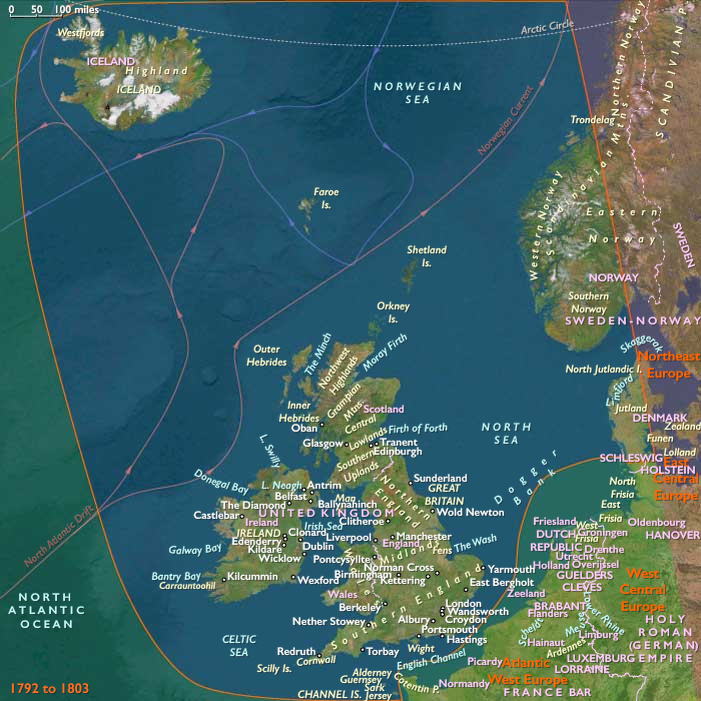
John Dalton, born into a Quaker family at Eaglesfield, near Cockermouth, Cumberland, England as the son of a weaver, had joined his older brother Jonathan at age fifteen in running a Quaker school in nearby Kendal.
Dalton seems to have considered taking up law or medicine around 1790, but his projects were not met with encouragement from his relatives—Dissenters were barred from attending or teaching at English universities—and he remained at Kendal until he moved n the spring of 1793 to Manchester.
Mainly through John Gough, a blind philosopher and polymath to whose informal instruction he owed much of his scientific knowledge, Dalton had won appointment as teacher of mathematics and natural philosophy at the "New College" in Manchester, a dissenting academy, remaining in that position until 1800, when the college's worsening financial situation led him to resign his post and begin a new career in Manchester as a private tutor for mathematics and natural philosophy.
Dalton's early life was highly influenced by a prominent Eaglesfield Quaker named Elihu Robinson, a competent meteorologist and instrument maker, who had gotten him interested in problems of mathematics and meteorology.
During his years in Kendal, Dalton had contributed solutions of problems and questions on various subjects to the Gentlemen's and Ladies' Diaries, and in 1787 he had begun to keep a meteorological diary in which, during the succeeding fifty-seven years, he will enter more than two hundred thousand observations.
He also rediscovered George Hadley's theory of atmospheric circulation (now known as the Hadley cell) around this time.
Dalton's first publication, Meteorological Observations and Essays (1793), contains the seeds of several of his later discoveries.
However, in spite of the originality of his treatment, little attention was paid to them by other scholars.
A second work by Dalton, Elements of English Grammar, is published in 1801.
Dalton in 1794, shortly after his arrival in Manchester, had been elected a member of the Manchester Literary and Philosophical Society, the "Lit & Phil", and a few weeks later, he had communicated his first paper on "Extraordinary facts relating to the vision of colours", in which he postulated that shortage in color perception was caused by discoloration of the liquid medium of the eyeball.
In fact, a shortage of color perception in some people had not even been formally described or officially noticed until Dalton wrote about his own.
Although Dalton's theory is to lose credence in his own lifetime, the thorough and methodical nature of his research into his own visual problem is so broadly recognized that Daltonism becomes a common term for color blindness.
Examination of his preserved eyeball in 1995 demonstrated that Dalton actually had a less common kind of color blindness, deuteroanopia, in which medium wavelength sensitive cones are missing (rather than functioning with a mutated form of their pigment, as in the most common type of color blindness, deuteroanomaly).
Besides the blue and purple of the spectrum he was able to recognize only one color, yellow.
He followed that paper on the subject with many others on diverse topics on rain and dew and the origin of springs, on heat, the color of the sky, steam, the auxiliary verbs and participles of the English language and the reflection and refraction of light.
Locations
People
Groups
Topics
Subjects
Regions
Subregions
Years: 1801 - 1801
Locations
People
Groups
Topics
Subjects
Regions
Subregions