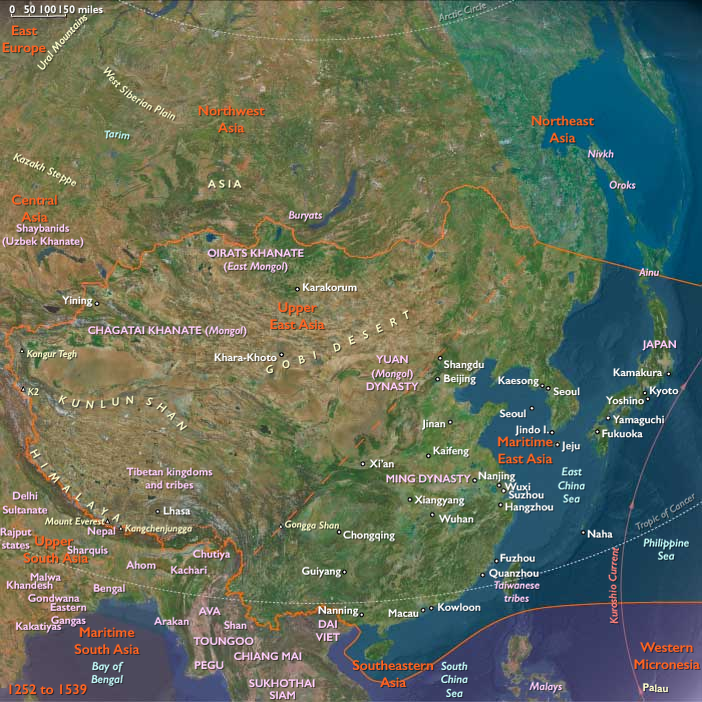
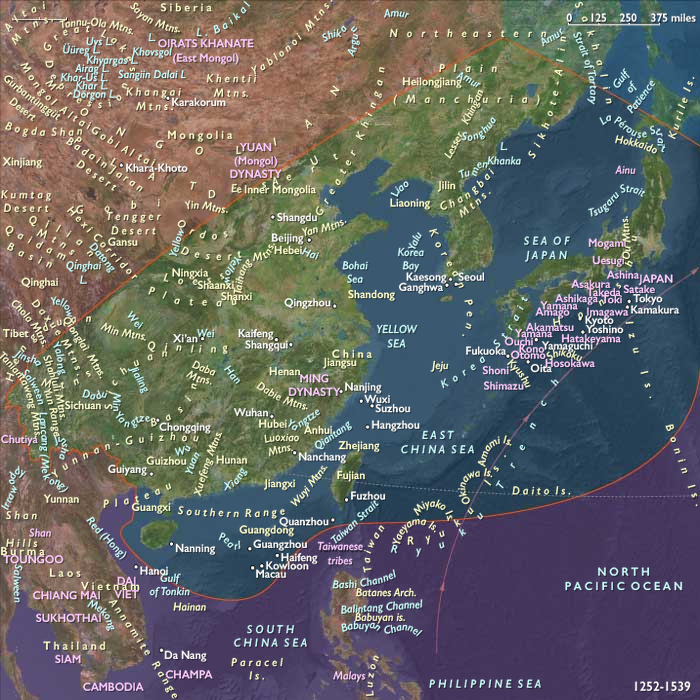
…Jindo Island in the southwest.
Years: 1270 - 1270
…Jindo Island in the southwest.
Locations
People
Groups
Topics
Commodoties
Subjects
Regions
Subregions
Related Events
Filter results
Showing 10 events out of 45755 total
A Song census of the Chinese city of Hangzhou in 1270 establishes that some 186,330 families reside within it, not including visitors and soldiers.
(Historian Jacques Gernet argues that this means a population of over one million inhabitants, making Hangzhou the most populous city in the world at this time.)
Goryeo, controlled by a military government led by the Choe family, has been intermittently invaded by the Mongols from 1231.
The government under the nominal king had fled in 1232, to Ganghwa Island, on which Mongol cavalry had been unable to land.
Because of its fragile government, Goryeo has faced frequent rebellions.
The 1258 rebellion had resulted in the establishment of Ssangseong and Dongnyeong Prefectures under Mongol rule.
Unlike these rebels, the Sambyeolcho (Three Elite Patrols) are an organ of the military government, organized by the Choe family to maintain security.
However, unlike the Choe private guards unit (which is meant to personally protect the family), the Sambyeolcho assume public functions performed by police and combat forces, effectively replacing the Six Divisions of the military.
Choe Ui, the fourth ruler of the Choe family, had been overthrown in 1258, by Kim Jun (also known as Kim Injun) using the Sambyeolcho.
Taking a pro-Mongol stance, Kim Jun had sent Crown Prince Wang Jeon to the Mongol Empire.
At the same time, King Gojong and the crown prince had approached the Mongols to take power from Kim Jun.
Kim Jun had been assassinated in 1268, however, by the Sambyeolcho under the order of Im Yeon.
The next year, Im Yeon's attempt to replace King Wonjong had been reversed by the crown prince (Chungnyeol) with help from the Mongol occupying force.
Im Yeon's successor Im Yumu is killed in 1270 by the pro-Mongol faction using the Sambyeolcho; this marks the end of the military regime.
By order of the Mongol Court, Wonjong moves the capital from Ganghwa Island to …

…Kaesong.
Regaining power from military officials with the support of the Mongols, the king decides to abolish the Sambyeolcho, who, resentful of the peace terms worked out with the Mongols, revolt, against the government.
Led by Bae Jungson, the Sambyeolcho, systematically blocking passage between Gangwha and the mainland, bring nearby islands and coastal regions under their domain.
Wang On, a royal kinsman, is proclaimed king of the maritime kingdom.
They abandon Ganghwa Island and flee to …
Lithuania has had three Grand Dukes—Treniota, Vaišvilkas, and Shvarn—from 1263 to 1269, following the assassination of Mindaugas, its only king.
The state has not disintegrated, however, and Traidenis, who had come to power in 1269, strengthens Lithuanian control in Black Ruthenia (the western part of contemporary Belarus on the upper reaches of the Neman River) and fights with the Livonian Order.
The circumstances surrounding Traidenis' advance to power are not clear.
While his ancestors are unknown, it is known that he came from Aukštaitija, as he was Duke of Kernavė.
From the outset, his relationships with Halych-Volhynia were tense as he replaced Shvarn, Duke of Halych-Volhynia and Lithuania.
The tension will eventually result in the 1274–1276 war.
The Lithuanians and Semigallians, led by Traidenis, raid Livonia in winter 1270, reaching as far as Saaremaa island by marching across the frozen sea.
They are confronted on their way back by the Livonian Order and its Danish allies from Tallinn on the Muhu Strait.
The Order is well-prepared for the battle: for a year it has been recruiting soldiers for an expedition into Semigalia.
The Lithuanians arrange their sleighs as a barricade and successfully stop the main cavalry force.
As horses become stuck in the improvised barricade, fifty-two knights, including the Grand Master Otto von Lutterberg, and some six hundred low-ranking soldiers are killed.
It is the fifth-largest defeat of the Livonian or Teutonic Orders in the thirteenth century.
Vice-Master Andreas von Westfalen, who acts as a Grand Master before proper elections can be held, decides to restore lost morale of the knights by winning a quick victory.
In summer 1270, he learns of another Lithuanian raid into Livonia and hurries his soldiers to seek out the enemy.
While the knights are resting, the Lithuanians attack their camp and kill von Westfalen and twenty more knights.
The New or Great Synagogue, situated in Josefov, Prague, completed in 1270 in the Gothic style, is one of Prague's first Gothic buildings.
Nine steps lead from the street into a vestibule, from which a door opens into a double-nave with six vaulted bays.
This double-nave system is most likely adapted from plans of monasteries and chapels by the synagogue's Christian architects.
The molding on the tympanum of the synagogue’s entryway has a design that incorporates twelve vines and twelve bunches of grapes, said to represent the twelve tribes of Israel.
Two large pillars aligned east to west in the middle of the room each support the interior corner of four bays.
The bays have two narrow Gothic windows on the sides, for a total of twelve, again representing the twelve tribes.
The vaulting on the six bays has five ribs instead of the typical four or six.
It has been suggested that this was an attempt to avoid associations with the Christian cross.
Many scholars dispute this theory, pointing to synagogues that have quadripartite ribs, and Christian buildings that have the unusual five rib design.
When newer synagogues are built in the sixteenth century, the building will become known as the Old-New Synagogue.
Today Europe's oldest active synagogue, with the Scolanova Synagogue in Italy, it is also the oldest surviving medieval synagogue of twin nave design.
The domains of Ottokar II of Bohemia now stretch from Silesia to the Adriatic, making him, at the death of his committed foe, Hungarian king Béla IV, the most powerful prince in the Empire.
Stephen V inherits the whole Kingdom of Hungary after his father's death on May 3, 1270, although the deceased senior king had entrusted his daughter, Anna, and his followers to King Ottokar II of Bohemia in his last will, and they had escaped to Prague before Stephen arrived to Esztergom.
Before his (second) coronation, Stephen grants the County of Esztergom to the Archbishop.
To secure foreign support, Stephen forms a double matrimonial alliance with the Angevins, chief partisans of the pope.
The first of these is the marriage, in 1270, of his twelve-year-old daughter Mary to the future King Charles II of Naples.
The second alliance is the marriage of Stephen's infant son, Ladislaus, to Charles II's sister Elisabeth.
Stephen has a meeting in August 1270 with his brother-in-law, Prince Boleslaw V of Poland, in Kraków where they conclude an alliance against the King of Bohemia.
Stephen also has a meeting with Ottokar on October 16 on an island of the Danube near Pozsony, where the two rulers conclude a two-year truce.