Jews in the Swedish province of Norway …
Years: 1851 - 1851
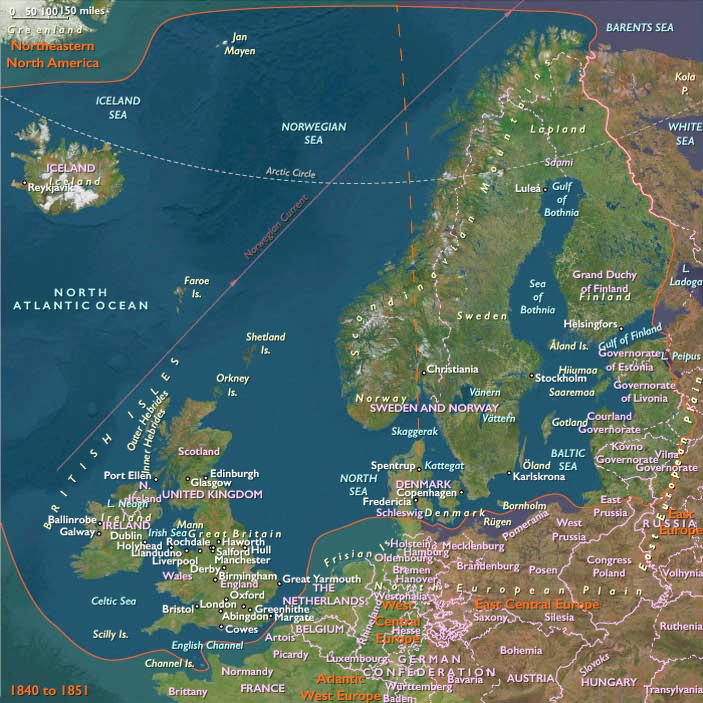
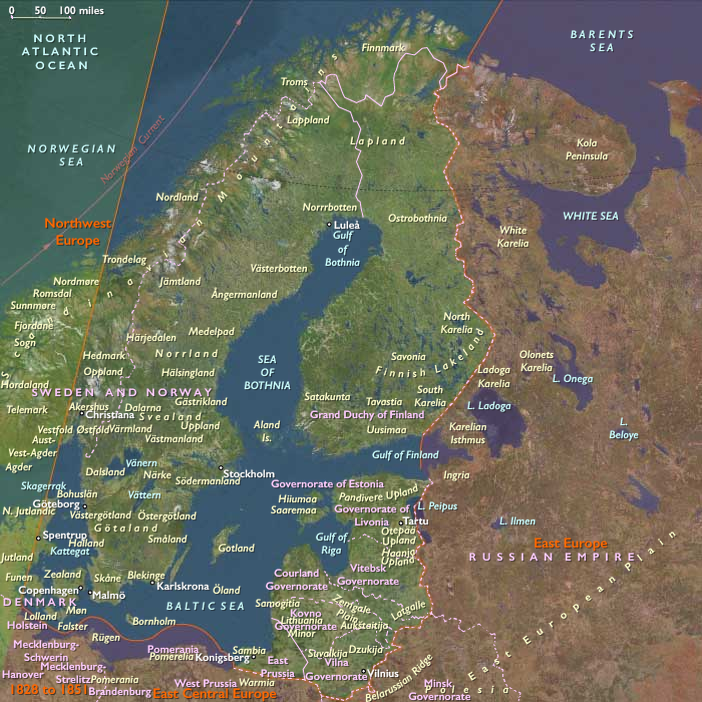
Jews in the Swedish province of Norway receive full emancipation in 1851.
Locations
Groups
Topics
Subjects
Regions
Subregions
Related Events
Filter results
Showing 10 events out of 16295 total
Ending the slave trade in Brazil has a number of consequences.
First, because labor needs increase in Rio de Janeiro and Sao Paulo as the world demand for coffee rises, Northeastern planters sell their surplus slaves to Southern growers.
In addition, Parliament passes laws encouraging European immigration, as well as the Land Law of 1850.
Second, ending the slave trade frees capital that can then be used for investment in transport and industrial enterprises.
Third, it ensures that Britain does not interfere in Brazil's military intervention to end the rule in Buenos Aires of Juan Manuel de Rosas (president of Argentina, 1829-33, 1835-52).
There is no civil service, no police, no militia, and virtually every British colonist is an employee of the HBC.
Frustrated, Blanshard had abandoned his post a year later, returning to England.
In 1851, his resignation is finalised, and the colonial office appoints James Douglas as governor.
Its founder, the Reverend Vincent John Stanton, is the first colonial chaplain of the Colony of Hong Kong, appointed in 1843.
In 1841, Stanton had raised funds in England to start an Anglo-Chinese school Hong Kong.
The original purpose of the establishment of The Church of England Anglo-Chinese School was to train 'a body of native clergy and Christian teachers for the propagation of the Gospel in China...[and] to aid in the diffusion of Christian principles among the Chinese'.
Thus, the school had opened for the purpose of teaching English to Chinese boys in 1849
St. Paul's College is officially founded in 1851, located at Glenealy in what is today the Central District.
Franz Liszt has largely invented the symphonic poem, or tone poem—a piece of orchestral music, in one movement, in which some extra-musical program provides a narrative or illustrative element—in a series of single-movement orchestral works composed in the 1840s and 1850s.
Hermann von Helmholtz, increasingly fascinated by the epistemological question of perception, had turned his attention to the physiology of the senses in 1850.
Embarking on explorations in physiological optics, Helmholtz revolutionizes the field of ophthalmology in 1851 with the invention of the ophthalmoscope; an instrument used to examine the inside of the human eye.
This makes him world famous overnight.
His main publication, entitled Handbuch der Physiologischen Optik (Handbook of Physiological Optics), provides empirical theories on spatial vision, color vision, and motion perception, and is to become the fundamental reference work in his field during the second half of the nineteenth century.
His theory of accommodation will go unchallenged until the final decade of the twentieth century.
Vienna rules Vojvodina harshly after 1850 and silences Serbian irredentists there.
Russia withdraws in 1851 from Wallachia and ...
...Moldavia.
David Livingstone had been obliged to leave his first mission at Mabotsa in Botswana in 1845 after irreconcilable differences emerged between him and his fellow missionary, Roger Edwards, and because the Bakgatla were proving indifferent to the Gospel.
He had abandoned Chonuane, his next mission, in 1847 because of drought and the proximity of the Boers and his desire "to move on to the regions beyond".
At Kolobeng Mission Livingstone converts Chief Sechele in 1849 after two years of patient persuasion, but only a few months later Sechele lapses.
In 1851, when Livingstone finally leaves Kolobeng, he does not use this failure to explain his departure, although it plays an important part in his decision.
Just as important had been the three journeys far to the north of Kolobeng which he had undertaken between 1849 and 1851 and which had left him convinced that the best long-term chance for successful evangelizing is to open up Africa to European plunderers and missionaries by mapping and navigating its rivers which might then become "Highways" into the interior.
Therefore, Livingstone will travel the African interior to the north between 1852 and 1856, mapping almost the entire course of the Zambezi, and will be the first European to see the Mosi-o-Tunya ("the smoke that thunders") waterfall, which he will call Victoria Falls after his monarch Queen Victoria.