
Jews expelled from Palestine by the Romans …
Years: 135 - 135
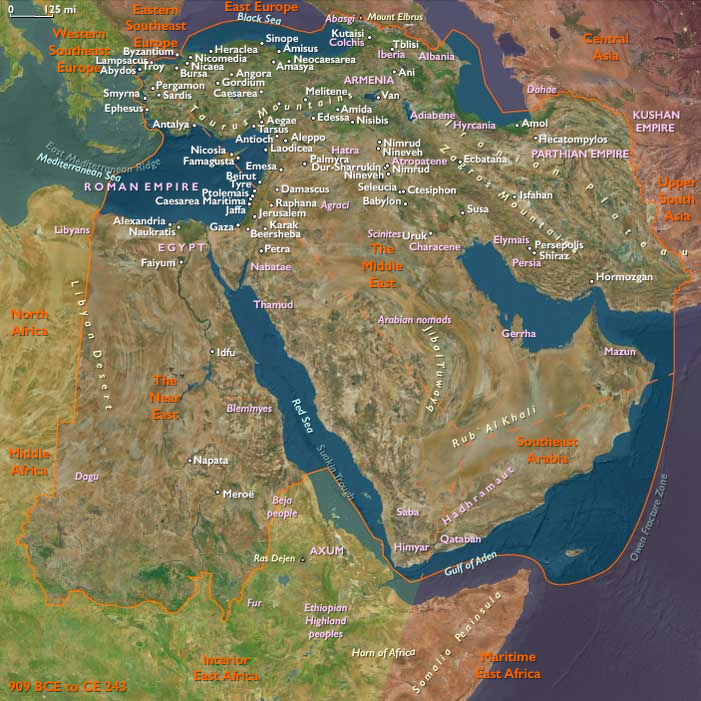
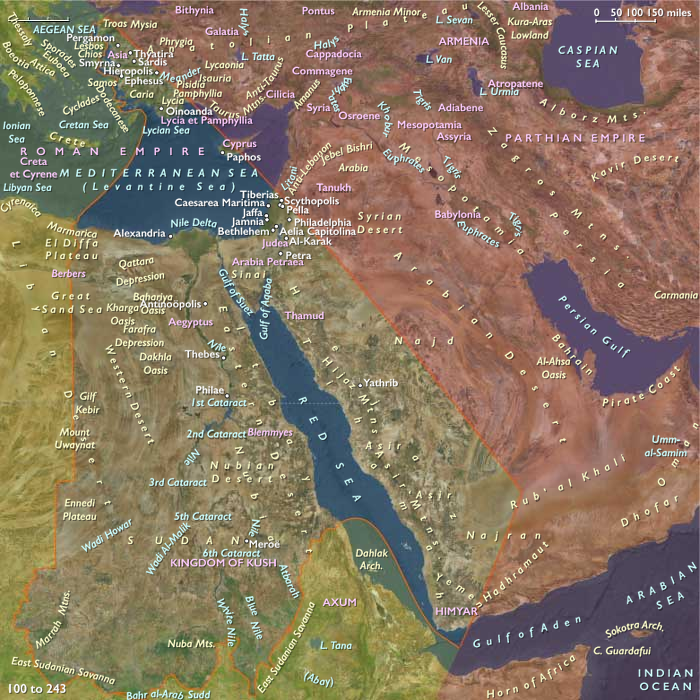
Jews expelled from Palestine by the Romans in 135 settle Yathrib (the future Medina, or in Arabic, Al-Madinah) on the western edge of a large lava field along the eastern slope of the Hejaz mountain range, about three hundred miles (four hundred and eighty-five kilometers) north of present Mecca and one hundred and twenty miles (one hundred and ninety-three kilometers kilometers) northeast of the Red Sea.
Yathrib is supposedly the final resting place of Aaron, brother of Moses and High Priest of the Hebrews.
Locations
Groups
- Arab people
- Jews
- Syria (Roman Province)
- Judea (Roman province)
- Roman Empire (Rome): Nerva-Antonine dynasty
- Syria Palæstina, Roman province of (Judea, Samaria, and Idumea)
Topics
Commodoties
Subjects
Regions
Subregions
Related Events
Filter results
Showing 10 events out of 61136 total
Two major political changes occur in 135—eunuch-marquesses begin to be allowed to pass their marches to their adopted sons, and Liang Shang becomes the commander of the armed forces and effectively the most powerful individual in the imperial government.
Neither of these developments appear at the time to be major, but are to have great implications; the former demonstrates that the power of the eunuchs is becoming systemic, and the latter leads to the start of Liang control of the imperial government for several successive administrations.
Arrian, born of Greek ethnicity in the coastal town of Nicomedia (present-day Izmit), the capital of the Roman province of Bithynia, in what is now northwestern Turkey, about seventy kilometers from Byzantium (later Constantinople, now Istanbul), had studied philosophy in Nicopolis in Epirus, under the Stoic philosopher Epictetus, and had written two books about the philosopher's teachings.
At the same time he had entered the Imperial service, and served as a junior adviser on the consilium of Gaius Avidius Nigrinus, governor of Achaea and a close friend of the future Emperor Hadrian, around 111-114.
Very little is known about his subsequent career—though it is probable that he served in Gaul and on the Danube frontier, and possible that he was in Baetica and Parthia—until he held the office of Consul in 129 or 130.
In 131, he had been appointed governor of the Black Sea province of Cappadocia and commander of the Roman legions on the frontier with Armenia.
It is unusual at this time for a Greek to hold such high military command.
As the Empire's north-easternmost province, Cappadocia, which also incorporates the regions of Pontus and Armenia Minor, hosts a permanent military garrison of two legions and several Auxiliary troops.
In 135, Cappadocia is threatened by an Alan invasion.
Arrian will later write a military treatise called Ektaxis kata Alanōn, which details the battle against the Alans, and the Technē Taktikē, in which he describes how he would organize the legions and auxiliary troops at his disposal, among which are legions XII Fulminata and XV Apollinaris.
He would deploy the legionaries in depth supported by javelin throwers, archers, and horse archers in the rear ranks to defeat the assault of the Alan cavalry using these combined arms tactics.
However, Arrian's work may have been entirely hypothetical, because there is no historical record of a battle between Romans and Alans in 135.
He also writes a short account of a tour of inspection of the Black Sea coast in the traditional 'periplus' form (in Greek) addressed to the Emperor Hadrian, the Periplus Ponti Euxini or "Circumnavigation of the Black Sea".
The methodical and ruthless tactics of Severus gradually wear down and constrict the rebels' area of operation, until in 135 Bar Kokhba is himself killed at Bethar, a fortress on the seacoast south of Caesarea.
The Romans suppress the revolt with great brutality, killing more than half a million people (according to some accounts) and destroying fifty fortresses and nine hundred and eighty-five Palestinian cities and villages. (The Romans According to tradition tortured and killed the ten greatest leaders and sages of Palestinian Jewry, including Rabbi Akiva, with Caesarea being the place of execution of Rabbi Akiva and the others. The death of these Ten Martyrs is still commemorated in the liturgy for Yom Kippur, "the Day of Atonement".)
Hadrian, erasing the name of Judea, combines Iudaea Province with neighboring provinces to create Syria Palaestina, which includes Judah and forms the southern third of the Roman province of Syria; Caesarea becomes the capital of the province.
The name Philistia is used to designate Syria-Palaestina.
The Jews are virtually exterminated in Judaea proper, but survive in Galilee, which, ...
…like Samaria, apparently has held aloof from the revolt.
Hadrian romanizes the city of Jerusalem, renaming it Aelia Capitolina (after his first name, Aelius), and bans the Jews from entering it on pain of death, except for one day each year.
These anti-Jewish measures, which affect also Jewish Christians, is taken to ensure 'the complete and permanent secularization of Jerusalem.' (E. Mary Smallwood, The Jews under Roman rule: from Pompey to Diocletian: a study in political relations; BRILL, 1981 p.460.)
According to Eusebius, the Jerusalem church was scattered twice, in CE 70 and CE 135, with the difference that from 70-130 the bishops of Jerusalem have evidently Jewish names, whereas after 135 the bishops of Aelia Capitolina appear to be Greeks.
Hadrian places the city's main Forum, as is standard for new Roman cities, at the junction of the main cardo and decumanus, now the location for the (smaller) Muristan.
Adjacent to the Forum, at the junction of the same cardo, and the other decumanus, Hadrian builds a large temple to the goddess Venus, which will later become the Church of the Holy Sepulcher.
Several boundary walls of Hadrian's temple, despite eleventh-century destruction, which will result in the modern Church having a much smaller footprint, have been found among the archaeological remains beneath the Church.
The city is without walls, protected by a light garrison of the Tenth Legion.
The detachment at Jerusalem, which apparently encamps all over the city’s western hill, is responsible for preventing Jews from returning to the city.
The enforcement of the ban on Jews entering Aelia Capitolina will continue until the fourth century CE.
Ptolemy of Alexandria, a Greek astronomer and geographer about whose life little is known, makes astronomical observations from Alexandria (where he probably spends most of his life) beginning in about 127.
Ptolemy in about 135 records the brightness and positions of one thousand and twenty-two stars in a magnificent astronomical synthesis, the Almagest ("The Greatest Compilation"—probably the earliest of his works).
Compiling the astronomical knowledge of the past with his own research, he presents in detail his mathematical theory of the motions of the Sun, Moon, and planets.
In each of the book’s thirteen chapters, Ptolemy explains a specific aspect of his geocentric world system.
Accepting the solar theory of his predecessor Hipparchus, Ptolemy improves on the lunar theory by accounting for the Moon’s chief irregularity, called the equation of the center, which allows for the prediction of eclipses.
He also discovers and corrects another irregularity, evection, at other points of the Moon's orbit by employing an epicycle on a movable eccentric deferent, whose center revolves around the Earth.
Developing a further refinement known as prosneusis, Ptolemy is able to predict the place of the Moon within 10 1/6 feet, or 1/6 degrees, of arc in the sky.
In his most original contribution, Ptolemy presents details for the motions of each of the planets.
Because the apparent motions of the planets in the sky are clearly not circular, Ptolemy bases his complicated explanatory geometric model on circular motions of planets around points going in larger circles within the framework of the basic Earth-centered system supplied by Aristotle.
Ptolemy’s epicycle system (though eventually—fourteen centuries later—proved wrong) predicts, with relatively good accuracy, the apparent positions of the planets over several years.
Ptolemy also introduces a kind of trigonometry in terms of a table of chords that was equivalent to a sine table.
The Almagest, which contains formulas for the sines and cosines of the sums and differences of angles, also provides the rudiments of spherical trigonometry.
In the chapters on planetary motion, Ptolemy introduces the concept of uniform planetary motion around a point eccentric to the Earth, known as the equant point.
Zhang Ling, a faith healer, traces his ancestral home to Feng County, Jiangsu, and is said to be a descendant of Zhang Liang, a strategist and statesman of the early Han Dynasty.
Born during the reign of Emperor Guangwu of Han, he had begun reading the Tao Te Ching at a young age and studied in the Taixue (Imperial Academy), and had then served as a magistrate in Jiangzhou, Ba prefecture (present-day Chongqing) during the reign of Emperor Ming of Han.
He later retired to lead a reclusive life at Mount Beimang, where he practices ways of achieving longevity.
When invited to serve as a boshi (equivalent of a present-day professor) in the Imperial Academy, he claimed that he was ill. Emperor He of Han had thrice summoned him to serve as the Taifu (Imperial Tutor) but he refused each time.
According to tradition, in 142, Laozi appeared to Zhang on Mount Heming, and informed the hermit that the world was coming to an end, to be followed by an era of Great Peace.
Laozi explained that those following him would go on to another life, part of the "Orthodox One Covenant with the Powers".
Through this covenant, Zhang and his followers would have access to the assistance of celestial powers who control the fate of mankind.
Zhang goes on to found the first regular Taoist community.
A major change instituted by the new Covenant is the rejection of food and animal sacrifices.
Also, the teachings of Laozi as transmitted by Zhang include the first true Taoist religious pantheon as distinguished from the prior ancient religion of China.
Zhang also writes a 24-volume Taoist classic, said to be the Xiang'er, a commentary to the Tao Te Ching.
Zhang’s patients give him five pecks of rice annually in exchange for either cures or membership, causing the cult to become known as the Way of Five Pecks of Rice.
East Central Europe (136–147 CE): Stability under Antoninus Pius and Deepening Cross-Cultural Ties
Between 136 and 147 CE, East Central Europe—encompassing Poland, Czechia, Slovakia, Hungary, and those portions of Germany and Austria lying east of 10°E and north of a line stretching from roughly 48.2°N at 10°E southeastward to the Austro-Slovenian border near 46.7°N, 15.4°E—continued to experience sustained stability and prosperity under stable Roman governance. Following the secure frontier policies of Emperor Hadrian (r. 117–138 CE), his successor, Emperor Antoninus Pius (r. 138–161 CE), maintained a peaceful and prosperous Roman presence along the Danube. This period was characterized by strengthened economic relations, stable diplomatic interactions with Germanic tribes, and the further consolidation of political structures within regional tribal confederations.
Political and Military Developments
Antoninus Pius and Frontier Stability
-
Emperor Antoninus Pius upheld and reinforced the frontier security system established by his predecessor, maintaining effective defenses in the provinces of Pannonia Superior, Pannonia Inferior, and Noricum.
-
The Roman frontier along the Danube remained secure, supported by a strong military presence, fortified installations, and well-managed administrative networks.
Diplomatic Relations with Germanic Tribes
-
Roman diplomatic policies promoted stability and peaceful coexistence with the principal Germanic confederations, especially the Marcomanni and Quadi, based primarily in modern Czechia and Slovakia, and neighboring regions.
-
The Langobardi (Lombards), residing north and northeast of the Roman provinces, maintained stable territorial control and actively engaged in peaceful trade and diplomatic relations with Roman frontier authorities.
Economic and Technological Developments
Prosperous Cross-Border Trade
-
Economic relationships flourished, supported by well-established trade routes linking Roman frontier towns (Carnuntum, Vindobona, Aquincum) with neighboring Germanic settlements. Goods including Roman manufactured ceramics, textiles, glassware, and metal goods were exchanged extensively for regional products like amber, grain, livestock, and iron artifacts.
-
The widespread circulation of Roman coins promoted greater economic integration and standardization across frontier markets.
Agricultural Improvements and Technological Exchange
-
Agricultural productivity benefited significantly from continued adoption and adaptation of Roman farming techniques, enhancing local prosperity and economic resilience.
-
Technological exchanges, especially in metallurgy, pottery, and tool-making, contributed to improvements in local craftsmanship and economic specialization among Germanic groups.
Cultural and Artistic Developments
Ongoing Cultural Integration
-
Deepened cultural interactions produced a diverse material culture reflecting combined Roman and Germanic traditions. The period's pottery, jewelry, and metalwork reveal blended artistic influences, signifying an increasingly integrated frontier cultural identity.
Artistic Excellence and Craftsmanship
-
Local artisans, benefiting from sustained economic prosperity, produced sophisticated jewelry, weaponry, and domestic artifacts, creatively integrating Roman artistic styles with traditional Germanic motifs.
Settlement and Urban Development
Expansion of Roman Frontier Towns
-
Roman frontier settlements such as Carnuntum, Vindobona, and Aquincum continued to thrive as vibrant administrative, economic, and cultural centers, attracting traders, artisans, and military personnel.
Stability of Germanic Villages
-
Germanic settlements north of the frontier expanded modestly, remaining stable and prosperous. Communities continued to grow around agricultural villages and localized production sites, enjoying increased wealth from sustained trade relations.
Social and Religious Developments
Tribal Leadership and Stability
-
Germanic tribes maintained hierarchical social structures led by powerful warrior elites and chieftains whose authority was reinforced through trade alliances and diplomatic relations with Roman authorities.
Continued Religious Practices and Syncretism
-
Religious practices among Germanic groups continued to emphasize traditional nature worship, ancestor veneration, and communal rituals. Increasing Roman cultural influence introduced new religious concepts, fostering gradual religious syncretism.
Long-Term Consequences and Historical Significance
The era from 136 to 147 CE, defined by Emperor Antoninus Pius's policies, brought continued stability, prosperity, and cultural exchange to East Central Europe. The secure Danube frontier facilitated thriving trade and productive diplomatic relations, significantly strengthening economic, political, and cultural ties between Roman provinces and Germanic communities. These conditions contributed to the ongoing development of regional identities, enhanced technological skills, and laid critical foundations for the enduring integration and future stability of East Central Europe's historical trajectory.
The Middle East: 136–147 CE
Post-Revolt Reconstruction and Stability under Antoninus Pius
Following the devastating suppression of the Bar Kokhba Revolt (132–135 CE), the period from 136 to 147 CE sees the Roman Empire under Emperor Antoninus Pius (r. 138–161 CE) embark on a period of cautious consolidation and reconstruction in the Middle East.
Antoninus Pius adopts a notably conciliatory and pragmatic approach, seeking stability rather than military expansion. In Judea, now renamed Syria Palaestina to erase Jewish national identity, the emperor promotes rebuilding efforts, although severe restrictions on Jewish religious practices and settlement remain. This period witnesses the reconstruction of urban centers, including the further establishment of Aelia Capitolina (formerly Jerusalem), which increasingly reflects Roman architectural styles and governance structures, gradually integrating the province more thoroughly into the Roman cultural sphere.
During these years, the Roman–Parthian frontier remains relatively calm, largely due to mutual interest in stabilizing trade routes and preventing costly conflicts. Antoninus focuses on diplomatic engagement rather than military confrontation, maintaining peace with Parthia through careful diplomacy. This approach enables trade along the Silk Road and regional commerce in cities such as Palmyra and Antioch to flourish, enriching the eastern provinces economically and culturally.
In the broader region, this era is characterized by urban renewal and growth in commercial prosperity. Cities like Antioch become vibrant cosmopolitan hubs, blending Greek, Roman, Syrian, and Persian cultural influences. Meanwhile, Christianity continues to spread steadily despite periodic localized persecution, increasingly shaping the cultural and social fabric of communities across the Middle East.
Thus, the period from 136 to 147 CE marks a phase of relative stability, careful governance, and economic recovery following significant turmoil, laying important foundations for continued Roman presence and cultural development in the Middle East.
Years: 135 - 135
Locations
Groups
- Arab people
- Jews
- Syria (Roman Province)
- Judea (Roman province)
- Roman Empire (Rome): Nerva-Antonine dynasty
- Syria Palæstina, Roman province of (Judea, Samaria, and Idumea)
