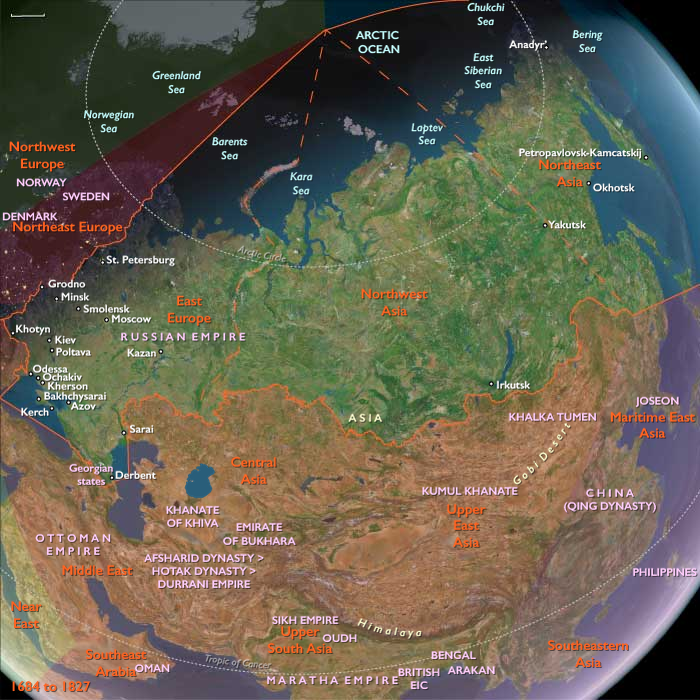
Jews have become the majority population of …
Years: 1700 - 1700
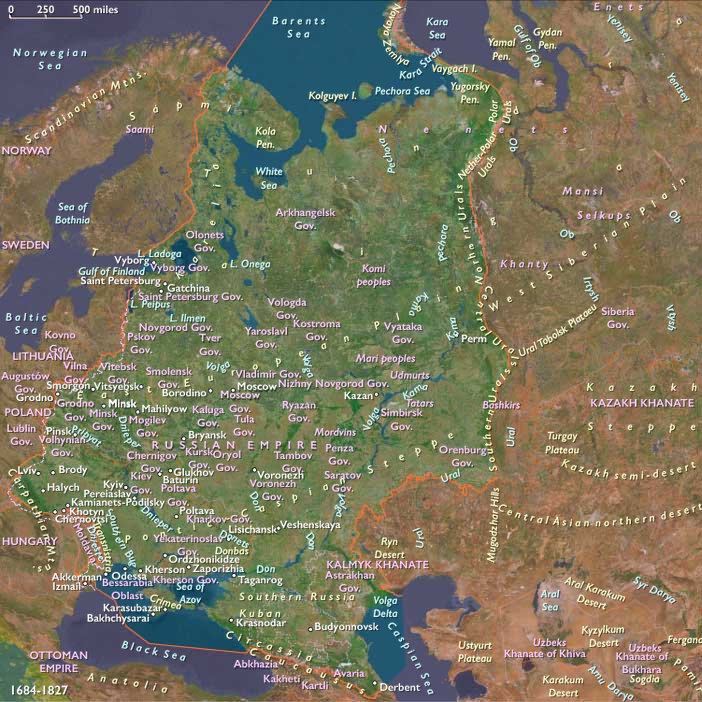
Jews have become the majority population of Pinsk by the beginning of the eighteenth century in Poland.
Locations
Groups
Topics
Regions
Subregions
Related Events
Filter results
Showing 10 events out of 28916 total
The Cascadia earthquake, which strikes at approximately 9 PM on January 26, 1700, is one of the largest earthquakes known, rupturing the Cascadia subduction zone offshore from Vancouver Island spreading along more than six hundred miles (nine hundred and sixty-six kilometers) of North America's West Coast to Cape Mendocino in northern California.
The magnitude of the earthquake is estimated as between 8.7 and 9.2.
Houses in First Nations communities on Vancouver Island collapse and an entire village on its west coast is destroyed with no survivors.
The earthquake triggers an Orphan Tsunami, which hits Japan approximately ten hours later and is recorded as flooding fields and washing away houses.
Peter abandons his Turkish cause to join Poland against Sweden at the start of the Second or Great Northern War while the Habsburgs make a separate peace to end the Austro-Turkish War of 1683-99.
In a truce with the Ottomans signed in 1700 at Suceava, ...
...Peter reluctantly gives up Russia’s Black Sea fleet but retains Azov.
Tsar Peter establishes suzerainty over the Cossacks of the Dnieper, and, ...
The great difficulties that stand in the way of prospective Jewish settlers in Lübeck suggests the evasion of the prohibition by a settlement in the neighboring territory of Denmark.
A number of Jews, mostly Polish fugitives, settle in the village of Moisling as early as 1700, and, in spite of constant protests by the guild, the council has to grant them, as Danish subjects, the right to enter the city, although under great restrictions.
Prince-elector Frederick III of Brandenburg founds the Prussian Academy of Sciences under the name of Kurfürstlich Brandenburgische Societät der Wissenschaften ("Electoral Brandenburg Society of Sciences") upon the advice of Gottfried Leibniz, who is appointed president.
Unlike other academies, the Prussian Academy is not directly funded out of the state treasury.
Frederick grants it the monopoly on producing and selling calendars in Brandenburg, a suggestion by Leibniz.
When, in 1701, Frederick is crowned "King in Prussia", creating the Kingdom of Prussia, the academy will be renamed Königlich Preußische Sozietät der Wissenschaften ("Royal Prussian Society of Sciences").
The matter of Habsburg or Bourbon control of the Spanish crown had been further confused following the death of Joseph Ferdinand of smallpox in 1699 at the age of six, reopening the issue of the Spanish succession.
England and France soon ratify the Second Partition Treaty, assigning the Spanish throne to the Archduke Charles.
The Italian territories will go to France, while the Archduke will receive the remainder of the Spanish empire.
The Austrians, who are not party to the treaty, are displeased, for in the first case they have openly vied for the whole of Spain and its possessions, and in the second it is the Italian territories that interest them most, being richer, closer to Austria, and more governable.
Distaste for the treaty is even greater in Spain; the courtiers are unified in opposing partition, but are divided on whether the throne should go to a Habsburg or a Bourbon.
Pro-French statesmen, however, are in the majority, and Charles II agrees in October 1700 to bequeath all of his territory to the Dauphin's second son, the Duke of Anjou.
Charles takes steps to prevent the potential union of France and Spain; should Anjou by chance inherit the French throne, Spain is to go to his younger brother, the Duc de Berri, and thereafter Archduke Charles will be next in the line of succession.

The name Whydah is an anglicized form of Xwéda (pronounced o-wi-dah), from the Yoruba language of Benin. (Today the port city of Ouidah, in the far west of the former Popo Kingdom where most of the European slave traders lived and worked, bears the kingdom's name.)
According to one European visitor between 1692 and 1700, Whydah exports some thousand slaves a month, mainly from the interior of Africa.
For this reason, it has been considered a "principal market" for human beings.
When the king cannot supply the European traders with sufficient slaves, he supplements them with his own wives.
Robbery is common.
Everyone in Whydah pays a toll to the king, but corruption among collectors is endemic.
Despite this, the king is wealthy, and clothed in gold and silver—goods of which little is known in Whydah.
He commands great respect, and, unusually, is never seen to eat.
The color red is reserved for the royal family.
The king is considered immortal, despite successive kings dying of natural causes.
Interregna, even of only a few days, are met by plundering and anarchy.
Wives are isolated and protected by their husbands; fathers with more than two hundred children had been recorded.
Three public objects are the subject of devotion: some lofty trees, the sea, and a type of snake.
This snake is the subject of many stories and incidents; worshiped perhaps because it eats the rats who would otherwise ruin the harvest.
Priests and priestesses are held in high regard, and immune from capital punishment.
The king can field upward from twenty thousand, although contemporary interpretation is generally that these armies were of "overwhelming size".
Battles are normally won by strength of numbers alone, with the weaker side fleeing.
The Jewish population of Livorno has expanded rapidly over the past decade, numbering five thousand at the end of the seventeenth century.
Refined sugar is France’s most important export by 1700.