
Jesus reportedly promises the availability to the …
Years: 29 - 29
Jesus reportedly promises the availability to the "poor"—those who know and acknowledge their need—of a share in God's kingdom, and that those who pride themselves in their possessions and attainments will be punished on the Day of Judgment.
Jewish law forbids the eating of certain foods, but Jesus (according to the Gospels) teaches that people are defiled by their words and deeds rather than by what they eat.
Performing forbidden activities on the Sabbath when it is necessary to serve human needs, Jesus does not hesitate to eat and drink with those regarded as sinners, not only accepting invitations to eat with the ritually impure, but inviting himself to their meals.
This is a radical stance during a time when observance of purity laws at the meals eaten by family and friends is the most important means of establishing Jewish identity.
Two of the dominant themes in Jesus’ ethical teachings (summarized by Matthew in his account of the Sermon on the Mount) are the command to love one's neighbor—including one’s enemies—and the assurance that God's purpose is achieved through the suffering of the righteous.
In a departure from the commonplace notion that suffering is a sign of divine disfavor, Jesus explains to his followers that being a servant of God inevitably involves suffering.
This is another objectionable concept to those of traditional piety, and also to those who are convinced that God's people must direct action militarily and in resistance movements if Roman power is to be overthrown and an independent Jewish national state reestablished.
Jesus refuses to permit his followers to take up arms, instead counseling his questioners to pay taxes to the Roman state.
Since Judah's semi-legendary King David is taken as a symbol of fulfillment in the future, the New Testament writers will emphasize that Jesus is of the lineage of David, the founding royal house of Judah.
Jesus shatters his follower’s expectations of a conquering Messiah, however, by repeatedly insisting that he will be, in fulfillment of his messianic role, rejected by the authorities, suffer, and die.
This is a nearly impossible concept for his disciples to grasp, even though some of them—Peter, James and John—share in a visionary experience on a mountain—called the Transfiguration—intended to assure them that beyond his coming sacrificial death is a day of triumphant vindication.
He is to be raised up from the dead and exalted as the chosen instrument of God.
Locations
People
Groups
- Jews
- Galilee, Roman province of
- Judea (Roman province)
- Roman Empire (Rome): Julio-Claudian dynasty
- Christians, Jewish
Topics
Commodoties
Subjects
Regions

Subregions
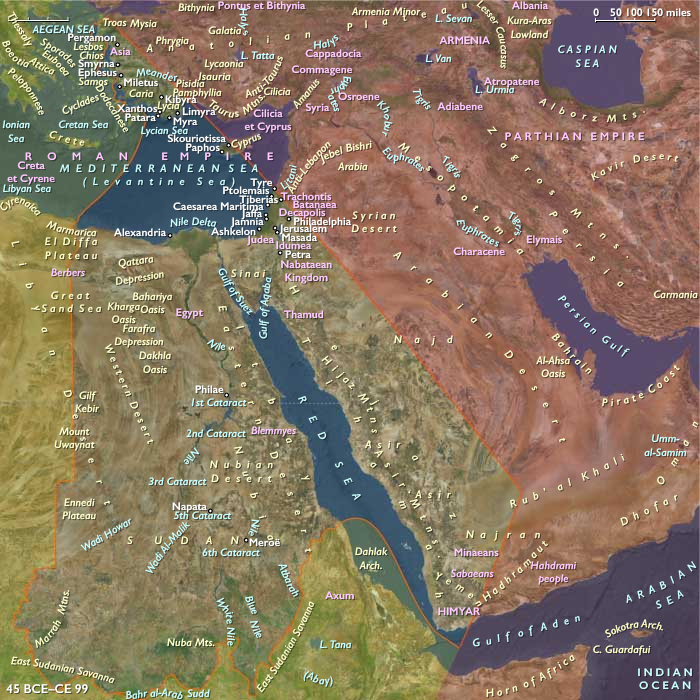
Years: 29 - 29
Locations
People
Groups
- Jews
- Galilee, Roman province of
- Judea (Roman province)
- Roman Empire (Rome): Julio-Claudian dynasty
- Christians, Jewish
Topics
Commodoties
Subjects
Regions
Subregions