
Jerusalem's Christian golden age is brought to …
Years: 614 - 614
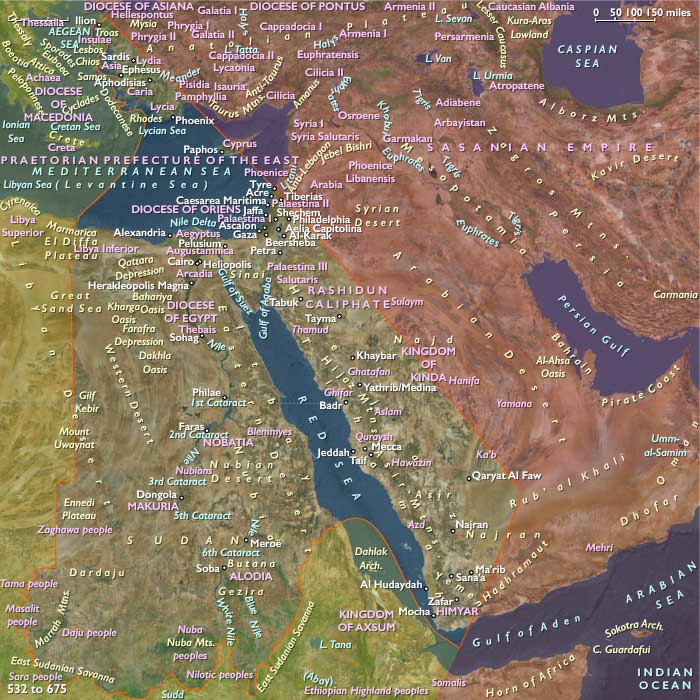
Jerusalem's Christian golden age is brought to an end in 614 by the Persian invasion by Khosrow II's ablest general, Shahrbaraz, after a twenty-day siege, in which the inhabitants of Jerusalem are massacred and the churches razed.
The Holy Sepulchre is destroyed and the True Cross carried to Ctesiphon.
Khosrow himself is generally tolerant of Christianity (and is famously in love with his Armenian Christian wife Shirin), but Shahrbar'z permits his Jewish aides to torture thousands of Christian prisoners and deport some thirty-seven thousand.
The Persians permit the Jews to run the city government.
There are at this time approximately one hundred and fifty thousand Jews living in forty-three settlements throughout Palestine, primarily in Judaea and Galilee.
Locations
People
Groups
- Persian people
- Zoroastrians
- Jews
- Persian Empire, Sassanid, or Sasanid
- Palaestina Prima (Roman province)
- Palaestina Salutaris (Roman province)
- Palaestina Secunda (Roman province)
- Christianity, Chalcedonian
- Greeks, Medieval (Byzantines)
- Roman Empire, Eastern: Heraclian dynasty
Topics
Commodoties
Subjects
Regions
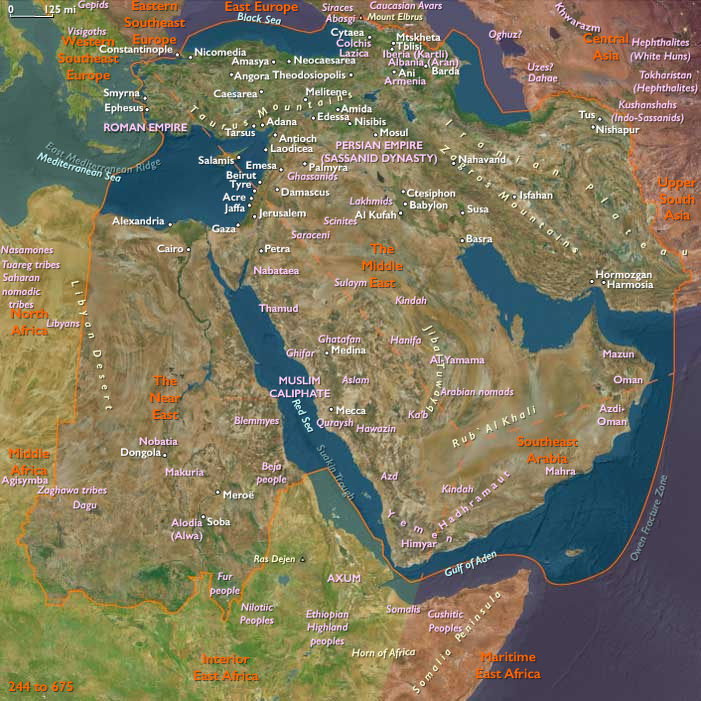
Subregions
Related Events
Filter results
Showing 10 events out of 119 total
Sweyn Estridsen's son, Canute IV, raids England for the last time in 1085.
He plans another invasion to take the throne of England from an aging William I.
He calls up a fleet of one thousand Danish ships, sixty Norwegian long boats, with plans to meet with another six hundred ships under Count Robert of Flanders in the summer of 1086.
Canute, however, is beginning to realize that the imposition of the tithe on Danish peasants and nobles to fund the expansion of monasteries and churches and a new head tax (Danish: nefgjald) has brought his people to the verge of rebellion.
Canute takes weeks to arrive at Struer where the fleet has assembled, but he finds only the Norwegians still there.
Canute's nephew Sweyn Estridson (1020–74) re-establishes strong royal Danish authority and builds a good relationship with Archbishop Adalbert of Hamburg-Bremen—at this time the Archbishop of all of Scandinavia.
Atlantic West Europe (1084–1095): Capetian Challenges, Norman Expansion, and Monastic Renewal
The era 1084–1095 in Atlantic West Europe—including the Low Countries, Normandy, Brittany, Aquitaine, the Duchy of Burgundy, the County of Burgundy (Franche-Comté), Alsace, and central France—was characterized by ongoing Capetian struggles to assert royal authority, the continued strengthening and expansion of Norman power, persistent regional autonomy, economic dynamism, and significant religious developments culminating in the First Crusade.
Political and Military Developments
-
France: Capetian Authority Challenged
- King Philip I (r. 1060–1108) faced continuous difficulty in asserting control over powerful feudal vassals, notably in Normandy, Aquitaine, and Flanders.
- Philip’s controversial marital arrangements (his repudiation of Bertha of Holland in favor of Bertrade de Montfort in 1092) provoked papal censure, complicating royal legitimacy.
-
Normandy and England: Norman Supremacy and William’s Succession
- William the Conqueror died in 1087, dividing his domains between his sons: Robert Curthose inherited Normandy, while William II Rufus received England.
- This division resulted in tension and conflict between the brothers, weakening overall Norman cohesion.
-
Flanders: Continued Stability and Influence
- Robert I the Frisian (r. 1071–1093) maintained a stable rule, successfully managing Flemish commerce and fortifying the region's prominence in European trade networks.
- His successor, Robert II (r. 1093–1111), continued this stability, promoting further economic and cultural growth.
-
Aquitaine: Ducal Stability
- William IX of Aquitaine (r. 1086–1127) maintained Aquitaine’s independence, promoting economic prosperity and cultural patronage, laying foundations for the later flowering of troubadour culture.
-
Brittany: Autonomy Amid External Pressures
- Breton autonomy continued under Alan IV (r. 1084–1112), who skillfully navigated between Norman and Capetian pressures, sustaining internal stability and regional identity.
-
Duchy of Burgundy: Ducal Consolidation
- Eudes I (r. 1079–1103) maintained Burgundian stability, navigating complex feudal relationships while reinforcing autonomy from direct Capetian interference.
-
County of Burgundy (Franche-Comté) and Alsace
- Franche-Comté under William I the Great (r. 1057–1087) and his successor, Reginald II (r. 1087–1097), maintained strong ties with the Holy Roman Empire, diverging politically and culturally from the French duchy.
- Alsace remained economically prosperous, bridging trade and culture between France and the Empire.
Economic and Social Developments
-
Urban Growth and Commercial Prosperity
- Cities in Flanders (Bruges, Ypres, Ghent) flourished as key textile production centers, enriching regional trade networks and urbanization.
- Normandy and Aquitaine benefited from increased stability and trade, contributing to urban and rural economic prosperity.
-
Feudal Consolidation and Territorial Dynamics
- Feudal structures became increasingly entrenched, particularly in Normandy and England, reshaping regional governance and landholding patterns.
Religious and Cultural Developments
-
First Crusade and Ecclesiastical Renewal
- Pope Urban II preached the First Crusade at the Council of Clermont (1095), dramatically impacting Atlantic West Europe by galvanizing widespread noble and popular participation.
- Monastic reforms, particularly through the Cluniac and emerging Cistercian movements, profoundly influenced ecclesiastical organization and spiritual life.
-
Cultural Growth and Patronage
- William IX of Aquitaine emerged as an influential cultural patron, eventually becoming one of the earliest troubadour poets, laying the groundwork for subsequent cultural developments.
Legacy and Long-term Significance
The era 1084–1095 marked critical shifts in Atlantic West Europe:
- The division of William the Conqueror’s empire weakened Norman unity but set the stage for future Anglo-Norman dynamics.
- Capetian royal power faced internal and external pressures, highlighting enduring weaknesses in central authority.
- Economic prosperity and urban growth continued, particularly in the Low Countries, laying critical foundations for later commercial dominance.
- Religious fervor spurred by the First Crusade reshaped regional identities, ecclesiastical structures, and social dynamics.
These developments significantly influenced the political, cultural, and economic trajectories of the region, setting critical foundations for the High Middle Ages.
Atlantic West Europe (1096–1107): Crusading Zeal, Dynastic Struggles, and Economic Transformation
Between 1096 and 1107, Atlantic West Europe—including the Low Countries, Normandy, Brittany, Aquitaine, the Duchy of Burgundy, the County of Burgundy (Franche-Comté), Alsace, and central France—underwent significant transformation characterized by the profound impact of the First Crusade, continuing dynastic and territorial conflicts, urban expansion, and religious revitalization.
Political and Military Developments
-
France: Capetian Challenges and Limited Authority
- Philip I (r. 1060–1108) maintained only limited control over powerful vassals, focusing instead on internal stability and managing regional disputes.
- Philip's ongoing marital controversy continued to strain his relationship with the papacy, undermining royal prestige.
-
Normandy and England: Conflict and Succession Struggles
- Robert Curthose, Duke of Normandy (r. 1087–1106), departed for the First Crusade (1096–1099), temporarily leaving Normandy vulnerable to political instability and rebellion.
- William II Rufus of England died under suspicious circumstances (1100), and his younger brother, Henry I, swiftly seized the English throne, heightening tensions with Robert.
- In 1106, Henry decisively defeated Robert at the Battle of Tinchebray, capturing Normandy and reunifying the Anglo-Norman domains under his rule.
-
Flanders: Stable Leadership and Economic Growth
- Robert II of Flanders (r. 1093–1111) continued stable governance, benefiting from increasing urban prosperity and successful trade networks in northern Europe.
-
Aquitaine: Ducal Prosperity
- William IX (r. 1086–1127), known for his cultural patronage, strengthened Aquitaine's autonomy, focusing on internal economic development and literary patronage.
-
Brittany: Strategic Diplomacy
- Duke Alan IV (r. 1084–1112) sustained Breton independence, carefully balancing relations with Normandy, England, and France to secure regional autonomy.
-
Duchy of Burgundy: Continued Stability
- Eudes I (r. 1079–1103) and his successor Hugh II (r. 1103–1143) consolidated Burgundian territorial authority, managing local feudal relationships while keeping autonomy from direct Capetian control.
-
County of Burgundy (Franche-Comté) and Alsace: Imperial Alignment
- Reginald II (r. 1087–1097) and his successor William II (r. 1097–1125) maintained strong ties to the Holy Roman Empire, diverging politically from the French-controlled Duchy of Burgundy.
- Alsace remained prosperous, leveraging strategic trade positions and cultural exchanges between French and German territories.
Economic and Social Developments
-
Urbanization and Commercial Expansion
- Major cities in the Low Countries (Bruges, Ghent, Ypres) continued thriving as leading textile and trade hubs, reinforcing Atlantic West Europe's economic vitality.
- Champagne fairs gained prominence, integrating trade routes across northern and southern Europe.
-
Feudal Consolidation and Social Structures
- Feudal structures deepened in Normandy and the Duchy of Burgundy, with increasing delineation of aristocratic and knightly responsibilities, especially influenced by the Crusades.
Religious and Cultural Developments
-
Impact of the First Crusade (1096–1099)
- The First Crusade, launched in 1096, profoundly influenced the region, drawing away prominent nobles (like Robert Curthose and Robert II of Flanders) and reshaping the political landscape upon their return.
- The Crusade intensified religious fervor, reshaped ecclesiastical authority, and spurred popular enthusiasm across the region.
-
Monastic Reform and Expansion
- The rapid growth of Cluniac and early Cistercian monasteries continued, driven by widespread religious reform movements and increased lay patronage.
-
Cultural Patronage and Literary Growth
- Duke William IX of Aquitaine, considered the first troubadour poet, stimulated a new cultural renaissance in Aquitaine, promoting vernacular literature, poetry, and courtly culture.
Legacy and Long-term Significance
The era 1096–1107 significantly reshaped Atlantic West Europe:
- The successful conclusion of the First Crusade altered regional politics, redistributed feudal power, and heightened religious sentiment.
- Normandy's reunification under Henry I laid the groundwork for later Anglo-French conflicts, influencing centuries of rivalry.
- Economic growth and urbanization, particularly in the Low Countries, set a precedent for the later medieval economic prosperity of the region.
- William IX’s cultural patronage laid crucial foundations for the flourishing troubadour tradition and courtly literature of the High Middle Ages.
This era concluded the transformative eleventh century, setting Atlantic West Europe firmly onto a path of greater political complexity, economic vitality, and cultural sophistication.
…Euchaita and …
Jewish communities in the Rhineland (north of the main departure areas at Neuss, Wevelinghoven, Altenahr, Xanten and Moers) had been attacked in June and July 1095, but the leadership and membership of these crusader groups was not chronicled.
Some Jews have dispersed eastward to escape the persecution.
On top of the general Catholic suspicion of Jews at this time, when the thousands of French members of the People's Crusade arrive at the Rhine, they have run out of provisions.
To restock their supplies, they begin to plunder Jewish food and property while attempting to force them to convert to Catholicism.
In general, the crusader mobs do not fear any retribution as the local courts do not have the jurisdiction to pursue them past their locality nor the ability to identify and prosecute individuals out of the mob.
The pleas of the clergy are ignored on similar grounds (no cases against individuals are brought forward for excommunication) and the mob believes that anyone preaching mercy to the Jews is only doing so because they had succumbed to Jewish bribery.
Not all crusaders who have run out of supplies resort to murder; some, like Peter the Hermit, use extortion instead.
While no sources claim he preached against the Jews, he carries a letter with him from the Jews of France to the community at Trier.
The letter urges them to supply provisions to Peter and his men.
The Solomon bar Simson Chronicle records that they were so terrified by Peter’s appearance at the gates that they readily agreed to supply his needs.
Whatever Peter's own position on the Jews is, men claiming to follow after him feel free to massacre Jews on their own initiative, to pillage their possessions.
Bishop Egelbert of Trier, after being attacked by a mob on April 10, 1096, and threatened with death, offers to save all Jews who are willing to be baptized.
Most Jews choose to drown themselves instead.
Philip I’s Marital Scandal, Excommunication, and the Role of Hugh of Vermandois in the First Crusade (1092–1096)
By 1092, Philip I of France had become entangled in a scandalous affair that led to his excommunication and further complicated his relationship with Pope Urban II. His brother, Hugh of Vermandois, however, emerged as a key figure in the First Crusade, despite Philip’s own inability to participate due to his excommunication. Meanwhile, the Crusade triggered widespread anti-Jewish violence in France and the Rhineland, as religious fervor and millenarian expectations fueled persecution.
Philip I’s Marital Scandal and Excommunication (1092–1095)
- Philip married Bertha of Holland in 1072, and she bore him the necessary heir, Louis VI.
- However, in 1092, Philip fell in love with Bertrade de Montfort, who was already married to Fulk IV of Anjou.
- Philip repudiated Bertha (claiming she was “too fat”) and married Bertrade on May 15, 1092, despite her existing marriage.
- In 1094, Hugh, Archbishop of Lyon, excommunicated Philip for adultery and bigamy.
- At the Council of Clermont in November 1095, Pope Urban II renewed the excommunication, formally severing Philip from the Church.
Philip’s Position on the First Crusade and Hugh of Vermandois’ Role (1096)
- Because of his excommunication, Philip was unable to join the First Crusade, despite its origination at the Council of Clermont in his own kingdom.
- However, Philip’s brother, Hugh of Vermandois, became a leading participant in the Crusade, possibly to restore the family’s standing with the Church.
- In early 1096, Philip and Hugh discussed the Crusade, but Philip remained politically distant due to his conflict with the pope.
- Hugh was reportedly influenced to take the cross after witnessing a lunar eclipse on February 11, 1096, which he interpreted as a divine sign.
- Unlike other Crusader leaders who traveled by land, Hugh’s army departed France in the summer of 1096, crossed into Italy, and sailed across the Adriatic to reach the Byzantine Empire.
Jewish Persecutions in France and the Rhineland (1096)
- The Crusade triggered widespread anti-Jewish violence, beginning in France before spreading to the Rhineland.
- Sigebert of Gembloux wrote that Crusaders believed Jewish communities should convert before the war for the Lord began.
- The first outbreaks of violence occurred in France, where Crusaders attacked Jewish communities in Rouen, Paris, and other cities.
- A contemporary chronicle from Mainz describes how the Jews of France, fearing for their safety, sent letters to the Jewish communities along the Rhine, warning them of impending danger.
- The Jewish leaders in Mainz responded with a call for fasting and prayer, recognizing the grave threat posed by the Crusaders.
Significance and Consequences
- Philip’s excommunication prevented him from playing a major role in the First Crusade, but his brother Hugh of Vermandois ensured Capetian representation in the campaign.
- The anti-Jewish violence of 1096 marked one of the first large-scale massacres of European Jews, setting a precedent for future Crusader attacks on Jewish communities.
- Philip’s marital scandal and subsequent fallout with the papacy weakened his political authority, but he remained King of France, eventually reconciling with the Church years later.
Although Philip I himself could not join the First Crusade, his brother Hugh of Vermandois played a prominent role, while the Crusade’s religious fervor fueled devastating Jewish persecutions across France and Germany.
The largest of these “peoples’ crusades,” and the one most involved in attacking Jews, is that led by Count Emicho of Leiningen, on his way to join the Crusade led by Peter the Hermit.
Setting off in the early summer of 1096, an army of around ten thousand men, women and children proceed through the Rhine valley, towards the Main River and then to the Danube.
Emicho is joined by William the Carpenter and Drogo of Nesle, among others from the Rhineland, eastern France, Lorraine, Flanders and even England.
Emperor Henry IV, absent in southern Italy, had ordered the Jews to be protected when he learned of Emicho's intent.
After some Jews were killed at Metz in May, John, Bishop of Speyer had given shelter to the Jewish inhabitants.
Still, eleven Jews of Speyer are slain on May 3 by Emicho’s crusaders.
Count Emico attacks the synagogue at Speyer, but the Bishop of Speyer calls out his army, and the crusaders depart.
The Bishop of Worms also attempts to shelter Jews, but the crusaders break in to his episcopal palace and kill the Jews inside on May 18, regardless of age or sex.
Kalonymus Ben Meshullam, head of the Jewish community of Mainz, is said to have sent a messenger to King Henry IV in Italy, in consequence of which the king promulgated an order throughout his realm to the effect that the Jews were not to be molested.
However, he, together with fifty-three others, who had taken refuge in the palace of Bishop Adalbert of Worms from the Crusaders, put themselves to death rather than fall into the hands of the enemy during the Worms massacre.
At least eight hundred Jews are massacred in Worms when they refuse Catholic baptism.
One Jew, Simcha bar Isaac Hakohen, on May 25 pretends to submit to baptism.
As he enters the church, he attacks the priest, and is "torn to bits" by the crowd.
News of Emicho's crusade spreads quickly, and he is prevented from entering Mainz on May 25 by Bishop Ruthard.
Emicho also takes an offering of gold raised by the Jews of Mainz in hope to gain his favor and their safety.
Bishop Ruthard tries to protect the Jews by hiding them in his lightly fortified palace.
Nevertheless Emicho does not prevent his followers from entering the city on May 27 and a massacre follows.
Many among the Christian business class (the burghers) in Mainz, have working ties with Jews and give them shelter from the mobs (as the burghers in Prague also do).
The Mainz burghers join with the militia of the bishop and the burgrave (the town's military governor) in fighting off the first waves of crusaders.
This stand has to be abandoned when crusaders continue to arrive in ever greater numbers,and the militia of the bishop together with the bishop himself flees and leaves the Jews to be slaughtered by the crusaders Despite the example of the burghers, many ordinary citizens in Mainz and other the towns are caught up in the frenzy and joined in the persecution and pillaging.
Mainz is the site of the greatest violence, with at least eleven hundred Jews and (possibly more) being killed by troops under Clarambaud and Thomas.
The idea of suicide, normally abhorrent, is considered acceptable or even preferable under these circumstances.
One man, named Isaac, is forcefully converted, together with his two daughters and a friend called Uriah, but later, wracked with guilt, kills his family and burns himself alive in his house.
Another woman, Rachel, kills her four children with her own hands so that they will not be cruelly killed by the crusaders.
Emicho arrives on May 29 at Cologne, where most Jews had already left or were hiding in Christian houses.
The Bishop later escorts them to towns under his protection.
In Cologne, other smaller bands of crusaders meet Emicho, and they leave with quite a lot of money taken from the Jews here.
Emicho continues towards Hungary, soon joined by some Swabians.
Years: 614 - 614
Locations
People
Groups
- Persian people
- Zoroastrians
- Jews
- Persian Empire, Sassanid, or Sasanid
- Palaestina Prima (Roman province)
- Palaestina Salutaris (Roman province)
- Palaestina Secunda (Roman province)
- Christianity, Chalcedonian
- Greeks, Medieval (Byzantines)
- Roman Empire, Eastern: Heraclian dynasty
