
Violence and irreconcilable demands by radical elements …
Years: 1995 - 1995
September
Violence and irreconcilable demands by radical elements in the populations of both sides have obstructed talks between the PLO and the Israeli government.
However, the series of deadly suicide bombing attacks, directed against soldiers and civilians in Israel and the Gaza Strip by Hamas and Islamic Jihad, fail to derail the ongoing peace talks between the PLO and Israel.
On September 28, 1995, Arafat, Rabin, and Israeli foreign minister Shimon Peres sign the Interim Agreement on the West Bank and Gaza Strip (often called Oslo II).
This detailed and long-delayed agreement establishes a schedule for Israeli withdrawals from the Palestinian population centers (to be implemented in several stages) and creates a complex system of zones that are divided between areas fully controlled by the Palestinians, those under Palestinian civil authority but Israeli military control, and those exclusively under Israeli control.
It also sets elections for a president and council of the Palestinian Authority, which will govern the Palestinian population in the occupied territories.
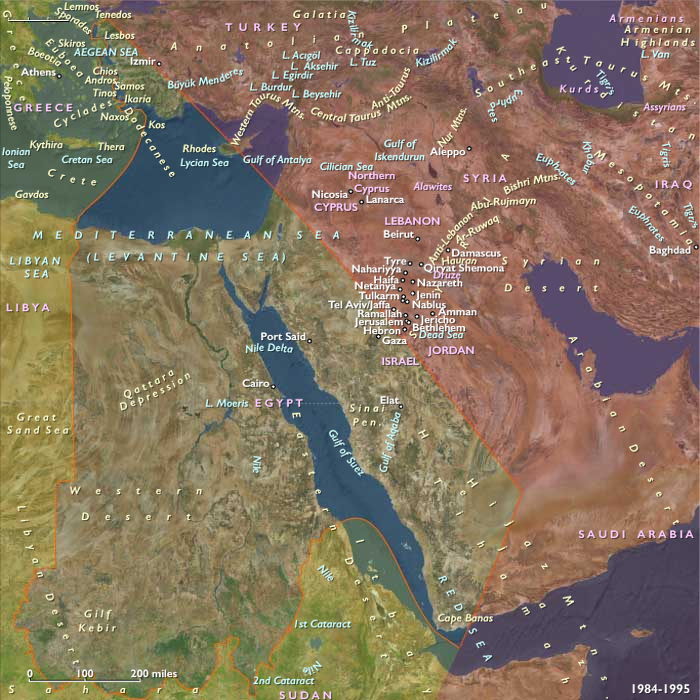
The PA will gain control over six large West Bank towns (Jenin, Nablus, Tulkarm, Qalqiyah, Ram Allah, and Bethlehem) as well as control over most of Hebron.
Israel will also gradually redeploy from some four hundred and forty villages, which will come under Palestinian rule. Security for these areas will rest with the Palestinian police, although Israelis will be guaranteed freedom of movement.
Reaffirming the commitment made in the 1993 peace accord, permanent-status negotiations are to be concluded by 1999.
However, the series of deadly suicide bombing attacks, directed against soldiers and civilians in Israel and the Gaza Strip by Hamas and Islamic Jihad, fail to derail the ongoing peace talks between the PLO and Israel.
On September 28, 1995, Arafat, Rabin, and Israeli foreign minister Shimon Peres sign the Interim Agreement on the West Bank and Gaza Strip (often called Oslo II).
This detailed and long-delayed agreement establishes a schedule for Israeli withdrawals from the Palestinian population centers (to be implemented in several stages) and creates a complex system of zones that are divided between areas fully controlled by the Palestinians, those under Palestinian civil authority but Israeli military control, and those exclusively under Israeli control.
It also sets elections for a president and council of the Palestinian Authority, which will govern the Palestinian population in the occupied territories.
The PA will gain control over six large West Bank towns (Jenin, Nablus, Tulkarm, Qalqiyah, Ram Allah, and Bethlehem) as well as control over most of Hebron.
Israel will also gradually redeploy from some four hundred and forty villages, which will come under Palestinian rule. Security for these areas will rest with the Palestinian police, although Israelis will be guaranteed freedom of movement.
Reaffirming the commitment made in the 1993 peace accord, permanent-status negotiations are to be concluded by 1999.
Locations
People
Groups
- United States of America (US, USA) (Washington DC)
- Israel
- West Bank
- Gaza Strip
- HAMAS (Harakat al-Muqawama al-Islamiyya or "Islamic Resistance Movement")
- Islamic Jihad Movement in Palestine, or Palestinian Islamic Jihad (PIJ)
Topics
Commodoties
Subjects
Regions
Subregions
Related Events
Showing 10 events out of 848 total
Years: 1995 - 1995
September
Locations
People
Groups
- United States of America (US, USA) (Washington DC)
- Israel
- West Bank
- Gaza Strip
- HAMAS (Harakat al-Muqawama al-Islamiyya or "Islamic Resistance Movement")
- Islamic Jihad Movement in Palestine, or Palestinian Islamic Jihad (PIJ)
Topics
Commodoties
Subjects
Regions
Subregions