
Jerusalem is at this time is known …
Years: 1005BCE - 994BCE
Jerusalem is at this time is known as Jebus and its independent Canaanite inhabitants at this time are known as Jebusites, according to the Hebrew scriptures; the Israelite history of the city begins in about 1000 BCE, with King David's sack of Jerusalem, following which Jerusalem becomes the City of David and capital of the United Kingdom of Israel.
The Jebusites, according to the Books of Samuel, managed to resist attempts by the Israelites to capture the city, and by the time of King David were mocking such attempts, claiming that even the blind and lame could defeat the Israelite army.
The Masoretic Text (the authoritative Hebrew and Aramaic text of the Tanakh for Rabbinic Judaism) for the Books of Samuel states that David managed to capture the city by stealth, sending his forces through a "water shaft" and attacking the city from the inside.
Archaeologists now view this as implausible, as the Gihon spring—the only known location from which water shafts lead into the city—is now known to have been heavily defended (and hence an attack via this route would have been obvious rather than secretive).
There was another king in Jerusalem, Araunah, during, and possibly before, David's control of the city, according to the biblical narrative, who was probably the Jebusite king of Jerusalem.
The city, which at that point stood upon the Ophel, was, according to the biblical account, expanded to the south, and declared by David to be the capital city of the Kingdom of Israel.
David also, according to the Books of Samuel, constructed an altar at the location of a threshing floor he had purchased from Araunah; a portion of biblical scholars view this as an attempt by the narrative's author to give an Israelite foundation to a preexisting sanctuary.
King Solomon, according to the biblical narrative, built a more substantive temple, the Temple of Solomon, at a location which the Book of Chronicles equates with David's altar.
The Temple became a major cultural center in the region; eventually, particularly after religious reforms such as those of Hezekiah and of Josiah, the Jerusalem temple became the main place of worship, at the expense of other, formerly powerful, ritual centers, such as Shiloh and Bethel.
Solomon is also described as having created several other important building works at Jerusalem, including the construction of his palace, and the construction of the Millo (the identity of which is somewhat controversial).
However, archaeologists have found no major building works at Jerusalem dating from this era (except perhaps the Large Stone Structure—the name given to the remains of a large public building in the City of David neighborhood of central Jerusalem, south of the Old City, tentatively dated to tenth to ninth century BCE—which is the subject of some controversy), and some have suggested that Solomon's building program was somewhat mythical—being based on the building program of the later Omrides.
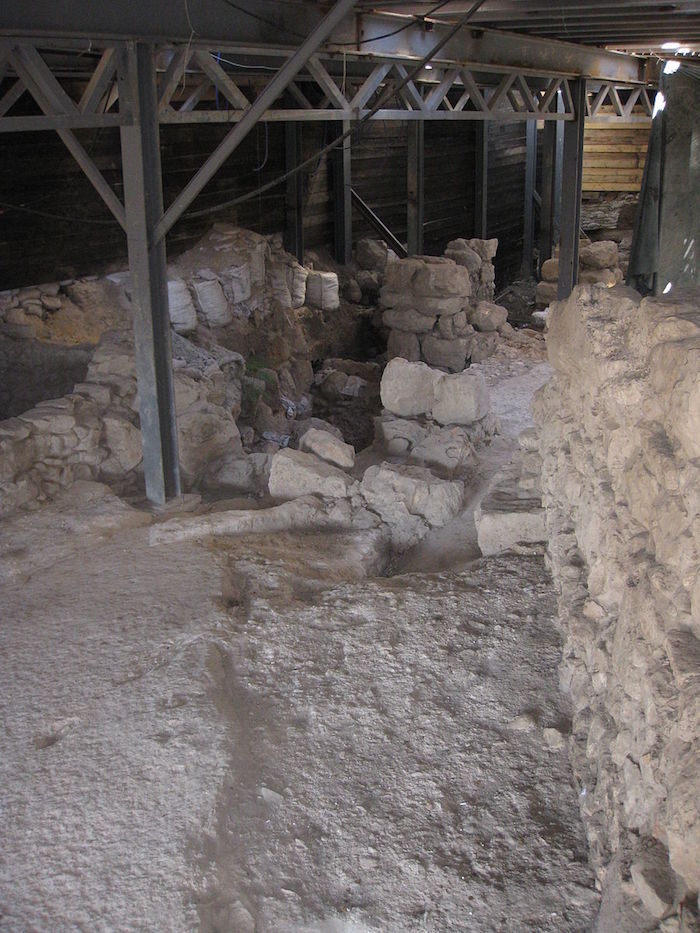
Part of the large stone structurein Jerusalem (Photo taken June 5, 2009 by Deror avi)
Locations
Groups
Topics
Subjects
Regions
Subregions
Related Events
Showing 10 events out of 66884 total
Years: 1005BCE - 994BCE
Part of the large stone structurein Jerusalem (Photo taken June 5, 2009 by Deror avi)
Locations
Groups
Topics
Subjects
Regions
Subregions