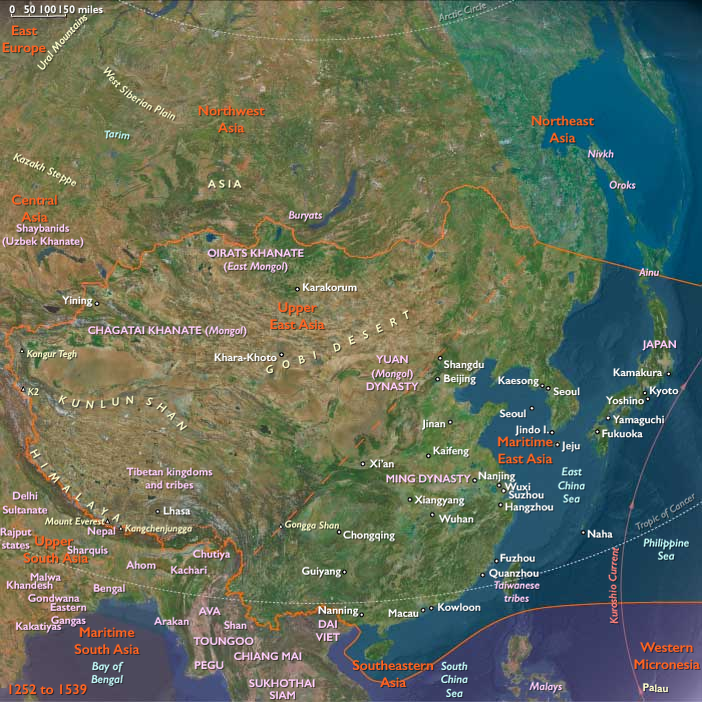
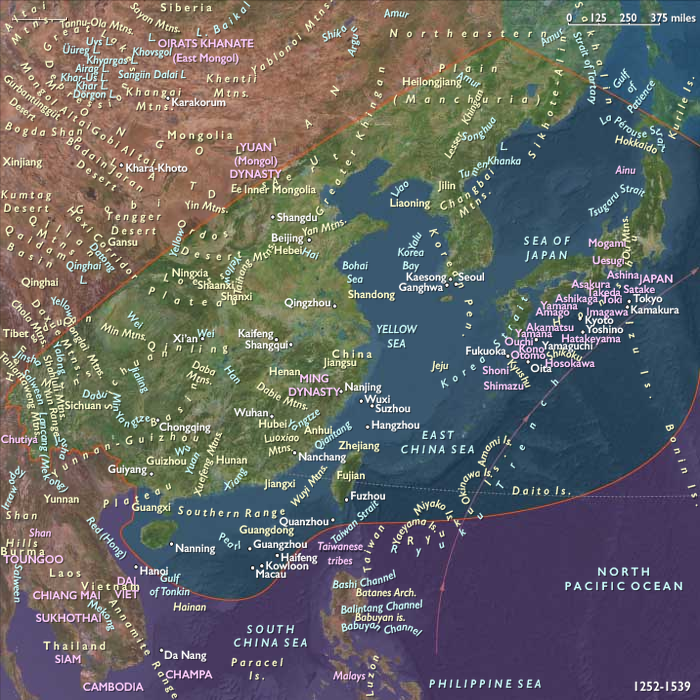
…Jeju Island, which the rebels capture, banishing …
Years: 1271 - 1271
…Jeju Island, which the rebels capture, banishing the king of Tamna in November 1271.
Locations
People
Groups
Topics
Commodoties
Subjects
Regions
Subregions
Related Events
Filter results
Showing 10 events out of 45728 total
The Sambyeolcho raid the coastlines of Jeolla Province, the southwestern province, but Jin Island had started to face food shortages in January 1271.
In February, the Mongol Court calls for the Sambyeolcho's surrender.
In response, its leader, Bae Jungson, asks Kublai Khan to secure Jeolla Province and put it under the direct rule of the empire, just as preceding rebels had, but his request is never fulfilled.
The Mongol Court decides in April to crush the rebels.
It only takes a month until Jindo Island falls to a combined Goryeo and Mongol army.
The puppet king is killed and the survivors, led by Kim Tongjeong, flee to …
Kublai renames his empire "Yuan" on December 18, 1971, officially marking the start of the Yuan Dynasty of China.
War again breaks out between Hungary and Bohemia following smaller skirmishes on the border.
Ottokar II leads his armies against Hungary; Stephen is defeated in two smaller battles, but finally wins a decisive victory on May 21, 1271 over Ottokar’s Czech and Austrian troops.
In the subsequent Peace of Pressburg, the King of Bohemia hands back the fortresses occupied during his campaign, while Stephen renounces his claim to the Hungarian royal treasury that his sister, Anna had taken to Prague after their father's death.
Abaqa retaliates in 1271 by sending an army against the Chagatai Khanate.
His forces plunder Bukhara and surrounding areas.
There will be small conflicts between Abaqa and Qara'unas under Chagataid noyans until 1280.
The Knights Hospitallers at Krak des Chevaliers, the primary fortress guarding approaches to the crusader's County of Tripoli, a state founded after the First Crusade, control a number of castles along the border of the County of Tripoli.
Krak des Chevaliers is among the most important and acts as a center of administration as well as a military base.
After a second phase of building was undertaken in the thirteenth century, Krak des Chevaliers became a concentric castle.
This phase created the outer wall and gave the castle its current appearance.
The first half of the century has been described as Krak des Chevaliers' "golden age".
At its peak, Krak des Chevaliers housed a garrison of around two thousand.
Such a large garrison has allowed the Hospitallers to extract tribute from a wide area.
The fortunes of the Hospitallers had taken a turn for the worse in 1252, when an army estimated to number ten Master Hugh Revel had complained in 1268 that the area, which had previously been home to around ten thousand people, was deserted and the order's property in the Kingdom of Jerusalem was producing little income; he also noted that by this point there were only three hundred of the order's brothers left in the east.
One of the effects of Baibars’ unification of Egypt and Syria that Muslim settlements which had previously paid tribute to the Hospitallers at Krak des Chevaliers are no longer intimidated into doing so.
Baibars had ventured in the area around Krak des Chevaliers in 1270 and allowed his men to graze their animals on the fields around the castle.
When he received news that year that King Louis IX of France was leading the Eighth Crusade, Baibars had left for Cairo.
Louis died in 1271 and Baibars returned north to deal with Krak des Chevaliers.
Before marching on the castle he captures the smaller castles in the area, including Chastel Blanc.
On March 3, Baibars' army arrives at Krak des Chevaliers.
By the time the Sultan arrived the castle may already have been blockaded by Mamluk forces for several days.
There are three Arabic accounts of the siege; only one, that of Ibn Shaddad, was by a contemporary although he was not present.
Peasants who lived in the area had fled to the castle for safety and are kept in the outer ward.
As soon as Baibars arrives he begins erecting mangonels, powerful siege weapons which he will turn on the castle.
According to Ibn Shaddad, two days later the first line of defenses was captured by the besiegers; he was probably referring to a walled suburb outside the castle's entrance.
Rain interrupts the siege, but on March 21, a triangular outwork immediately south of Krak des Chevaliers, possibly defended by a timber palisade, is captured.
On March 29, the tower in the southwest corner is undermined and collapses.
Baibars' army attacks through the breach and on entering the outer ward, they encounter the peasants who had sought refuge in the castle.
Though the outer ward had fallen, and in the process a handful of the garrison killed, the Crusaders retreat to the more formidable inner ward.

The besiegers, after a lull of ten days, convey a letter to the garrison, supposedly from the Grand Master of the Knights Hospitaller in Tripoli, which grants permission for them to surrender.
Although the letter is a forgery, the garrison capitulates and the Sultan spares their lives.
The new owners of the castle undertake repairs, focused mainly on the outer ward.
The Hospitaller chapel is converted to a mosque and two mihrabs are added to the interior.
Baibars' seizure of the great Krak des Chevaliers seals the fate of the crusaders, who will never be able to recover from their territorial losses.
Baibars conducts an unsuccessful siege of the city of Tripoli; …
…he also fails in an attempted naval invasion of Cyprus.
Marco Polo visits the Armenian harbor of Ayas in 1271 and comments favorably about Leo's reign and the abundance of the country, although he mentions his military forces are rather demoralized: "The king [Leo II] properly maintains justice in his land, and is a vassal of the Tartars.
There are many cities and villages, and everything in abundance.(...)
In the past, men were courageous at war, but today they are vile and chetive, and don't have other talents than drink properly."
—Marco Polo "Le Livre des Merveilles"
Prince Edward of England, having arrived in North Africa too late to salvage Louis' Eighth Crusade, finally lands at Acre on May 9, 1271, to participate in what is known as the Ninth Crusade.
Edward's men, although an important addition to the garrison, stand little chance against Baibars' superior forces, and an initial raid at nearby St Georges-de-Lebeyne in June is largely futile.
An embassy to the Mongols helps bring about an attack on Aleppo in the north, which aids in distracting Baibar's forces.
In November, Edward leads a raid on Qaqun, which could have served as a bridgehead to Jerusalem, but both the Mongol invasion and the attack on Qaqun fail.
Cardinal Tedaldo Visconti, who has joined the future English king in Palestine, is notified of his election as pope, on September 1, 1271, at Viterbo in the Papal States.
Not even a member of the priesthood, Visconti is a compromise candidate put up to end the three-year vacancy of the Roman see that had followed the death of Pope Clement IV.
Visconti returns to Rome and takes the regnal name of Gregory X.