
Jean Siméon Chardin was born in Paris, …
Years: 1728 - 1728
Jean Siméon Chardin was born in Paris, the son of a cabinetmaker, and rarely left the city.
He will live on the Left Bank near Saint-Sulpice until 1757, when Louis XV grants him a studio and living quarters in the Louvre.
Chardin had entered into a marriage contract with Marguerite Saintard in 1723, whom he will not marry until 1731.
He serves apprenticeships with the history painters Pierre-Jacques Cazes and Noël-Nicolas Coypel, and in 1724 became a master in the Académie de Saint-Luc.
According to one nineteenth-century writer, at a time when it was hard for unknown painters to come to the attention of the Royal Academy, he first found notice by displaying a painting at the "small Corpus Christi" (held eight days after the regular one) on the Place Dauphine (by the Pont Neuf).
Van Loo, passing by in 1720, bought it and later assisted the young painter. (Édouard Fournier, Histoire du Pont-Neuf, 1862)
Upon presentation of The Ray in 1728, he was admitted to the Académie Royale de Peinture et de Sculpture.
The Ray, hung from a chain and gutted, reads like a Crucifixion.
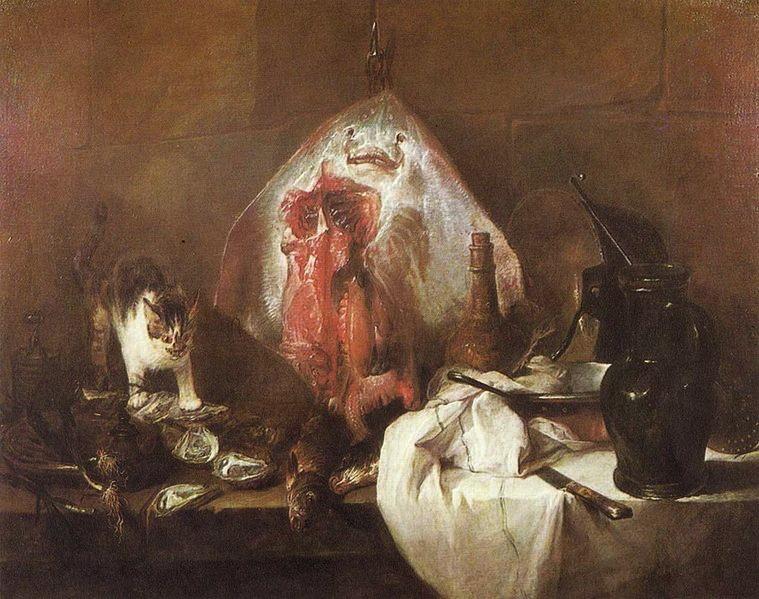
The Ray, 1728, Musée du Louvre, Paris. (oil on canvas; 114 × 146 cm (44.9 × 57.5 in); Louvre Museum
Locations
People
Groups
Topics
Subjects
Regions
Subregions
Years: 1728 - 1728
The Ray, 1728, Musée du Louvre, Paris. (oil on canvas; 114 × 146 cm (44.9 × 57.5 in); Louvre Museum
Locations
People
Groups
Topics
Subjects
Regions
Subregions