
The Aftermath of Poitiers and the Causes …
Years: 1358 - 1358
The Aftermath of Poitiers and the Causes of the Jacquerie Revolt (1356–1358)
Following the Battle of Poitiers (September 1356) and the capture of King John II ("the Good"), France descended into chaos, plagued by political instability, economic collapse, and social unrest. The chronicler Jean de Venette, a Carmelite friar, vividly describes the period as one of lawlessness, corruption, and suffering, blaming both the French nobility and the roaming mercenary bands known as the "Companies" (routiers).
Jean de Venette’s Account: France in Ruins
Jean de Venette provides a firsthand account of the devastation, writing:
"...From that time on all went wrong with the Kingdom and the state was undone.
Thieves and robbers rose up everywhere in the land.
The nobles despised and hated all others and took no thought for the mutual usefulness and profit of lord and men.
They subjected and despoiled the peasants and the men of the villages.
In no wise did they defend their country from enemies.
Rather did they trample it underfoot, robbing and pillaging the peasants' goods."
- His criticism is directed not only at the nobility, who exploited and abandoned their subjects, but also at the routiers—mercenary bands left unchecked in the wake of the war.
- With the monarchy leaderless, local warlords and nobles took advantage, taxing the peasants heavily while failing to provide protection from external threats.
Political Instability and the Estates-General’s Failure
- With King John II in captivity, power fractured between:
- The Estates-General, which proved too divided to govern effectively.
- Charles II of Navarre, who sought his own advantage.
- The Dauphin, later Charles V, who struggled to assert control.
- This lack of leadership left France vulnerable, as nobles pursued their own interests rather than defending the country.
- The prestige of the nobility, already tarnished by defeats at Courtrai (1302) and Crécy (1346), reached a new low after they failed to protect France at Poitiers.
Economic Hardships and the Peasantry’s Growing Resentment
- To fund ransoms, military campaigns, and personal expenses, the privileged classes (nobles, clergy, and merchants) increased taxes on peasants.
- The taille (a direct land tax) was raised to unbearable levels, while the corvée (forced labor) forced peasants to rebuild war-damaged noble estates—without pay.
- A new law requiring peasants to defend châteaux (noble castles) became the final spark that ignited the Jacquerie rebellion.
- Many commoners already blamed the nobility for their failures at Poitiers and now questioned why they should continue working for a ruling class that could not even provide protection.
Mercenaries and the Breakdown of Order
- The countryside was overrun by routiers (unemployed mercenaries and brigands)—including English, Gascon, German, and Spanish troops, many of whom had fought for the English before being left without pay or leadership.
- These roving bands looted, raped, and burned villages, pillaging the land almost at will, while the Estates-General proved powerless to stop them.
- Many peasants faced a double threat:
- Noble exploitation through high taxes and forced labor.
- Uncontrolled mercenary violence that the nobility failed to suppress.
The Jacquerie Revolt (1358): A Violent Peasant Uprising
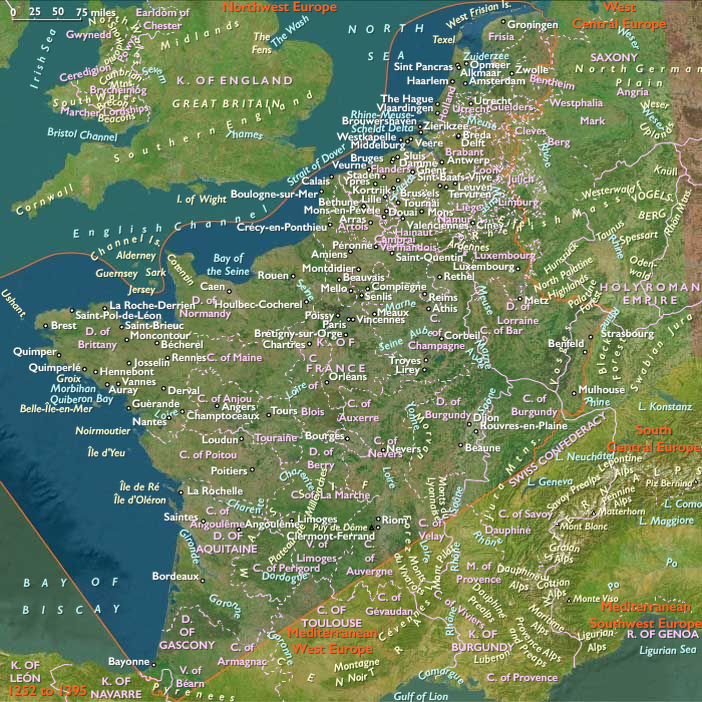
- In May 1358, these tensions erupted into the Jacquerie, a violent peasant rebellion in northern France.
- The revolt was short-lived but extremely bloody, with peasant mobs attacking nobles, burning estates, and killing aristocrats.
- Although the Jacquerie was brutally crushed by June 1358, it left a lasting impact, exposing deep class tensions that would continue to shape France’s social and political struggles.
Long-Term Consequences
- The failure of the nobility to defend France and its people in the 1350s permanently damaged the feudal system.
- The Jacquerie foreshadowed later peasant revolts, including:
- The English Peasants' Revolt (1381).
- The French Revolution (1789).
- France’s internal divisions further weakened the country’s ability to resist English advances in the Hundred Years’ War.
The years after Poitiers (1356–1358) were among the darkest in medieval France, as the absence of strong leadership, economic suffering, and unchecked mercenaries led to mass discontent and violent peasant uprisings.
Locations
People
Groups
- Navarre, Kingdom of
- Normandy, Duchy of
- Christians, Roman Catholic
- England, (Plantagenet, Angevin) Kingdom of
- France, (Valois) Kingdom of
Topics
Subjects
Regions

Subregions
Years: 1358 - 1358
Locations
People
Groups
- Navarre, Kingdom of
- Normandy, Duchy of
- Christians, Roman Catholic
- England, (Plantagenet, Angevin) Kingdom of
- France, (Valois) Kingdom of
Topics
Subjects
Regions
Subregions