
Jean de Béthencourt: Norman Noble, Crusader, and …
Years: 1401 - 1401
Jean de Béthencourt: Norman Noble, Crusader, and Conqueror of the Canary Islands
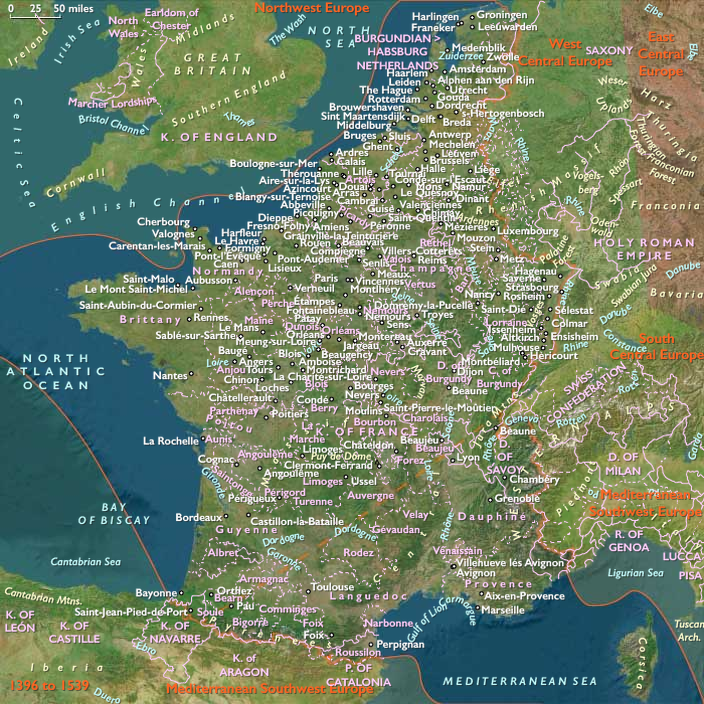
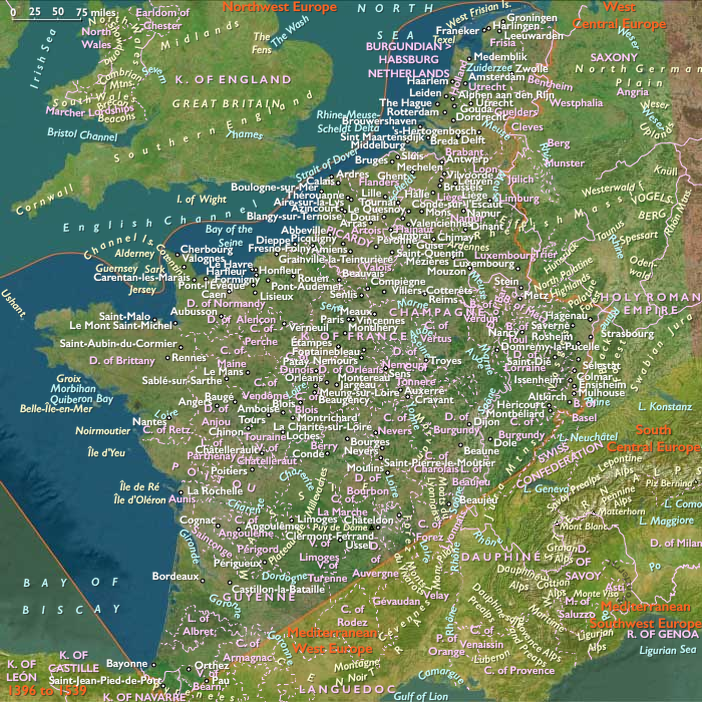
Jean de Béthencourt (1362–1425), Baron of Saint-Martin-le-Gaillard, was a Norman noble, soldier, and explorer whose career spanned the Hundred Years’ War, crusades against North African corsairs, and the conquest of the Canary Islands. His life reflected the turbulence of late medieval France, as shifting alliances, piracy, and overseas expansion shaped his rise to prominence.
I. Early Life and Feudal Struggles in Normandy (1362–1387)
- Born in Grainville-la-Teinturière, Normandy, Jean was the son of Jean III de Béthencourt and Marie de Bracquemont.
- His father, a supporter of King Charles V, fought under Bertrand du Guesclin against Charles II of Navarreand was killed in May 1364 at the Battle of Cocherel.
- Following his father’s death, the Château de Grainville was demolished in 1365, part of royal efforts to dismantle fortresses that could be used by rebellious lords.
- In 1377, at age fifteen, Béthencourt entered the service of Louis I, Duke of Anjou, beginning a long military and courtly career.
II. Service to the House of Valois and Expeditions in North Africa (1387–1391)
- Between 1387 and 1391, he held the honorary position of chancellor to Louis de Valois, Duke of Touraine(later Duke of Orléans).
- In 1387, King Charles VI of France authorized the rebuilding of the Château de Grainville, restoring Béthencourt’s territorial power.
- As lord of Grainville, he held seven parishes and rights over all trade crossing his land, first as a vassal of Olivier du Guesclin, son of Bertrand du Guesclin.
- Later, during Henry V’s conquest of Normandy (1417–1419), he was forced to acknowledge English overlordship, though he likely engaged in piracy against both French and English vessels during periods of instability.
III. The Mahdia Crusade (1390) and First Encounters with the Canaries
- In 1390, Béthencourt joined the Mahdia Crusade, an expedition organized by Genoese merchants and led by Louis II, Duke of Bourbon, against the Barbary corsairs of Tunis.
- The campaign, presented as a "crusade," offered participants prestige, a moratorium on debts, immunity from lawsuits, and papal indulgences.
- However, the French knights were unprepared for the terrain, lacked siege equipment, and suffered from internal quarrels, leading to a negotiated withdrawal.
- During this campaign, Béthencourt likely first heard of the Canary Islands, where merchants spoke of orchil lichen, a rare dye highly valuable for the textile industry.
IV. The Conquest of the Canary Islands (1402–1405)
- Seeking economic opportunities in the dye trade, Béthencourt planned an expedition to the Canary Islands, which at the time were frequented by merchants and Spanish pirates.
- To fund his venture, he sold property in Paris for 200 gold francs and secured a 7,000-pound loan from his uncle, Robert de Bracquemont, the French ambassador to Castile, by mortgaging his estates.
- According to Louis Moréri, King Henry III of Castile had entrusted the conquest of the islands to Bracquemont, who then delegated the mission to Béthencourt.
- Accompanied by Gadifer de La Salle, whom he had met in service under the Duke of Orléans, Béthencourt set sail for the Canaries in December 1401.
V. Legacy and Impact
- Béthencourt’s conquest of the Canaries marked the beginning of European expansion into the Atlantic, preceding Portugal’s and Spain’s later colonial endeavors.
- His expedition combined feudal ambition, economic opportunity, and religious justification, foreshadowing later European imperial ventures.
- His rule over the islands was later challenged and disputed, leading to his eventual withdrawal from direct governance in favor of Castilian control.
Jean de Béthencourt’s career reflects the shifting dynamics of late medieval Europe, where knightly service, piracy, crusading, and overseas conquest blended in the pursuit of power, wealth, and prestige.
Locations
People
- Charles VI of France
- Gadifer de La Salle
- Henry III of Castile
- Jean de Béthencourt
- Louis I, Duke of Orléans
- Louis II, Duke of Bourbon
- Robert de Bracquemont
Groups
- Guanches
- Berber people (also called Amazigh people or Imazighen, "free men", singular Amazigh)
- Normandy, Duchy of
- Genoa, (Most Serene) Republic of
- Castile, Kingdom of
- Castile, Crown of
- France, (Valois) Kingdom of
Topics
Commodoties
Subjects
- Origins
- Commerce
- Labor and Service
- Conflict
- Exploration
- Faith
- Government
- Technology
- Movements
- Piracy
Regions
Subregions
Related Events
Showing 10 events out of 42724 total
Years: 1401 - 1401
Locations
People
- Charles VI of France
- Gadifer de La Salle
- Henry III of Castile
- Jean de Béthencourt
- Louis I, Duke of Orléans
- Louis II, Duke of Bourbon
- Robert de Bracquemont
Groups
- Guanches
- Berber people (also called Amazigh people or Imazighen, "free men", singular Amazigh)
- Normandy, Duchy of
- Genoa, (Most Serene) Republic of
- Castile, Kingdom of
- Castile, Crown of
- France, (Valois) Kingdom of
Topics
Commodoties
Subjects
- Origins
- Commerce
- Labor and Service
- Conflict
- Exploration
- Faith
- Government
- Technology
- Movements
- Piracy
Regions
Subregions