
Jean-Baptiste-Siméon Chardin had ceded his position in …
Years: 1733 - 1733
Jean-Baptiste-Siméon Chardin had ceded his position in the Académie de Saint-Luc a year after his admission to the Académie Royale de Peinture et de Sculpture, and is now making a modest living by "produc[ing] paintings in the various genres at whatever price his customers chose to pay him", and by such work as the restoration of the frescoes at the Galerie François I at Fontainebleau in 1731. (Rosenberg, Pierre, and Florence Bruyant (2000), Chardin. p. 20. London: Royal Academy of Arts).
His son Jean-Pierre was baptized in November 1731, and a daughter, Marguerite-Agnès, is baptized in 1733.
Largely self-taught, Chardin is greatly influenced by the realism and subject matter of the seventeenth-century Low Country masters.
Despite his unconventional portrayal of the ascendant bourgeoisie, early support comes from patrons in the French aristocracy, including Louis XV.
Though his popularity rests initially on paintings of animals and fruit, by the 1730s he has introduced kitchen utensils into his work.
Soon figures populate his scenes as well, supposedly in response to a portrait painter who had challenged him to take up the genre.
Woman Sealing a Letter (about 1733) may have been his first attempt.
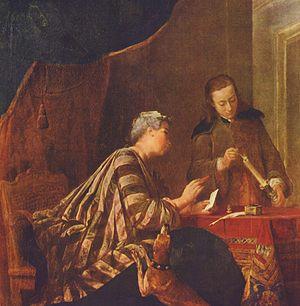
Jean-Baptiste Siméon Chardin, Lady Sealing a Letter, 1732 (oil on canvas; Sanssouci Picture Gallery)
Locations
People
Topics
Subjects
Regions

Subregions
Years: 1733 - 1733
Jean-Baptiste Siméon Chardin, Lady Sealing a Letter, 1732 (oil on canvas; Sanssouci Picture Gallery)
Locations
People
Topics
Subjects
Regions
Subregions