
Jayavarman II, according to an older established …
Years: 802 - 802
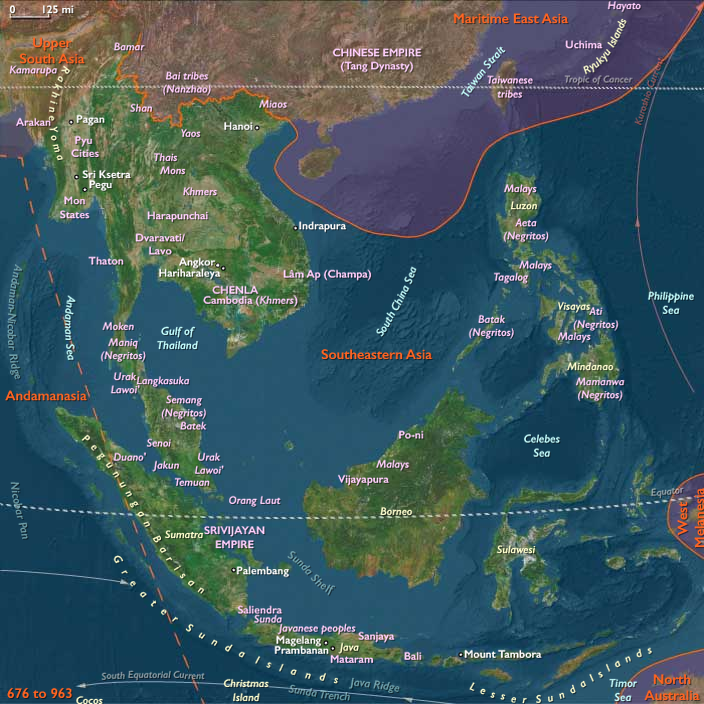
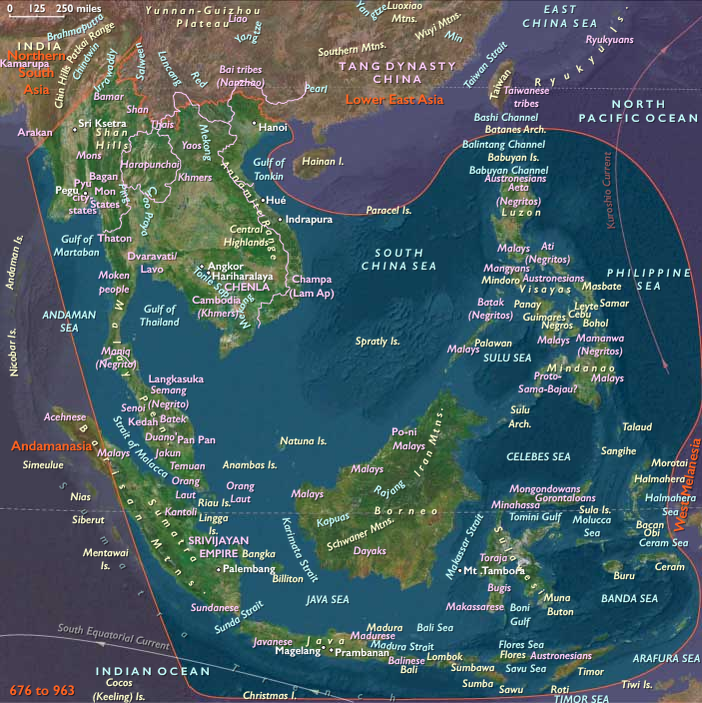
Jayavarman II, according to an older established interpretation, was supposed to be a prince who lived at the court of the Sailendra dynasty in Java (today's Indonesia) and brought back to his home the art and culture of the Javanese Sailendran court to Cambodia.
At this time, Sailendras allegedly rule over Java, Sumatra, the Malay Peninsula and parts of Cambodia.
This classical theory was revisited by modern scholars, such as Claude Jacques and Michael Vickery, who noted that Khmer called chvea the Chams, their close neighbors.
Moreover, Jayavarman's political career began at Vyadhapura (probably Banteay Prei Nokor) in eastern Cambodia, which make more probable long time contacts with them (even skirmishes, as the inscription suggests) than a long stay in distant Java.
Finally, many early temples on Phnom Kulen shows both Cham (e.g., Prasat Damrei Krap) and Javanese influences (e.g., the primitive "temple-mountain" of Aram Rong Cen and Prasat Thmar Dap), even if their asymmetric distribution seems typically Khmer.
Jayavarman appears to have been of aristocratic birth, beginning his career of conquest in the southeast of present-day Cambodia.
After he eventually returned to his home, the former kingdom of Chenla, he quickly built up his influence, conquered a series of competing kings, and in 790 became king of a kingdom called "Kambuja" by the Khmer.
In the following years he extended his territory and eventually established his new capital of Hariharalaya near the modern Cambodian town of Roluos.
He thereby laid the foundation of Angkor, which is to arise some fifteen kilometers to the northwest.
In 802, he declares himself Chakravartin, in a ritual taken from the Indian-Hindu tradition, thereby becoming not only the divinely appointed and therefore uncontested ruler, but also simultaneously declares the independence of his kingdom from Java.
The foundation of Hariharalaya near present day Roluos is the first settlement in what will later become the empire of Angkor.
Despite this key role in Khmer history, few firm facts survive about Jayavarman.
No inscriptions authored by him have been found, but he is mentioned in numerous others, some of them written long after his death.
Locations
People
Groups
Topics
Subjects
Regions
Subregions
Years: 802 - 802
Locations
People
Groups
Topics
Subjects
Regions
Subregions