Jaromír’s third reign is short-lived. He …
Years: 1034 - 1034
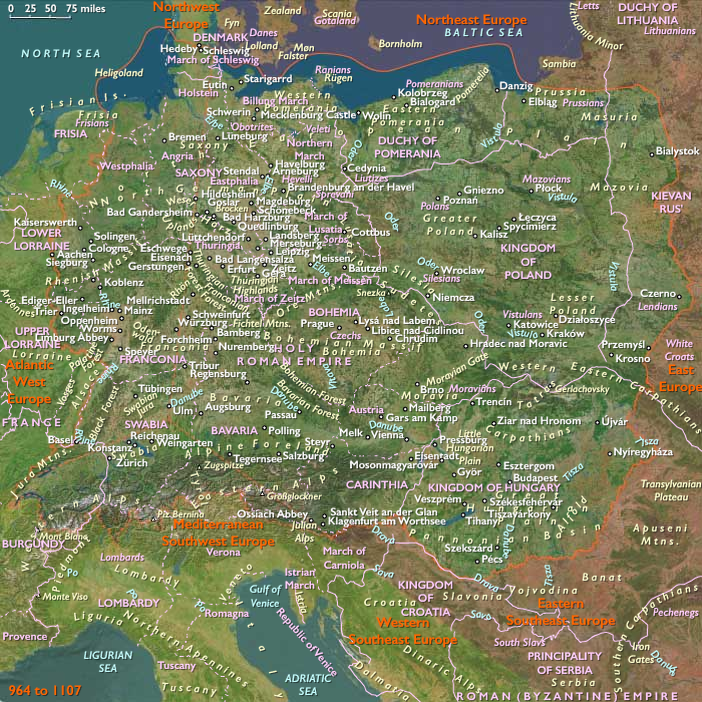
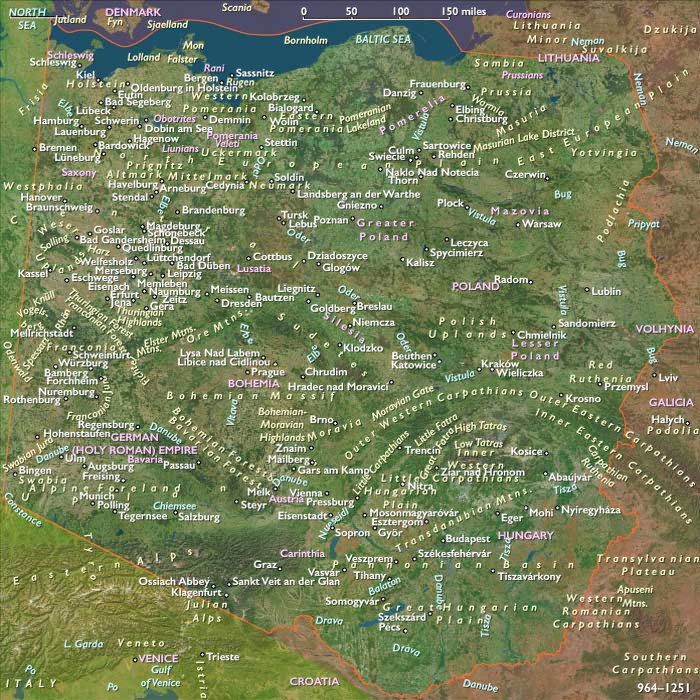
Jaromír’s third reign is short-lived.
He is in turn was captured, blinded, and deposed by Oldrich, who seizes power again and drives out Jaromír's son from Moravia.
Oldrich dies abruptly on November 11, 1034 and later examination of his skeleton reveals his skull to have suffered a fatal blow.
Jaromír now renounces the throne in favor of Bretislaus, called the Restorer, who had fled beyond the Bohemian border.
Locations
People
Groups
- Bohemia, Duchy of
- Czechs [formerly Bohemians] (West Slavs)
- Hungary, Kingdom of
- Poland of the first Piasts, Kingdom of
Commodoties
Subjects
Regions
Subregions
Related Events
Filter results
Showing 10 events out of 51505 total
Mieszko II has regained full power, but he still has to fight against the nobility and his own subjects.
It should be noted that in Poland his renunciation of the royal crown isn't counted, and after 1032, in the chronicles he is still called King.
He dies suddenly between May 10 and 11, 1034, probably in Poznań.
The Polish chronicles clearly state that he died of natural causes; the information that he was murdered by the sword-bearer (Miecznik), given by the chronicles of Gottfried of Viterbo, refers to Bezprym.
However, the historians now think that he was killed in a plot hatched by the aristocracy.
He is buried in the Cathedral of St. Peter and St. Paul.
After Mieszko II's death, Poland's peasants revolt in a "pagan reaction."
The exact reasons and date are unknown.
Mieszko II's only son and heir, Casimir I, is either expelled by this insurrection, or the insurrection is caused by the aristocracy's expulsion of him.
Some modern historians argue that the insurrection was caused more by economic than by religious issues, such as new taxes for the Church and the militarization of the early Polish polity.
Priests, monks and knights are killed; cities, churches and monasteries are burned.
Conrad II had had to enforce his royal prerogatives in the Duchy of Carinthia just as he did in the Duchy of Swabia.
Duke Adalbero of Carinthia had been appointed as duke in 1012 under Emperor Henry II and had remained loyal to imperial authority, supporting Conrad's election as German king in 1024.
At a synod in Frankfurt in September 1027 at which Conrad had attempted to resolve the decades' long Gandersheim Conflict, Adalbero had accompanied the Emperor and acted as his sword-bearer during the proceeding, indicating Conrad's trust in him.
However, from 1028 on, Adalbero has governed his Duchy as an independent state.
In particular, he has attempted to conduct peaceful relations with the King Stephen I of the Kingdom of Hungary.
Under Emperor Henry II, who was the brother-in-law to Stephen, relations between the Empire and Hungary had been friendly.
Upon Henry's death in 1024, Conrad had adopted a more aggressive policy, prompting border raids into the Empire from Hungary.
The raids particularly have affected Adalbero's domain of Carinthia, which shares a long border with eastern border with Hungary.
Conrad summons Adalbero to court at Bamberg on May 18, 1034, to answer an indictment of treason for his actions regarding Hungary.
In the presence of the German dukes, Conrad demands that Adalbero be stripped of all his title and lands.
The dukes, however, hesitate and demand that Conrad's son Henry, the Germany's co-King and Conrad's designated successor, join the assembly before a decision is made.
Henry likewise refuses to depose Adalbero, citing an earlier agreement with Adelbero to be his ally in negotiating a settlement between him and his father.
Only by resorting to exhortations, pleas, and threats to Henry is Conrad able to persuade him to support deposing Adalbero.
Henry's support is soon followed by that of the other dukes.
Conrad then orders Adalbero removed as Duke and sentences him and his son to exile.
After attacking Conrad's allies in Carinthia, Adalbero flees to his mother's estates in Ebersberg in the Duchy of Bavaria, where he will remain until his death in 1039.

Zoë has become self-assertive and jealous: Theodora, though living in retirement, had excited Zoë's jealousy and, on a pretext of conspiracy, has been confined in a monastery.
Zoë, neglected by her husband, has become enamored of her young Paphlagonian chamberlain, Michael, a man of humble origin who owes his elevation to his brother, the influential and capable eunuch John the Orphanotrophus, who had brought him to court.
Emperor Romanus, allegedly poisoned by Zoë, becomes ill in 1034; upon his death on April 11, she at once takes control and marries her lover, who is proclaimed Emperor Michael IV, called the Paphlagonian.
The new emperor had shown great eagerness to make his mark as a ruler, but has mostly been unfortunate in his enterprises.
He has spent large sums upon new buildings and in endowing the monks.
His endeavor to relieve the pressure of taxation has disorganized the finances of the state.
Idealizing Marcus Aurelius, Romanos aspires to be a new "philosopher king", and similarly desires to imitate the military prowess of Trajan.
He had resolved in 1030 to retaliate upon the incursions of the Muslims on the eastern frontier by leading a large army in person against the Mirdasids of Aleppo, but by allowing himself to be surprised on the march he had sustained a serious defeat at Azaz, near Antioch.
Although this disaster had been reduced by the capture and successful defense of Edessa by George Maniakes in 1032, and by the sound defeat of a Saracen fleet in the Adriatic, Romanos has never recovered his early popularity.
As a member of the aristocracy, Romanos III had abandoned his predecessors' curtailment of the privileges of the nobility and reduced their taxes, at the same time allowing peasant freeholders to fall into a condition of serfdom.
In a vain attempt to reduce expenditure, Romanos had limited his wife's expenses, which has merely exacerbated the alienation between the two.
At home, Romanos III has faced several conspiracies, mostly centered around his sister-in-law Theodora, as in 1029 and 1030.
Although he had survived these attempts on the throne, his early death in 1034 is supposed to have been due to poison administered by his wife, though it has also been that he was drowned in a bath on his wife's orders.
He is buried in the Church of St. Mary Peribleptos, which he built.
The governor of Damascus, al-Duzbari, finds the Mirdasid alliance with Constantinople to be unacceptable and calls for a jihad.
The imperial government announces their desire for a truce with al-Duzbari, causing Nasr to worry that he will be sacrificed by the Greeks to the Fatimids.
He, along with the Numayrids, Marwanids, and the Banu 'l-Djarrah and Kalb Arabs, sends envoys to Constantinople to determine the fate of the Muslims situated between the Fatimids and the Empire.
Nasr declares his submission to Romanos III, who claims Aleppo as under his protection.
The Fatimids refuse to accept this, however, and after Romanos III dies in 1034 his successor Michael IV recommends to Nasr that he accept Fatimid suzerainty.
The duchy of Carinthia remains unoccupied until February 2, 1035, when Conrad names his cousin Conrad the Younger as the new duke.
With the appointment, the three southern German duchies of Swabia, Bavaria, and Carinthia are all under the control of Emperor Conrad through his family members (his cousin Conrad in Carinthia, …
Pisa’s interest in curtailing Islamic piracy had not stopped at Sardinia.
In 1034, her fleet destroys the pirate base of Bône.
Sancho III’s Coronation in León and the Peak of His Rule (1034 CE)
By 1034, Sancho III of Pamplona reaches the pinnacle of his power, extending his rule from the borders of Galicia in the west to the County of Barcelona in the east.
His military campaign against Bermudo III of León culminates in the fall of the city of León, which Sancho sees as the imperiale culmen (imperial capital). Seizing the opportunity to legitimize his dominance, he has himself crowned in León, symbolizing his claim to supremacy over all the Christian kingdoms of Iberia.
This moment marks the height of Sancho III’s reign, making him the most powerful Christian ruler in Iberia, effectively uniting the Kingdom of Pamplona, Castile, and León under his authority.
Alan III of Brittany and His Struggle Against Norman Suzerainty (1008–1030s)
Alan III of Brittany, the son of Duke Geoffrey I and Hawise of Normandy, succeeded as Duke of Brittany in 1008. However, as he was still a minor, his mother acted as regent, while Richard II, Duke of Normandy—his maternal uncle—assumed guardianship over Brittany. This early connection with Normandy played a crucial role in shaping Alan’s later conflicts as he sought to assert Brittany’s independence.
Early Rule and Marriage Alliance (1008–1018)
- While his mother, Hawise of Normandy, governed Brittany as regent, Alan was raised under the influence of the Norman ducal court.
- In 1018, Alan married Bertha of Blois, daughter of Odo II, Count of Blois, and Ermengarde of Auvergne, solidifying an alliance with the House of Blois, a long-time rival of Normandy.
- This marriage strengthened Brittany’s political position and provided Alan with an influential continental allyagainst Norman expansion.
Break from Norman Suzerainty (1026–1030s)
- When Richard III of Normandy died in August 1026, his brother Robert I succeeded him. The transition sparked political unrest in Normandy.
- Alan III, seeing an opportunity, attempted to break free from Norman overlordship, effectively declaring Brittany’s independence from Norman control.
Conflict Between Alan III and Robert I of Normandy (1030s)
- The conflict escalated into a series of raids and counter-raids between Brittany and Normandy:
- Early 1030s: Robert I of Normandy launched an attack on Dol, an important Breton stronghold.
- In retaliation, Alan III raided Avranches, but his forces were repulsed, leading to continued border skirmishes between Brittany and Normandy.
- The situation worsened as Robert prepared for a full-scale invasion, planning a land assault alongside a fleet attack on Brittany.
The Truce at Mont Saint-Michel (1033–1034)
- As tensions mounted, Robert, Archbishop of Rouen—uncle to both Alan and Robert I—stepped in to mediatebetween his nephews.
- A truce was negotiated at Mont Saint-Michel, a symbolically neutral site between Brittany and Normandy.
- As part of the agreement:
- Alan III swore fealty to Robert I, acknowledging Norman suzerainty.
- In return, Normandy halted its invasion plans, stabilizing the region for the time being.
Legacy and Impact
- Alan III’s attempt at independence from Norman overlordship ultimately failed, though he preserved Brittany’s territorial integrity.
- The truce at Mont Saint-Michel ensured temporary peace, but Brittany remained under Norman influence for the remainder of Alan’s reign.
- His alliance with Blois placed Brittany in a strategic position between France and Normandy, a factor that would continue to shape Breton politics in the 11th century.
Alan III’s rebellion and subsequent truce reflected the delicate balance of power in feudal Europe, where dukes and counts continually maneuvered between autonomy and vassalage, depending on the shifting fortunes of war and diplomacy.
…his stepson Herman in Swabia, and his son Henry in Bavaria).
Control of the southern duchies allows Conrad to continue the process begun under the Ottonian dynasty of centralizing authority over the Empire in the hands of the Emperor at the expense of the regional dukes.
Conrad breaks with Ottonian tradition, however, in favoring a more strict means of controlling rebellious vassals.
Whereas the Ottonians follow a policy of informal public submission and subsequent reconciliation, Conrad uses treason trials to declare rebels as "public enemies" to legitimize his subsequent harsh treatment as he had done with Ernest II of Swabia and Adalbero.
The use of these treason trials though is seen by the nobles not as a mere shifting a power in favor of the Emperor but as a cruel breach of German tradition.
Years: 1034 - 1034
Locations
People
Groups
- Bohemia, Duchy of
- Czechs [formerly Bohemians] (West Slavs)
- Hungary, Kingdom of
- Poland of the first Piasts, Kingdom of