
Japan’s Kofun period, which had begun around …
Years: 397 - 397
Japan’s Kofun period, which had begun around 250, is named after the large burial mounds that had appeared at the time.
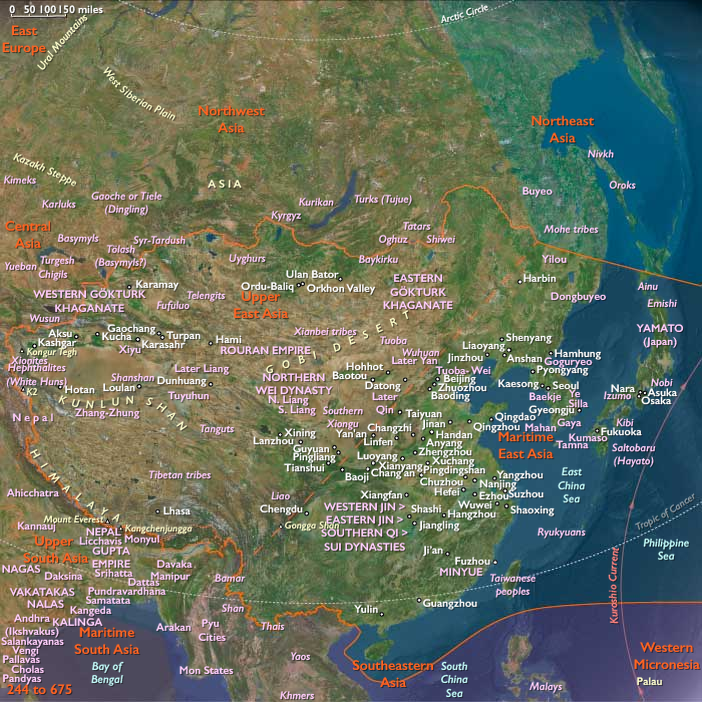
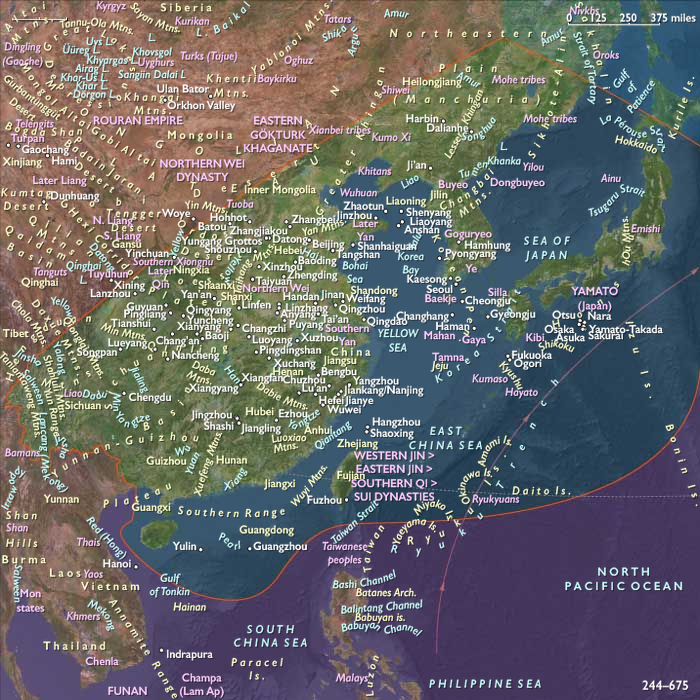
Illustrated by an animistic culture that exists prior to the introduction of Buddhism, the Kofun period sees the establishment of strong military states centered around powerful clans, and the establishment of a dominant polity centered in the Yamato area from the third century on: the Yamato Court, origin of the Japanese imperial lineage.
The Yamato Court, suppressing the clans and acquiring agricultural lands, maintains a strong influence in the western part of Japan (the Asuka region).
Based upon the Chinese model, they have developed a central administration and an imperial court system and society is organized into occupation groups.
Several proto-state formations rival one another, possibly representing different ethnic backgrounds.
Close relationships between the Three Kingdoms of Korea and Japan begin during the middle of this period, around the end of the fourth century.
(According to the Gwanggaeto Stele, Japan actively participates with large armies on the Korean Peninsula during the late fourth and early fifth centuries.
According to the Book of Song, of the Liu Song Dynasty, the Chinese emperor appointed the king of Yamato to also be ruler of Silla, Baekje, and the Gaya confederacy.
According to the Samguk Sagi (Chronicles of the Three Kingdoms), Baekje and Silla sent their princes as hostages to the Yamato court to ensure military support; King Asin of Baekje sent his son Jeonji in 397.)
Locations
People
Groups
- Buddhism
- Silla, Kingdom of
- Goguryeo (Koguryo), Kingdom of
- Baekje (or Paekche), Kingdom of
- Japanese people
- Gaya confederacy
- Chinese Empire, Tung (Eastern) Jin Dynasty
Topics
- Three Kingdoms of Korea
- Six Dynasties Period in China
- Japan, Yamato Kofun period
- Sixteen Kingdoms Period in China
Subjects
Regions
Subregions
Years: 397 - 397
Locations
People
Groups
- Buddhism
- Silla, Kingdom of
- Goguryeo (Koguryo), Kingdom of
- Baekje (or Paekche), Kingdom of
- Japanese people
- Gaya confederacy
- Chinese Empire, Tung (Eastern) Jin Dynasty
Topics
- Three Kingdoms of Korea
- Six Dynasties Period in China
- Japan, Yamato Kofun period
- Sixteen Kingdoms Period in China
Subjects
Regions
Subregions