Japanese contact with Ming Dynasty China is …
Years: 1401 - 1401
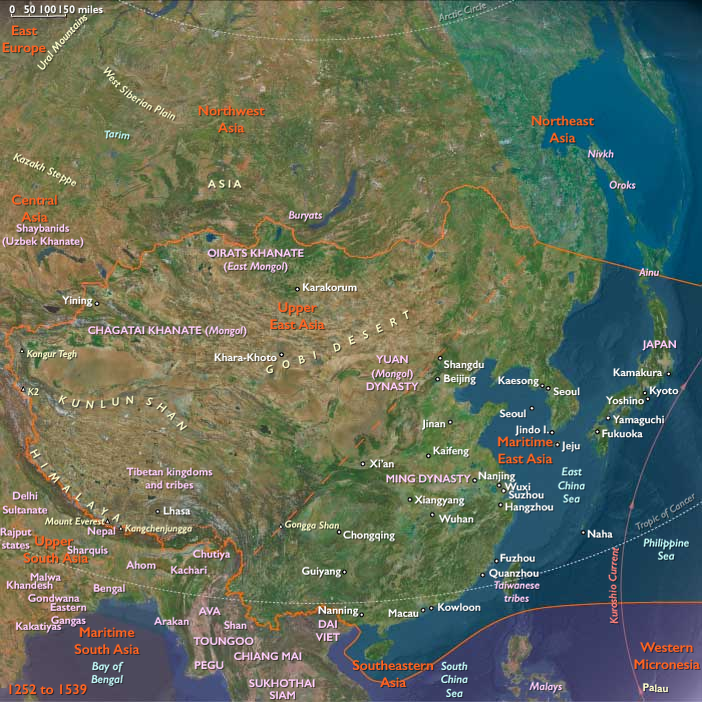
Japanese contact with Ming Dynasty China is renewed during the Muromachi period when the Chinese seek support in suppressing Japanese pirates, referred to as wokou by the Chinese and wako by the Japanese, in coastal areas of China.
Wanting to improve relations with China and to rid Japan of the wokou threat, Yoshimitsu accepts a relationship with the Chinese that is to last for half a century.
In 1401 he restarts the tribute system, trading Japanese wood, sulfur, copper ore, swords, and folding fans for Chinese silk, porcelain, books, and coins, in what the Chinese consider tribute but the Japanese see as profitable trade.
Locations
People
Groups
Commodoties
Subjects
Regions
Related Events
Filter results
Showing 10 events out of 42724 total
The rulers of Dai Viet, in the person of King Tran Thuong Tong and his regent, General Ho Qui Ly, transfer the Vietnamese capital southward from Hanoi to Thanh Hoa in 1398.
Shortly thereafter, the general had adroitly engineered Tong’s overthrow, placing the three-year-old crown prince on the throne.
By 1400 however, Ho had seized the Tran throne for himself.
The following year, Ho abdicates in favor of his son, Ho Han Thuong, but remains the real power in Dai Viet.
The region of present Burma, or Mynamar, had divided in the fourteenth century into a number of rival kingdoms, chief of which are Ava in Upper Burma and Pegu in Lower Burma.
These two states, while warring with each other, also fight Toungoo (a state on the Ava-Pegu frontier), the neighboring Shan people, and the Arakan kingdom on the west coast.
Since 1369-1539, Hanthawaddy has been the capital of the Mon Kingdom of Ramanadesa.
A succession dispute following the death of Ava’s King Minyekyawswa in 1401 enables Pegu’s King Rajadhirat, or Razadarit, to launch several attacks against his northern neighbor.
His flotilla sails up the Irrawaddy river in 1406 and, despite defeats suffered en route, manages to reach and settle outside the town walls of Sagaing, across the river from Ava.
Ho Quy Ly’s foremost concern is stable relations with China’s Ming Dynasty.
Unfortunately, this matter proves impossible for the Ho family to pursue, given the level of civil unrest in Dai Viet.
The descendants of the deposed Tran Dynasty have begun agitating against the usurper, and the chaotic state of the country allows an opportunity for the Ming to reclaim Nanyue with the help of the Tran sympathizers.
The Joseon Dynasty is in 1401 officially admitted to enter into a tributary relationship with the Ming Dynasty.
Meanwhile, the Grand King Former, Taejo, has refused to relinquish the royal seal that signifies the legitimacy of any king's rule.
Uncomfortable at the fact that his father does not recognize him as a de jure ruler because of the family deaths he has caused, Taejong has sent several messengers, among them his childhood friend Bak Sun, to recover the royal seal.
However, Taejo has ordered the assassination of every messenger that comes into the sight of his guards as a sign of his fury at Taejong, who continues to remain unaware of their fates. (This episode is to become known as the Case of the Hamhung Envoys, and the term "Hamhung envoy" is still used to refer to a person who has gone on an assignment from whom there is no reply concerning their whereabouts.)
A war had broken out in 1386 between Algirdas' sons, Skirgaila and Andrei of Polotsk.
The latter had fled from Polotsk to Smolensk and asked its prince for help.
The armies of Smolensk and Skirgaila clashed near Mstislavl in the Battle of the Vikhra River.
After the prince was killed in battle and his brothers were taken prisoner, the Lithuanians approached Smolensk and allowed his son Yury to assume the throne on certain conditions, after exacting a sizable indemnity from him.
While Yury was visiting his father-in-law, Oleg Korotopol of Ryazan, in 1395, Grand Duke Vytautas the Great (Vitovt) of Lithuania had taken Smolensk and installed his governor there.
Four years later, Vytautas had been routed by the Tatars in the Battle of the Vorskla River.
In 1401, Yury and Oleg make use of his plight to retake Smolensk and …
Vytautas had signed the Salynas peace treaty with the Teutonic Knights and transferred Samogitia to them in preparation for the crusade against the Golden Horde in 1398.
Samogitia is especially important for the order because it separates Teutonic Knights, based in Prussia, from the Livonian Order, based in Latvia.
The two orders desire to unite and form a mighty force, and the Poles and the Lithuanians have little option but to suffer in silence, for they are still not prepared militarily to confront the power of the Knights.
However, after the Knights have ruled Samogitia for three years, the Samogitians, supported by Vytautas, rebel in 1401 and burn two castles.
The knights have received support from Vytautas’s cosuin Švitrigaila, brother of Jagiello, who desires to take Vytautas' title.
Švitrigaila, formerly based in Polotsk, had in 1392 made an ill-fated attempt to seize neighboring Vitebsk, but had been ousted by Vytautas to Prussia.
While living abroad, Švitrigaila had sided with the Teutonic Knights in their prolonged struggle against Vytautas.
He had been allowed in 1400 to return to Lithuania, receiving Podolia as his demesne.
The formal union of Poland and Lithuania is dissolved in 1401 as a result of disputes over legal terminology.
The Union of Vilnius and Radom of 1401 confirms Vytautas's status as grand duke under the overlordship of his cousin Wladyslaw, while assuring the title of grand duke to the heirs of Wladyslaw rather than those of Vytautas: should Wladyslaw die without heirs, the Lithuanian boyars are to elect a new monarch.
Since no heir has yet been produced by either monarch, the act's implications are unforeseeable, but it forges bonds between the Polish and Lithuanian nobility and a permanent defensive alliance between the two states, strengthening Lithuania's hand for a new war against the Teutonic Order in which Poland officially takes no part.
While the document leaves the liberties of the Polish nobles untouched, it grants increased power to the boyars of Lithuania, whose grand dukes have until now been unencumbered by checks and balances of the sort attached to the Polish monarchy.
The Union of Vilnius and Radom therefore earns Wladyslaw a measure of support in Lithuania.
The new war against the Order overstretches the resources of the Lithuanians, who in late 1401 find themselves fighting on two fronts after uprisings in the eastern provinces.
The annual Scania Market for herring, held from August 24 to October 9 at the Falsterbo Peninsula, chiefly between the two towns of Skanör and Falsterbo, at the southern mouth of Öresund, is a major event in the Hanseatic world around the Baltic Sea, and the cornerstone of the Hanseatic Leagues' wealth.
Beside the Hansa, also traders from England, Scotland, Flanders and Normandy come to the herring market, trading a wide variety of different goods, among them horses, butter, iron, tar, grain and handicraft products from the North, Prussia, and Livonia.
The basis for the market's popularity is the rich herring fishing around the peninsula.
During the fishing season, the necessary salt and barrels for conservation are provided by Hanseatic traders mainly from Lübeck, and to some extent also the work force, ensuring a swift salting of the landed fish.
The demand for herring, which is salted with salt from Hanseatic Lüneburg, is great as the Catholic Church demands fasting (from meat), in Christ's following, in connection with Lent.
In a strict sense, even Friday is considered a meat-free day.
The fishing and the Scanian market yield a large income to the Danish Crown, and together with the Sound Toll make the state virtually independent of tax incomes for extended periods of time.
A good fishing year in the fourteenth century can mean an export of three hundred thousand barrels of herring; it is estimated that one third of the Danish king's income came from the Scanian market, which, due to the large production and the great demand, has become the most important market of the region in the fourteenth century.
Most of the fourteenth century has been characterized by strife and wars between Danish kings and the Hansa, although with the Treaty of Stralsund a peace had been settled in 1370 that had left the Hanseatic League in control of the Scanian herring fishery for fifteen years.
The abundance of herring abruptly ceases abruptly, however, in the beginning of the fifteenth century.

Sigismund is once imprisoned and twice deposed on his return to Hungary in 1401.
This struggle in its turn leads to a war with the Republic of Venice, as Ladislas of Naples before departing to his own land had sold the Dalmatian cities to the Venetians for one hundred thousand ducats.