
James Oglethorpe, after purchasing Ayuba Suleiman Diallo, …
Years: 1733 - 1733
James Oglethorpe, after purchasing Ayuba Suleiman Diallo, sends him to the London office of the Royal African Company in London; Bluett and Ayuba travel in 1733 to England.
Ayuba learns during the journey to communicate in English.
However emotionally swayed his letters claimed him to be, Oglethorpe had not been so conscientious to leave instructions with the London office of the RAC concerning what to do with Ayuba in late April 1733 upon his arrival.
Captain Henry Hunt (or perhaps his brother, William Hunt), one of the original factors in charge of Ayuba's enslavement, arranges for lodging in a country province, yet Ayuba hears rumors that Hunt is planning to sell him to traders who claim they will deliver him home.
Ayuba, fearing yet more trickery, contacts Bluett and other men whom he had met en route to London.
Bluett arranges for Ayuba’s stay in Cheshunt in Hertfordshire.
The RAC, following Oglethorpe’s orders, made in part through persistent requests from interested men in London, subsequently pay all the expenses and purchase price of the bond for Ayuba.
Ayuba beseeches Bluett once again, explaining that none of this secured he would not be enslaved once again.
According to Bluett, all the honorable men involved had promised they would not sell Ayuba into slavery, so, though supposedly Ayuba is not under any threat, Bluett and other sympathizers pay “fifty-nine pounds, six shillings, and eleven pence half-penny” simply to ease Ayubya’s anxiety.
Englishmen in London and surrounding provinces who have met Ayuba collect money for his “freedom in form,” an official document seal made and sealed by the RAC.
Bluett later explained, “Job’s Mind being now perfectly easy,” he could fraternize with London’s elite, obtaining many gifts and new friendships, while also being of service to Hans Sloane through his newly acquired ability to translate Arabic into English.
Ayuba is in the company of many other prominent people, including the royal family and the Duke and Duchess of Montague.
The portrait of Diallo by William Hoare of Bath is painted in 1733.
Previously known only from a print, the original was believed lost.
It was not seen in public until 2010, it was offered to the National Portrait Gallery in London, which launched an appeal to raise its cost of £554,937 (with a deadline of August 25, 2010) to prevent its export.
Most of this money was provided by the Heritage Lottery Fund and the Art Fund; the Gallery launched a public appeal for the remaining one hundred thousand pounds.
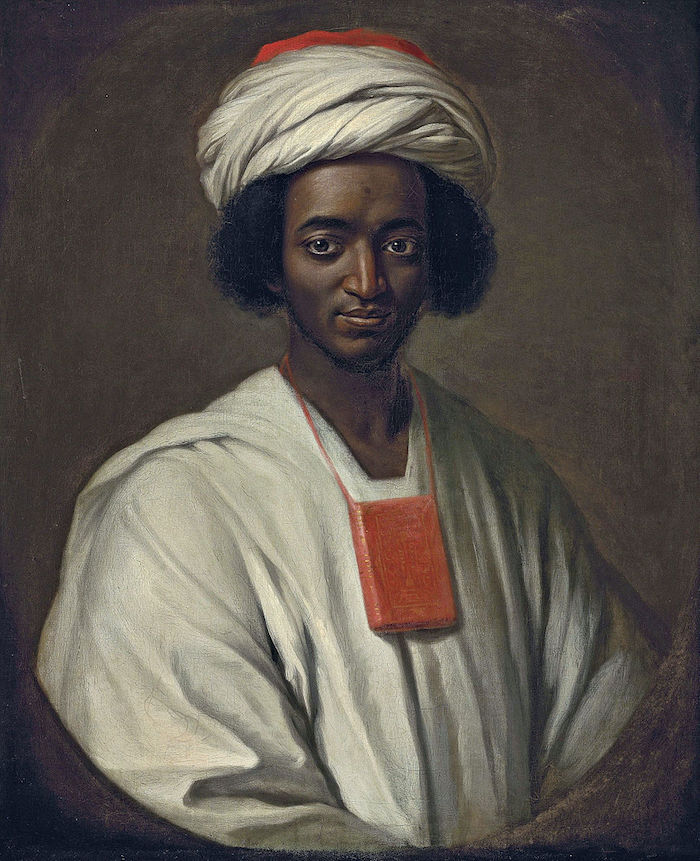
Portrait of Ayuba Suleiman Diallo, called Job ben Solomon, by William Hoare (1733) in African dress, with the Qu'ran around his neck
Locations
People
Groups
Topics
Commodoties
Subjects
Regions
Subregions
Years: 1733 - 1733
Portrait of Ayuba Suleiman Diallo, called Job ben Solomon, by William Hoare (1733) in African dress, with the Qu'ran around his neck
Locations
People
Groups
Topics
Commodoties
Subjects
Regions
Subregions