
Symphony in White, No. 2, also …
Years: 1865 - 1865
Symphony in White, No. 2, also known as The Little White Girl, a painting by James Abbott McNeill Whistler, shows a woman in three-quarter figure standing by a fireplace with a mirror over it, holding a fan in her hand, and wearing a white dress.
The model is Joanna Heffernan, the artist's mistress.
Though the painting is originally called The Little White Girl, Whistler will later start calling it Symphony in White, No. 2.
By referring to his work in such abstract terms, he intends to emphasize his "art for art's sake" philosophy.
In this painting, Heffernan wears a ring on her ring finger, even though the two are not married.
By this religious imagery, Whistler emphasizes the aesthetic philosophy behind his work.
Whistler had created the painting in the winter of 1864, and it is displayed at the Royal Academy in 1865 The original frame carries a poem written by Whistler's friend Algernon Charles Swinburne—titled Before the Mirror—written on sheets of golden paper.
The poem is inspired by the painting, and to Whistler this demonstrates that the visual arts need not be subservient to literature.
Though there are few clues to the meaning and symbolism of the painting, critics have found allusions to the work of Ingres, as well as oriental elements typical of the popular Japonisme.
James Abbott McNeill Whistler was born in the United States in 1834, the son of George Washington Whistler, a railway engineer.
In 1843, his father had relocated the family to Saint Petersburg, Russia, where James had received training in painting.
After a stay in England, he had returned to America to attend the US Military Academy at West Point in 1851.
In 1855, he had made his way back to Europe, determined to dedicate himself to painting.
At first settling in Paris, he had moved in 1859 to London, where he will spend most of the remainder of his life.
Her he has met Dante Gabriel Rossetti and other members of the Pre-Raphaelite Brotherhood, who have a profound influence on Whistler.
It was also in London that Whistler meets Joanna Hiffernan, the model who becomes his lover.
Their relationship has been referred to as a "marriage without benefit of clergy."(Weintraub, Stanley (1974). Whistler: A biography. London: Collins p. 71)
By 1861, Whistler had already used her as a model for other paintings.
In Wapping, painted between 1860 and 1864, Hiffernan (according to Whistler) portrayed a prostitute.
The direct precursor of The Little White Girl is a painting created in the winter of 1861–62, initially called The White Girl and later renamed Symphony in White, No. 1.
Hiffernan supposedly has a strong influence over Whistler; his brother-in-law Francis Seymour Haden had refused a dinner invitation in the winter of 1863–64 due to her dominant presence in the household.
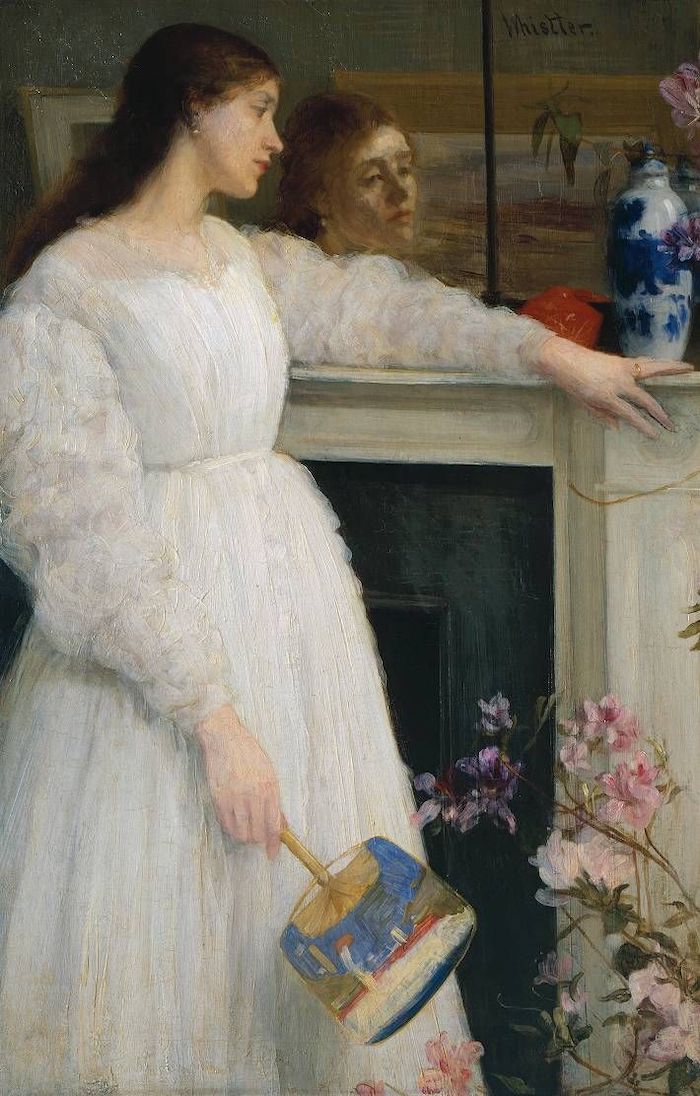
James McNeill Whistler: Symphony in White, No. 2: The Little White Girl (1864–65) Oil on canvas; 76 cm × 51 cm (30 in × 20 in), Tate Gallery, London
Locations
People
Groups
Topics
Subjects
Regions
Subregions
Years: 1865 - 1865
James McNeill Whistler: Symphony in White, No. 2: The Little White Girl (1864–65) Oil on canvas; 76 cm × 51 cm (30 in × 20 in), Tate Gallery, London
Locations
People
Groups
Topics
Subjects
Regions
Subregions