Jakob Fugger is responsible for his family's …
Years: 1488 - 1488
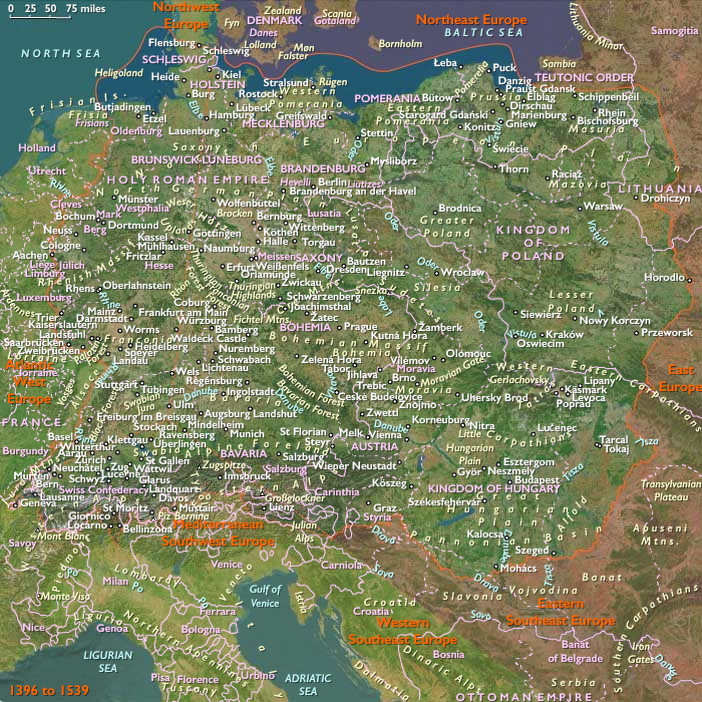
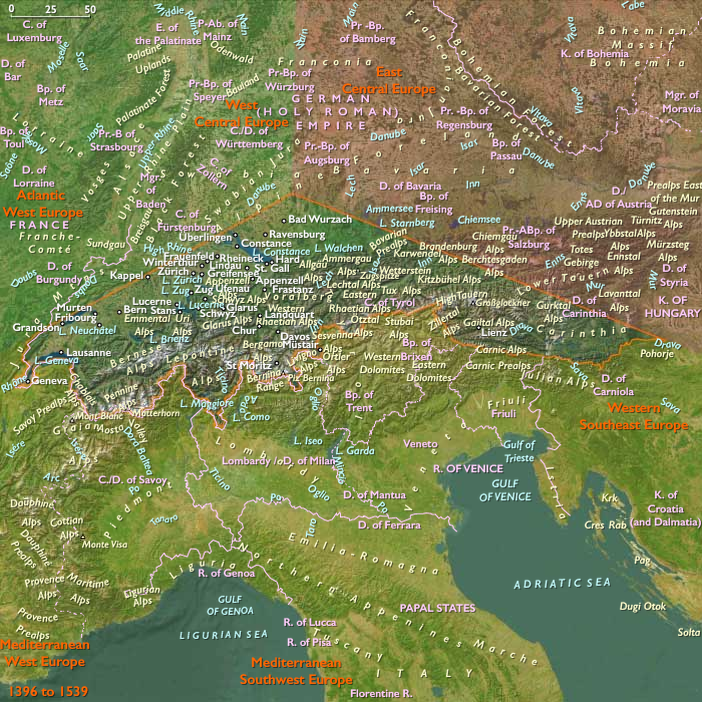
Jakob Fugger is responsible for his family's business in Augsburg, Tyrol, Venice and Rome.
Around 1485, the family had also founded manufactories in Innsbruck.
Through a small loan, he there had first come into contact with Archduke Sigismund, a member of the Habsburg family.
The archduke, as the sole owner of the Tyrol property rights, has handed out permissions for mining operations to private investors which in return have to pay a share of their profits to Sigismund.
Despite this income he is constantly short of money owing to a lavish lifestyle, several illegitimate children and his extensive construction projects.
A responsibility to pay the amount of one hundred thousand guilders of war reparations to Venice is eventually financed by Jakob Fugger.
In 1488, the total debt already amounts to more than one hundred and fifty thousand guilders.
Notable is the form of payment: instead of paying the Fürst directly, the Fugger family pays the money to his creditors as well as providing the wages for the royal court and craftsmen.
Locations
People
Groups
- Augsburg, Prince-Bishopric of
- Tyrol, County of
- Venice, (Most Serene) Republic of
- Austria, Archduchy of
- Nuremberg, Free Imperial City of
- Salzburg, Archbishopric of
- Holy Roman Empire
Commodoties
Subjects
Regions
Subregions
Related Events
Filter results
Showing 10 events out of 40457 total
The Mamluks—against whom the military leaders of Ottoman sultan Bayezid press for revenge in retaliation for Mamluk support of his rebellious brother in the recent civil war—interfere in Cappadocia by stirring up eastern Turkmen nomads and asserting authority over Lesser Armenia.
Hostilities had broken out in 1486 when Sultan Qaitbay contested with Bayezid the possession of some border towns in Palestine.
The Ottomans, desirous of a share in control of the Muslim holy cities of Mecca and Medina, had initiated a series of annual campaigns against the Mamluks, five of which end indecisively and one of which ends, in 1488, in a small victory by the Mamluks.
Al-Zagal has lost prestige from the fall of Málaga, and Boabdil had taken over all of the city of Granada in 1487; he additionally controls the northeast of the country with Vélez-Rubio, Vélez-Blanco, and Vera.
Al-Zagal still controls Baza, Guadix, and Almería.
Boabdil takes no action as the Christian forces take some of his land, perhaps assuming it will shortly be returned to him.
Amadeo is commissioned in 1488 by Cardinal Ascanio Sforza as the director of works of the new Pavia Cathedral, again with Bramante having a minor role, making a model for the cathedral.
Tuscan artist Luca Signorelli, associated by the 1470s with Piero della Francesca, from whom he learned perspective, and deeply influenced by the anatomical studies of Antonio Pollaiuolo, also employs the mythological iconography of Pollaiuolo and Sandro Botticelli.
Such paintings as his School of Pan, painted around 1488 (destroyed in Berlin by Allied bombs in 1945) correspond to Pollaiuolo's experiments in depicting human motion.
Signorelli's fresco decorations rank among the finest of such paintings made in central Italy in the 1480s and 1490s, displaying the artist’s commitment to the goal of scientifically rationalizing space and the human figure.
He was born Luca d'Egidio di Ventura in Cortona, Tuscany (some sources call him Luca da Cortona).
The precise date of his birth is uncertain; birth dates of 1441–1445 are proposed.
He is considered to be part of the Tuscan school, although he also works extensively in Umbria and Rome.
His first impressions of art seem to be due to Perugia—the style of Benedetto Bonfigli, Fiorenzo di Lorenzo and Pinturicchio.
Lazzaro Vasari, the great-grandfather of art historian Giorgio Vasari, was brother to Luca's mother; according to Giorgio Vasari he got Luca apprenticed to Piero della Francesca.
In 1472 the young man was painting at Arezzo, and in 1474 at Città di Castello.
He is known to have presented to Lorenzo de' Medici a picture that is probably the one named the School of Pan.
Girolamo is killed, after more than a half dozen failed attempts, on April 14, 1488 by a conspiracy led by the Orsis, a noble family of Forlì.
The lord's palace is sacked, while Caterina and her children are made prisoners.
The fortress of Ravaldino, a central part of the defensive system of the city, refuses to surrender to the Orsis.
Caterina offers to attempt to persuade the castellan, Tommaso Feo, to submit.
The Orsis believe Caterina because she has left her children as hostages, but once inside she lets loose a barrage of vulgar threats and promises of vengeance against her former captors.
According to a legend, when they threatened to kill her children, Caterina, standing in the walls of the fortress exposed her genitals and said: "Fatelo, se volete: impiccateli pure davanti a me... qui ho quanto basta per farne altri!"
("Do it, if you want to: hang them even in front of me...here I have what's needed to make others!").
Shocked by this response, the Orsis don't dare to touch the Riario children.
With the assistance of her uncle Ludovico il Moro (very interested in securing some influence in the Romagna, to counter the influence of Venice), Caterina defeats her enemies and regains possession of her dominions.
On April 30, 1488, Caterina becomes regent for her eldest son Ottaviano, formally recognized by all the members of the Commune and the head of the magistrates as the new Lord of Forlì that day, but too young to exercise power directly.
Caterina's first act as Regent of Forlì is to avenge the death of her husband, according to the custom of the time.
She orders that all those involved in the Orsi conspiracy are to be imprisoned, along with the Pope's governor, Monsignor Savelli, all the pontifical generals, and the castellan of the fortress of Forlimpopoli, and also all women of the Orsis and other families who had assisted in the conspiracy.
Soldiers seek out all who had taken part in the conspiracy.
Houses owned by those imprisoned are razed while their valuables are distributed to the poor.
News comes on July 30 that Pope Innocent VIII has given Ottaviano Riario the official investiture of his state "until his line ended."
In the meantime, Forlì is visited by Cardinal Raffaele Riario, officially to protect the orphan children of his late cousin Girolamo but actually to oversee the government of Caterina.
The young Countess personally deals with all issues concerning the government of her city-state, both public and private.
To consolidate her power, she exchanges gifts with the lords of neighboring states and involves herself in marriage negotiations for her children.
She decreases taxes by reducing some and eliminating others, and sharply controls her realm's spending.
Caterina deals directly with the training of her militia in the use of weapons and horses.
It is her intention that her cities and towns be orderly and peaceful, and she expects her subjects to appreciate these efforts.
Two months after the death of Girolamo, a rumor is spread that Caterina is close to marrying Antonio Maria Ordelaffi, who had started to court her.
This marriage would end the claims of the Ordelaffi family on the city of Forlì.
Antonio Maria, feeling confident, has written to the Duke of Ferrara that the Countess has promised to marry him.
When Caterina sees how things stand, she imprisons those who had spread the false news.
These promises are addressed by the Senate in Venice, which summons Antonio Maria to Friuli, where he will remain confined for ten years.
Caterina has meanwhile fallen in love with Giacomo Feo, the brother of Tommasso Feo, the castellan who had remained faithful to her after the assassination of her husband.
Caterina marries him in 1488, but secretly, to avoid losing custody of her children and the regency of her dominions.

The island of La Gomera had not been taken in battle but had been incorporated into the Peraza-Herrera fiefdom through an agreement between Hernán Peraza the Elder and some of the insular aboriginal groups who had accepted the rule of the Castilian.
Outrages committed by the rulers on the native Gomeros lead to a number of uprisings by the Guanches, the last of which, in 1488, causes the death of the island’s ruler, Hernán Peraza, whose widow, Beatriz de Bobadilla y Ossorio, has to seek the assistance of Pedro de Vera, conqueror of Gran Canaria, in order to snuff out the rebellion.
The subsequent repression causes the death of two hundred rebels and many others are sold into slavery in the Spanish markets.
The Breton Crisis and the Battle of Saint-Aubin-du-Cormier (1488)
By 1488, the fiercely independent Duchy of Brittany, at this time strategically aligned with England, faced imminent threat from the French crown, which sought its annexation. Brittany, ruled by Duke Francis II, had long resisted absorption into the French kingdom, preserving autonomy through shifting alliances—most notably with Henry VII of England. The prospect of Brittany falling permanently into French hands provoked intense anxiety and popular sympathy across England, motivating the English crown to support Brittany militarily.
English Intervention and Diplomatic Maneuvering (1488)
Responding to rising English popular sentiment supporting Brittany’s independence against France’s encroachments, King Henry VII secured parliamentary funding in 1488, enabling him to dispatch three warships and a contingent of English volunteer troops to Brittany. Although a relatively modest force, this deployment represented a symbolic commitment by England to uphold Breton independence, challenging France’s ambitions to incorporate the duchy directly under royal rule.
This English intervention reflected broader geopolitical interests, as Henry VII aimed to prevent a unified French coastline opposite England, safeguarding English trade and maritime influence in Atlantic West Europe.
Anne of France and the Battle of Saint-Aubin-du-Cormier
Within France, the regency government, led by the astute Anne of France (Anne of Beaujeu), acting on behalf of her younger brother, the teenage King Charles VIII, aggressively pursued the subjugation of Brittany. Breton nobles opposed the French crown and had openly supported Louis, Duke of Orléans, who sought greater power as regent during Charles VIII’s minority, triggering the conflict known as the Mad War (1485–1488).
The decisive encounter of this conflict occurred at the Battle of Saint-Aubin-du-Cormier, fought on July 28, 1488, where French royal forces decisively crushed the Breton forces, which included Breton loyalists and their noble allies who backed Duke Louis of Orléans’ claim to the regency. The battle marked a critical French victory that permanently weakened Breton autonomy and reinforced royal authority within Brittany.
Defeat and Consequences for Brittany
The defeat at Saint-Aubin-du-Cormier severely curtailed Brittany's autonomy, significantly undermining its independent political aspirations. Duke Francis II, Breton leader, died shortly after the battle, leaving his young daughter, Anne of Brittany, in a precarious position. The subsequent Treaty of Sablé (1488) restricted Brittany's ability to conduct independent diplomacy, forcing Anne of Brittany into marriage alliances acceptable to the French crown.
Geopolitical Consequences and Long-term Significance
This decisive battle significantly reshaped Western Europe's political landscape. Brittany’s defeat at Saint-Aubin-du-Cormier led directly to its eventual annexation into France, completed through the marriage of Anne of Brittany to King Charles VIII of France in 1491. This union effectively extinguished Brittany’s long-held independence, absorbing the duchy permanently into France and reshaping the geopolitical balance in the region.
For England, the outcome represented a major diplomatic setback, demonstrating the limitations of Henry VII's cautious foreign policy and setting the stage for renewed rivalry between France and England in the coming decades.
Historical Impact
The Breton Crisis and the Battle of Saint-Aubin-du-Cormier marked a decisive turning point in late medieval European history, symbolizing the growing power of centralized monarchies over regional autonomy. Brittany’s loss of independence exemplified the ongoing consolidation of royal authority, while simultaneously highlighting the emerging framework of early modern state diplomacy and international alliances in Atlantic West Europe.
The Treaty of Sablé and the End of Breton Independence (1488)
The Treaty of Sablé, signed in August 1488, marked a decisive turning point in the centuries-long struggle between Brittany and the French crown. The treaty, resulting directly from Brittany’s catastrophic defeat at Saint-Aubin-du-Cormier, stripped away the duchy’s remaining political autonomy and set the stage for its annexation into France. This pivotal agreement reshaped the political and territorial landscape of late medieval Atlantic West Europe.
Terms of the Treaty
Under the Treaty of Sablé, England, whose support Brittany had previously counted upon, was forced to withdraw entirely from Breton affairs. The key terms severely curtailed Breton independence:
- Foreign troops, particularly the English, were compelled to leave Brittany, ending direct foreign involvement.
- Anne of Brittany, the young daughter and heir of Duke Francis II, was expressly forbidden to marry without the permission of the French king, Charles VIII, a stipulation intended to ensure Brittany’s absorption into France through marriage rather than force.
- Brittany’s military independence was severely limited, and its foreign policy was explicitly subordinated to French oversight.
Death of Francis II and Charles VIII's Move
Just two weeks after the treaty’s ratification, Duke Francis II of Brittany died on September 9, 1488, leaving his eleven-year-old daughter, Anne of Brittany, vulnerable and politically isolated. Capitalizing quickly on these circumstances, King Charles VIII of France promptly asserted direct claims over Brittany, insisting upon his right to determine Anne’s marriage—and ultimately aiming to wed her himself, thus definitively uniting Brittany with the French crown.
Geopolitical Consequences
The sudden death of Francis II enabled Charles VIII to swiftly press his advantage. His claim over Anne and her duchy marked the effective end of independent Breton sovereignty, triggering a political realignment in Western Europe. This outcome decisively thwarted English ambitions in Brittany, consolidating French territorial and dynastic power while further isolating England diplomatically.
Charles's strategic maneuver ensured a significant expansion of French royal power and removed a persistent thorn from France’s western flank, thereby dramatically strengthening the monarchy’s geopolitical position.
Long-Term Historical Significance
The Treaty of Sablé (1488) and subsequent annexation of Brittany were pivotal events in the formation of early modern France. By absorbing Brittany through marriage rather than outright conquest, Charles VIII skillfully legitimized the integration of the duchy into the French state. This not only reinforced royal centralization but also set a precedent for future territorial annexations through marital diplomacy—an approach characteristic of late medieval and early modern European statecraft.
The treaty also marked a critical defeat for England, ending decades of diplomatic and military attempts to maintain Brittany as a strategically independent counterweight to French power. The loss solidified French dominance in Western Europe, laying the groundwork for future conflicts, alliances, and territorial expansions that defined European politics for the next century.
Thus, the events surrounding the Treaty of Sablé fundamentally altered the geopolitical balance of power in late medieval Atlantic West Europe, accelerating the transition from a mosaic of semi-independent principalities toward a centralized, unified French monarchy.
Philip of Cleves and the Burgundian Crisis (1477–1492)
Philip of Cleves, son of Adolph of Cleves, Lord of Ravenstein, and grandson of the Burgundian Duke John the Fearless, emerged as a prominent figure during the chaotic transition of power following the death of Charles the Boldin 1477. Deeply rooted in the Burgundian dynasty—his mother, Beatrix of Portugal, was closely tied to the Burgundian royal lineage—Philip held influential roles as a military leader and political figure during the turbulent era of Burgundian succession and the Flemish revolts.
Early Career and Influence
In 1477, Philip had distinguished himself as a military commander in French Flanders, opposing French incursions vigorously in the wake of Charles the Bold’s death. He demonstrated diplomatic skill and military effectiveness by restoring stability in 1482 to the rebellious Prince-Bishopric of Liège after the assassination of Louis de Bourbon, the Burgundian-supported bishop, by the insurgent faction led by William de la Marck (the “Wild Boar of the Ardennes”).
Philip’s capability earned him the high-ranking position of Admiral of Flanders (1485–1488), and he served loyally under Archduke Maximilian of Austria, husband of Burgundian heiress Mary, in the struggle to suppress repeated rebellions by Flemish cities, notably Ghent, Bruges, and Ypres.
Diplomatic Alliances and Personal Ties
Philip’s marriage in 1485 to Beatrix of Portugal’s daughter, Beatrix (or Beatrice), further cemented his dynastic prestige, although the union produced no heirs. Despite this, his family connections granted Philip significant political influence, extending beyond local affairs into broader European politics.
Role During Maximilian’s Imprisonment (1488)
Philip’s loyalty to Maximilian was tested when the archduke became imprisoned by rebellious citizens of Bruges in early 1488. Demonstrating considerable bravery and loyalty, Philip offered himself as a voluntary hostage, replacing Maximilian to secure the Archduke’s release. Although his offer was initially recognized as noble, the continued instability and distrust in Bruges led to its rejection. Maximilian, humiliated by the forced concessions of the subsequent Peace of Bruges, was eventually freed without Philip’s hostage exchange.
Disillusionment and Shift of Allegiance (1488–1492)
Following these events, Philip of Cleves became increasingly disillusioned with Maximilian’s political leadership, especially after witnessing firsthand the limits of Maximilian’s military strategy and diplomacy. Disenchanted by Maximilian’s heavy-handed attempts to impose centralized authority and offended by the archduke's perceived neglect of Flemish interests, Philip’s allegiance shifted dramatically. He actively aligned himself with the rebellious Flemish cities—particularly Ghent, Bruges, and Ieper—which strongly opposed Maximilian’s centralizing policies.
Failed Alliances and Isolation
Philip attempted to consolidate a broad coalition against Maximilian’s rule, seeking diplomatic and military support from external powers, most notably from King Charles VIII of France, Maximilian’s most potent rival. However, the French king’s assistance remained limited and largely symbolic. Further overtures toward the Dutch Hooks, the Brabantine estates, and the city of Liège similarly failed, leaving Philip politically isolated and militarily vulnerable. His anti-Habsburg strategy ultimately faltered due to inadequate external backing and growing internal division among the Flemish cities.
Historical Significance and Legacy
Philip of Cleves's political trajectory reflects the intense personal and political dilemmas confronting Burgundian nobility in the late fifteenth century, as regional identities clashed with dynastic loyalties. His shifting allegiance from staunch Habsburg supporter to rebel leader demonstrates the volatile interplay between local autonomy and centralized governance characteristic of late medieval Europe.
Although Philip ultimately failed to achieve lasting independence for Flanders and his anti-Habsburg coalition dissolved, his rebellion contributed significantly to shaping regional identities and political alignments that persisted into the early modern era. The resistance Philip fostered helped shape regional identities, setting a lasting precedent for local autonomy movements that would later culminate in the broader Dutch Revolt of the late sixteenth century.
Philip of Cleves thus emerges as a pivotal figure, whose actions illustrate the complex interplay of dynastic politics, regional loyalties, and European diplomatic dynamics that profoundly influenced the historical trajectory of Atlantic West Europe during the late medieval period.
Conspirators directed by Douglas in 1488 capture James’ fifteen-year-old son.
After James attempts, unsuccessfully, to come to terms with the conspirators, he flees to Stirling, where the keeper of the castle refuses, treasonously, to grant his monarch admission.
James then faces the conspirators’ army at Suachie Burn, where, injured by a fall from his horse, James is stabbed to death by an unknown assailant.
His grieving son is released and crowned James IV, with Douglas named as regent.
Years: 1488 - 1488
Locations
People
Groups
- Augsburg, Prince-Bishopric of
- Tyrol, County of
- Venice, (Most Serene) Republic of
- Austria, Archduchy of
- Nuremberg, Free Imperial City of
- Salzburg, Archbishopric of
- Holy Roman Empire