
Filters:
David paints his famous Oath of the …
Years: 1784 - 1784
David paints his famous Oath of the Horatii, in Rome, 1784.
In this piece, the artist references Enlightenment values while alluding to Rousseau's social contract.
The republican ideal of the general will becomes the focus of the painting with all three sons positioned in compliance with the father.
The Oath between the characters can be read as an act of unification of men to the binding of the state.
The issue of gender roles also becomes apparent in this piece, as the women in Horatii greatly contrast the group of brothers.
David depicts the father with his back to the women, shutting them out of the oath making ritual; they also appear to be smaller in scale than the male figures.
The masculine virility and discipline displayed by the men's rigid and confident stances is also severely contrasted to the slouching, swooning female softness created in the other half of the composition.
Here we see the clear division of male-female attributes that confined the sexes to specific roles under Rousseau's popularized doctrine of "separate spheres".
These revolutionary ideals are also apparent in the Distribution of Eagles.
While Oath of the Horatii and The Tennis Court Oath stress the importance of masculine self-sacrifice for one's country and patriotism, the Distribution of Eagles will ask for self-sacrifice for one's Emperor (Napoleon) and the importance of battlefield glory.
In this piece, the artist references Enlightenment values while alluding to Rousseau's social contract.
The republican ideal of the general will becomes the focus of the painting with all three sons positioned in compliance with the father.
The Oath between the characters can be read as an act of unification of men to the binding of the state.
The issue of gender roles also becomes apparent in this piece, as the women in Horatii greatly contrast the group of brothers.
David depicts the father with his back to the women, shutting them out of the oath making ritual; they also appear to be smaller in scale than the male figures.
The masculine virility and discipline displayed by the men's rigid and confident stances is also severely contrasted to the slouching, swooning female softness created in the other half of the composition.
Here we see the clear division of male-female attributes that confined the sexes to specific roles under Rousseau's popularized doctrine of "separate spheres".
These revolutionary ideals are also apparent in the Distribution of Eagles.
While Oath of the Horatii and The Tennis Court Oath stress the importance of masculine self-sacrifice for one's country and patriotism, the Distribution of Eagles will ask for self-sacrifice for one's Emperor (Napoleon) and the importance of battlefield glory.
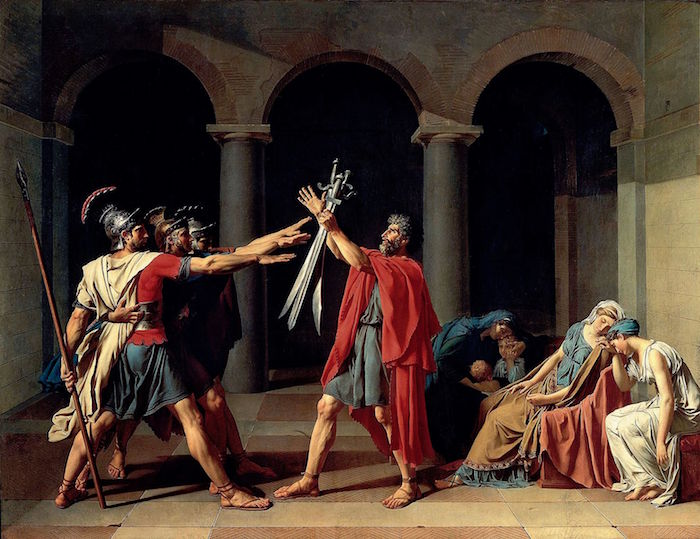
Jacques-Louis David: The Oath of the Horatii (1784/85); oil on canvas, 329.8 × 424.8 cm (129.8 × 167.2 in); Louvre Museum
Locations
People
Groups
Topics
Subjects
Regions
Subregions
Related Events
Showing 1 events out of 1 total
Years: 1784 - 1784
Jacques-Louis David: The Oath of the Horatii (1784/85); oil on canvas, 329.8 × 424.8 cm (129.8 × 167.2 in); Louvre Museum
Locations
People
Groups
Topics
Subjects
Regions
Subregions