
Jacqueline of Bavaria, Humphrey of Gloucester, and …
Years: 1425 - 1425
Jacqueline of Bavaria, Humphrey of Gloucester, and the Burgundian-English Struggle for Holland and Hainaut (1424–1425)
By autumn 1424, Jacqueline of Bavaria and her second husband, Humphrey, Duke of Gloucester, relocated to Gloucester’s ancestral lands in England. During this time, Jacqueline suffered a personal tragedy, giving birth to a stillborn child, her only recorded pregnancy.
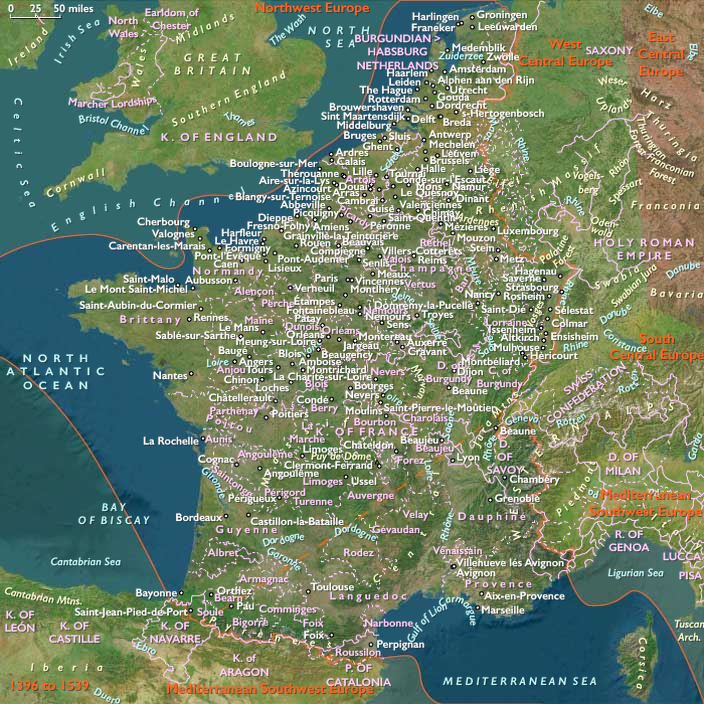
Shortly thereafter, the couple returned to the Low Countries, aiming to assert their rule over Hainaut, Holland, and Zeeland—territories Jacqueline had inherited but which remained contested by Burgundian forces.
I. Humphrey Declares Himself Ruler of Jacqueline’s Inherited Territories (December 1424 – January 1425)
- Jacqueline and Humphrey landed in Calais and, by late November 1424, entered Mons, the capital of Hainaut.
- On December 5, 1424, the Hainaut States formally recognized Humphrey as their sovereign Count, effectively rejecting Burgundian authority.
- On January 3, 1425, Humphrey asserted his full claim, signing documents with the grandiose title:
- “Humphrey, by the grace of God’s son, brother and uncle of kings, Duke of Gloucester, Count of Hainaut, Holland, Zeeland, and Pembroke, Lord of Friesland, and Grand Chamberlain of England.”
This public proclamation directly challenged the claims of both the Duke of Brabant and the Duke of Burgundy.
II. The Death of John III of Bavaria and the Burgundian Response (January 1425)
- On January 6, 1425, John III of Bavaria, Jacqueline’s longtime rival for Holland and Zeeland, died suddenly—apparently poisoned.
- With John III dead, John IV, Duke of Brabant, reasserted his claim over Holland, Zeeland, and Hainaut, once again challenging Jacqueline and Humphrey’s authority.
- As he had done before, John IV turned to Philip the Good, Duke of Burgundy, naming him:
- Regent of Holland and Zeeland.
- His heir, should he die without issue.
This maneuver effectively transferred control over Holland and Zeeland to Burgundy, dramatically weakening Jacqueline’s position.
III. The Burgundian Campaign Against the English and Jacqueline (1425)
- Philip the Good, Duke of Burgundy, launched a military campaign to assert his authority over Jacqueline’s contested lands.
- Burgundian forces decisively pushed back the English, forcing Humphrey’s troops to withdraw.
- By the end of the campaign, the English were completely ousted, and Philip consolidated control over Holland and Zeeland, effectively eliminating Jacqueline and Humphrey’s claim to the territories.
IV. Consequences and Jacqueline’s Diminishing Power
- The failure of the English to maintain control over Holland and Zeeland left Jacqueline politically isolated.
- The Burgundian expansion into the Low Countries continued, solidifying Philip the Good’s dominance in the region.
- Humphrey of Gloucester soon returned to England, leaving Jacqueline to face her fate alone in the Burgundian-controlled Low Countries.
By 1425, Jacqueline’s bid to rule independently had collapsed, as Burgundy successfully eliminated English influence in Holland and Zeeland, paving the way for the full Burgundian takeover of her territories.
Locations
People
- Humphrey of Lancaster, 1st Duke of Gloucester
- Jacqueline of Hainaut
- John III the Pitiless
- John IV, Duke of Brabant
- Philip the Good
Groups
- Burgundy, Duchy of
- Christians, Roman Catholic
- Hainaut, County of
- Holland, County of
- Brabant, Duchy of
- Zeeland, County of
- Bavaria-Straubing, Wittelsbach Duchy of
- Netherlands, Burgundian
- England, (Plantagenet, Lancastrian) Kingdom of
Topics
- Hundred Years' War
- Hook and Cod wars
- Armagnac-Burgundian Civil War
- Hundred Years' War: Resumption of the war under Henry V
Commodoties
Subjects
Regions
Subregions

Years: 1425 - 1425
Locations
People
- Humphrey of Lancaster, 1st Duke of Gloucester
- Jacqueline of Hainaut
- John III the Pitiless
- John IV, Duke of Brabant
- Philip the Good
Groups
- Burgundy, Duchy of
- Christians, Roman Catholic
- Hainaut, County of
- Holland, County of
- Brabant, Duchy of
- Zeeland, County of
- Bavaria-Straubing, Wittelsbach Duchy of
- Netherlands, Burgundian
- England, (Plantagenet, Lancastrian) Kingdom of
Topics
- Hundred Years' War
- Hook and Cod wars
- Armagnac-Burgundian Civil War
- Hundred Years' War: Resumption of the war under Henry V
Commodoties
Subjects
Regions
Subregions