
Jacob Sprenger, who in 1452 had been …
Years: 1487 - 1487
Jacob Sprenger, who in 1452 had been admitted as a novice in the Dominican house of Rheinfelden, Further Austria, had become a zealous reformer within the Order.
He had eventually become a Master of Theology, then Dean of the Faculty of Theology at the University of Cologne.
He had in 1474 founded an association of the Confraternity of the Holy Rosary in Strasbourg.
Appointed dean of the Faculty of Theology at the University in 1480, his lecture room had been thronged and the following year he had been appointed Inquisitor for the Provinces of Mainz, Trier and Cologne.
His activities in this post demand constant traveling through the very extensive district.
Named in the 1484 papal bull Summis desiderantes of Pope Innocent VIII, popular opinion makes Sprenger the co-author of the Malleus Maleficarum, the first important book on witchcraft.
The Malleus Maleficarum (“Hammer of Sorceresses”), written in 1486 in Speyer, is published in 1487 by Heinrich Kramer (Latinized as "Institoris").
Scholars have debated how much Sprenger contributed to the work.
Some say his role was minor, and that the book was written almost entirely by Kramer, who used the name of Sprenger for its prestige only, while others say there is little evidence for this claim.
It has been claimed that Sprenger was not interested in witches and that he cannot be linked to any witch trial.
His personal relationship to Kramer is acrimonious and Sprenger uses his powerful position whenever he can to make Kramer’s life and work as difficult as possible.
Scholars now believe that he became associated with the Malleus Maleficarum largely as a result of Kramer's wish to lend his book as much official authority as possible.
Kramer fails in his attempt to obtain endorsement for this work from the top theologians of the Inquisition at the Faculty of Cologne, who condemn the book as recommending unethical and illegal procedures, as well as being inconsistent with Catholic doctrines of demonology.
Magic, sorcery, and witchcraft had long been condemned by the Church, whose attitude towards witchcraft was explained in the canon Episcopi written in about 900.
It stated that witchcraft and magic did not really exist, and that those who believed in such things "had been seduced by the Devil in dreams and visions into old pagan errors".
Until about 1400 it was rare for anyone to be accused of witchcraft, but heresies had become a major problem within the Church by the thirteenth century, and by the fifteenth century belief in witches was widely accepted in European society.
Those convicted of witchcraft typically suffered penalties no more harsh than public penances such as a day in the stocks, but their persecution becomes more brutal following the publication of the Malleus Maleficarum, as witchcraft becomes increasingly accepted as a real and dangerous phenomenon.
Locations
People
Groups
- Papal States (Republic of St. Peter)
- Speyer, Prince-Bishopric of
- Christians, Roman Catholic
- Tyrol, County of
- Dominicans, or Order of St. Dominic
- Holy Roman Empire
Topics
Subjects
Regions
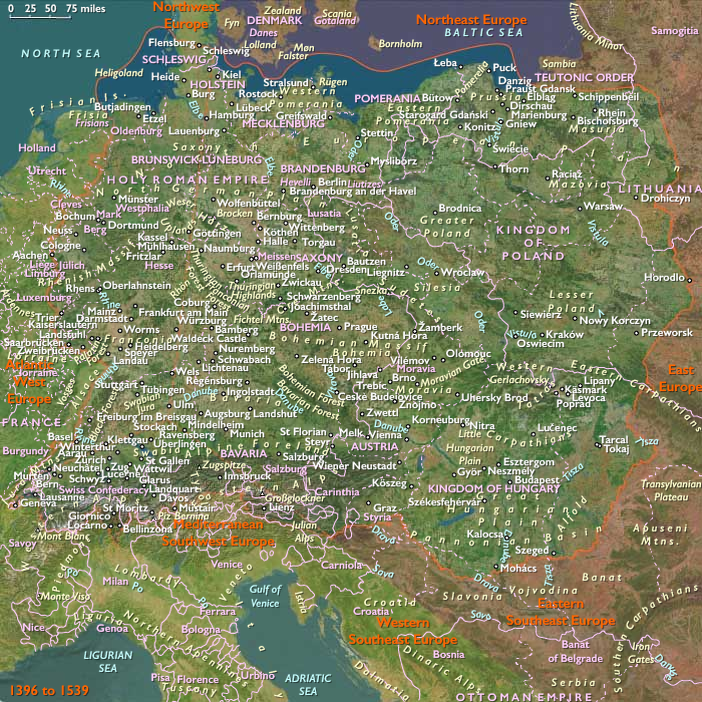
Subregions
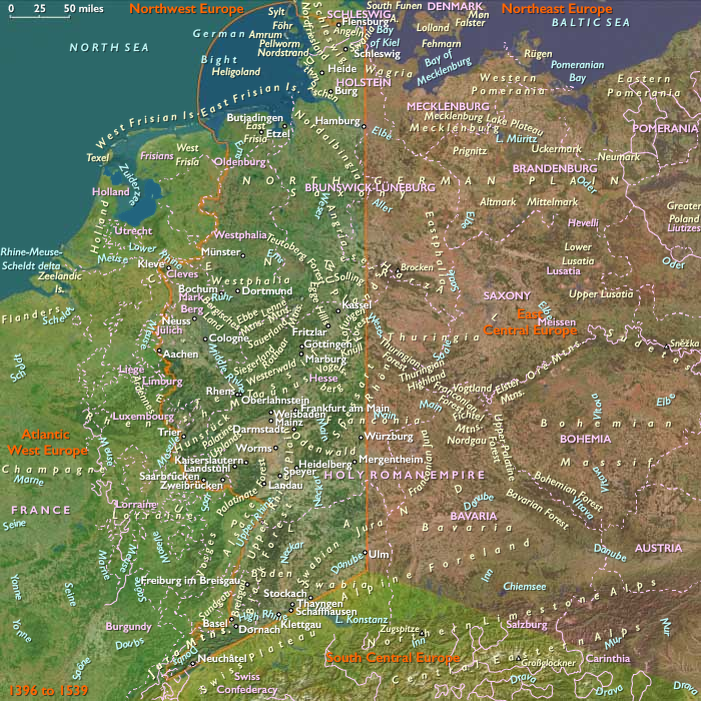
Related Events
Showing 10 events out of 20 total
Years: 1487 - 1487
Locations
People
Groups
- Papal States (Republic of St. Peter)
- Speyer, Prince-Bishopric of
- Christians, Roman Catholic
- Tyrol, County of
- Dominicans, or Order of St. Dominic
- Holy Roman Empire
Topics
Subjects
Regions
Subregions