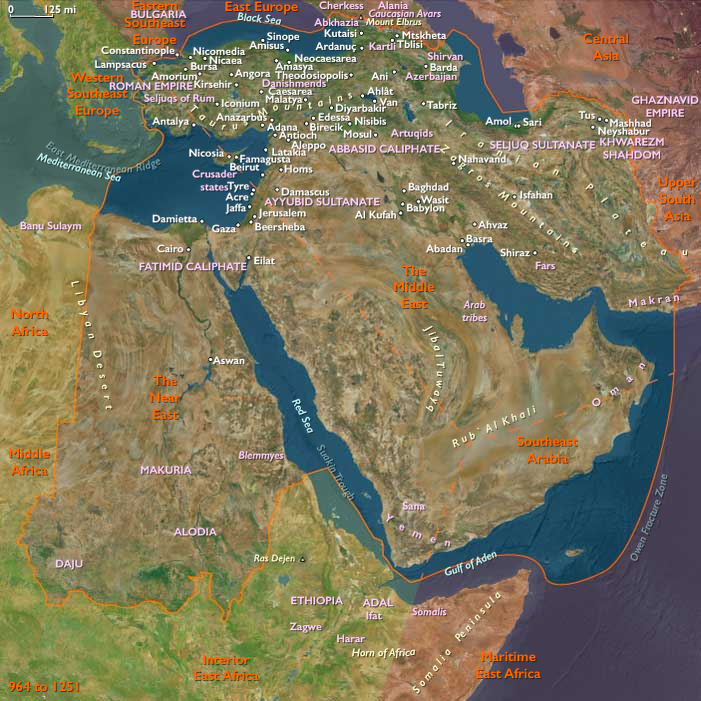
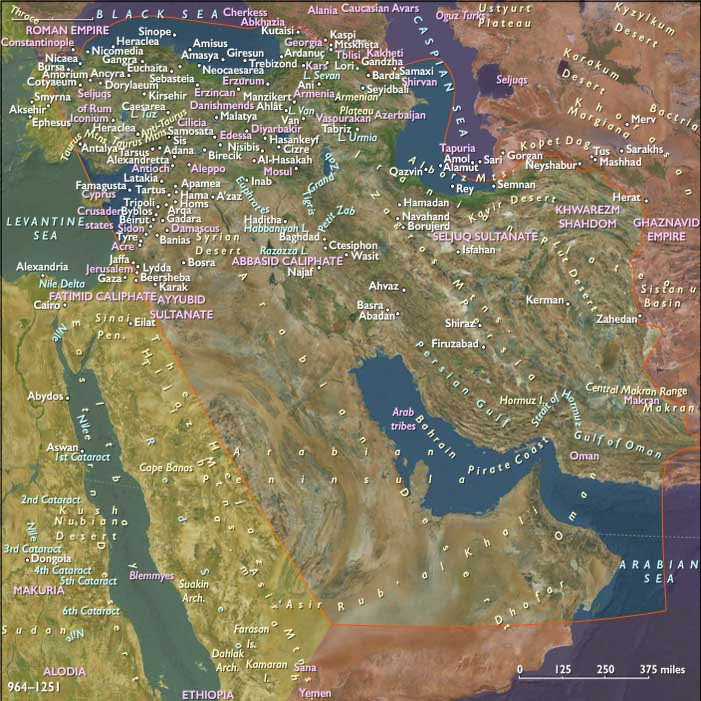
Izz al-Dawla, born as Bakhtiyar, is the …
Years: 967 - 967
Izz al-Dawla, born as Bakhtiyar, is the son of Mu'izz al-Dawla.
In the spring of 955, Mu'izz al-Dawla had become very ill and decided to name his son as his successor.
Five years later, the caliph had officially recognized this by granting Bakhtiyar the title of "Izz al-Dawla".
During his father's military expeditions, Izz al-Dawla had ruled in Baghdad.
Mu'izz al-Dawla dies in 967, leaving behind several pieces of advice for his son.
He recommends keeping the services of the Turkish commander Sabuktigin, respecting the wishes of the Turks, recognizing his uncle Rukn al-Dawla, who rules northern Persia, as senior amir, and respecting his cousin 'Adud al-Dawla, who rules from Fars.
He also gives a strategy for dealing with the Hamdanid emir of Mosul, Abu Taghlib.
Locations
People
Groups
Subjects
Regions
Subregions
Related Events
Filter results
Showing 10 events out of 10 total
The Near East, 2008 to 2019 CE: Uprisings, Conflict, and Political Transitions
Sudan: International Justice and Ongoing Turmoil
In 2009, the International Criminal Court (ICC) issues an arrest warrant for Sudanese President Omar al-Bashir, charging him with crimes against humanity and war crimes linked to the Darfur conflict. Despite international pressure, al-Bashir continues to hold power, defying the ICC's ruling and exacerbating tensions within the region.
Conflicts in South Kordofan between rival nomadic tribes escalate in 2009 and 2010, leading to significant casualties and mass displacement. The Sudanese government reaches a fragile ceasefire agreement with the Justice and Equality Movement (JEM) in February 2010, temporarily reducing violence in Darfur, although stability remains elusive.
Egypt: Revolution, Coup, and Political Turmoil
In early 2011, Egypt experiences the historic Egyptian Revolution, sparked by widespread discontent with President Hosni Mubarak’s regime, socioeconomic inequalities, and political repression. Massive demonstrations, particularly in Cairo's Tahrir Square, ultimately lead to Mubarak’s resignation and the installation of a transitional government.
Egypt holds democratic elections in 2012, bringing Mohamed Morsi, affiliated with the Muslim Brotherhood, to power as Egypt’s first democratically elected president. However, tensions quickly rise amid accusations of authoritarianism and Islamist dominance. In July 2013, a military coup led by General Abdel Fattah el-Sisi removes Morsi from power. El-Sisi assumes the presidency, marking a return to military-led governance, accompanied by widespread crackdowns on dissent.
Palestinian Territories: Gaza Conflict and Political Split
Tensions between Israel and Hamas-controlled Gaza flare into the destructive Gaza War (2008–2009), resulting in significant casualties and widespread infrastructure damage in Gaza. In subsequent years, the Fatah-Hamas conflict deepens political divisions, further entrenching the administrative split between Gaza and the West Bank.
Yemen: Civil War and Humanitarian Crisis
Yemen descends into severe internal conflict with the onset of the Yemeni Civil War in 2014, characterized by the Houthi rebellion against the internationally recognized government. Regional powers, notably Saudi Arabia and Iran, intervene, intensifying the conflict and triggering a catastrophic humanitarian crisis.
South Sudan: Independence and Civil War
In 2011, South Sudan gains independence following a referendum, ending decades of civil war with Sudan. However, peace proves short-lived as internal rivalries quickly ignite the South Sudanese Civil War in 2013. Ethnic tensions, political rivalries, and brutal violence displace millions and exacerbate famine and humanitarian disasters.
Sudan: Revolution and Transitional Government
Sudan faces another historic turning point with the Sudanese Revolution of 2018–2019, driven by public outrage over economic hardship and political oppression. Mass protests across the nation force Omar al-Bashir from power in April 2019, ending his 30-year rule. A transitional military-civilian government emerges, initiating cautious democratic reforms.
Regional Impact and Legacy
Between 2008 and 2019, the Near East undergoes profound transformations marked by revolutions, civil wars, and ongoing political crises. These events significantly reshape regional dynamics, highlighting the complexity and volatility of governance, national identity, and international influence in the region.
North Africa (2008–2019 CE)
Arab Spring, Turmoil, and New Realities
The period from 2008 to 2019 marks seismic shifts across North Africa, driven primarily by widespread dissatisfaction with entrenched authoritarianism, economic stagnation, and escalating demands for democratic governance. These transformative years are notably defined by the Arab Spring uprisings in 2010–2011, which dramatically reshape the region, resulting in hopeful democratic transitions, devastating conflicts, and ongoing instability.
Tunisia: Catalyst of the Arab Spring and Democratic Transition
In December 2010, the self-immolation of street vendor Mohamed Bouazizi in the town of Sidi Bouzid sparks nationwide protests, quickly becoming the catalyst for the Arab Spring. Mass demonstrations rapidly escalate, demanding economic reforms, democratic freedoms, and an end to corruption. Facing relentless pressure, President Zine El Abidine Ben Ali flees Tunisia in January 2011, ending his 23-year authoritarian rule.
Tunisia embarks on a fragile but largely successful democratic transition. A new constitution, adopted in 2014, establishes democratic governance, enhances human rights protections, and secures free and fair elections. Despite persistent economic challenges, high youth unemployment, and security threats from extremist groups, Tunisia remains the most notable success story emerging from the Arab Spring.
Egypt: Revolution and Authoritarian Restoration
Egypt, deeply influential throughout the region, witnesses massive protests beginning in January 2011, demanding the ouster of President Hosni Mubarak. Following weeks of widespread demonstrations, Mubarak resigns in February, initiating a brief democratic interlude marked by intense political polarization.
The election of the Muslim Brotherhood candidate, Mohamed Morsi, in 2012 exacerbates societal divisions. His controversial governance prompts further protests, and in July 2013, the military, led by General Abdel Fattah el-Sisi, seizes power, removing Morsi. Under el-Sisi’s regime, Egypt experiences significant authoritarian consolidation, marked by political repression, human rights abuses, and stringent control of the media.
Libya: Civil War and Fragmentation
In Libya, initial protests against longtime ruler Muammar Gaddafi in February 2011 swiftly escalate into a full-scale civil war. International military intervention, authorized by the United Nations, assists rebels in overthrowing Gaddafi, who is captured and killed in October 2011.
Following Gaddafi’s fall, Libya descends into prolonged chaos, fracturing along regional, tribal, and political lines. Rival governments and militias vie for control, leading to widespread violence, humanitarian crises, and the rise of extremist groups such as ISIS, severely undermining any prospects for immediate stability.
Algeria: Delayed Unrest and Hirak Movement
Initially avoiding major upheaval during the Arab Spring, Algeria experiences growing discontent driven by economic hardships, systemic corruption, and political stagnation under President Abdelaziz Bouteflika. Protests erupt dramatically in February 2019, known as the Hirak movement, sparked by Bouteflika’s announcement of a fifth presidential term.
Mass demonstrations across Algeria, unprecedented in scale and persistence, eventually force Bouteflika’s resignation in April 2019. The movement continues, demanding broader political reforms and a complete overhaul of the ruling elite, setting the stage for prolonged political uncertainty.
Morocco: Managed Reforms and Stability
Morocco also witnesses significant protests inspired by the Arab Spring in 2011, notably the February 20 Movement, calling for greater democracy, social justice, and anti-corruption measures. In response, King Mohammed VI implements constitutional reforms, slightly expanding parliamentary powers and improving human rights protections while retaining ultimate monarchical authority.
Though managing to quell unrest, Morocco continues grappling with economic inequalities, social grievances, and ongoing challenges related to human rights and governance.
Regional Dynamics and Ongoing Challenges
Across North Africa, the Arab Spring reveals underlying structural issues, including economic stagnation, unemployment, systemic corruption, and authoritarian resilience. Regional security deteriorates, exacerbated by terrorist threats, particularly from ISIS affiliates exploiting chaotic conditions in Libya and the broader Sahel region.
By 2019, North Africa remains deeply marked by the Arab Spring’s complex legacy, reflecting a mix of cautious democratic progress, entrenched authoritarianism, and unresolved conflicts, all underscoring the profound challenges and opportunities ahead.

Amid mass protests across Egypt, leading to widespread violence, the military dissolves the Shura Council and instalsl a temporary interim government.
The raids are described by Human Rights Watch as "one of the world's largest killings of demonstrators in a single day in recent history".
Sisi is sworn into office as President of Egypt on June 8, 2014.
The Muslim Brotherhood and some liberal and secular activist groups boycott the vote.
Even though the interim authorities had extended voting to a third day, the forty-six percent turnout was lower than the fifty-two percent turnout in the 2012 election.
The ambassador will be sent back to Egypt in 2017 by the new Prime Minister Paolo Gentiloni.
The proposals are approved in a referendum.