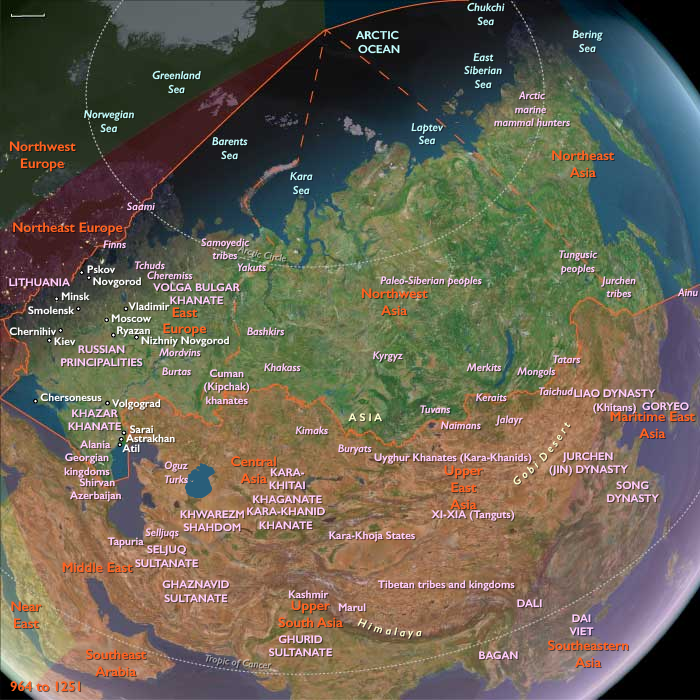
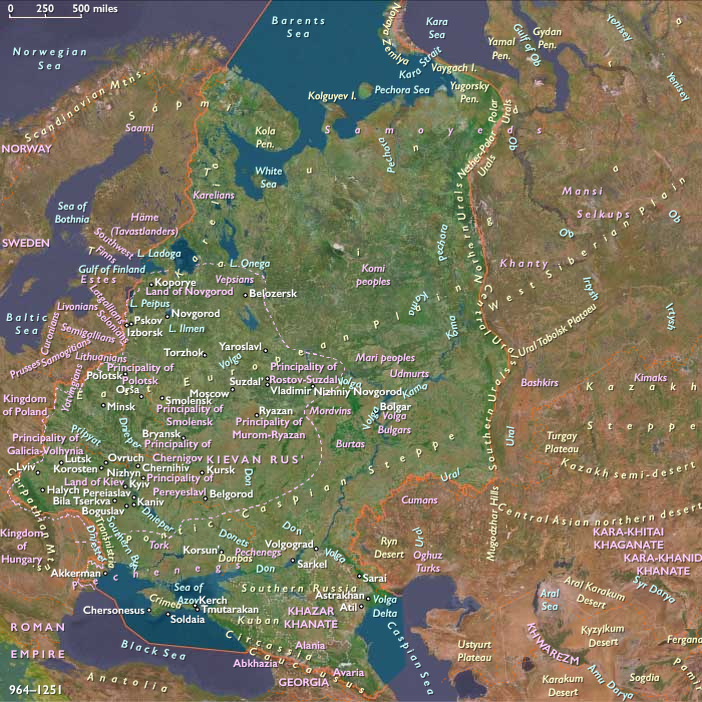
Iziaslav and Vsevolod flee back to Kiev …
Years: 1068 - 1068
Iziaslav and Vsevolod flee back to Kiev following the unsuccessful Battle on the Alta River near the city of Pereiaslavl, and their unwillingness to arm the general populace to march out and fight the raiders leads to an uprising in the city.
A veche (public assembly) is convened on an unknown initiative in the marketplace and the people there demand arms to fight the Kipchaks.
When these are not forthcoming, they ransack the house of voivode Konstantin.
The Kievans free Prince Vseslav of Polotsk, who had been imprisoned earlier by Iziaslav, Vsevolod, and Sviatoslav, and place him on the Kievan throne in hopes that he can stop the Cumans.
Iziaslav, for his part, flees to his nephew, Boleslaw II of Poland, whose aunt Gertrude is Iziaslav’s wife.
Locations
People
- Boleslaw II the Generous
- Gertrude of Poland
- Iziaslav I of Kiev
- Sviatoslav II of Kiev
- Vseslav of Polotsk
- Vsevolod I of Kiev
Groups
- Slavs, East
- Oghuz Turks
- Tmutarakan 'Rus, Principality of
- Pechenegs, or Patzinaks
- Rus' people
- Polatsk, Principality of
- Kievan Rus', or Kiev, Great Principality of
- Chernigov (Chernihiv), Principality of
- Pereslavl, Principality of
- Cuman people, or Western Kipchaks, also called Polovtsy, Polovtsians)
- Hungary, Kingdom of
- Poland of the first Piasts, Kingdom of
- Roman Empire, Eastern: Doukid dynasty
Topics
Commodoties
Subjects
Regions
Subregions
Related Events
Filter results
Showing 4 events out of 4 total
South Asia (1108 – 1251 CE): Sultanate Frontiers and Maritime Kingdoms
Between 1108 and 1251 CE, South Asia stood at a civilizational crossroads. In the north, Turkic cavalry from the Ghurid highlands swept through the Punjab and the Ganga plains, founding the Delhi Sultanate and transforming Indo-Islamic governance. In the south, Tamil, Kannada, and Sinhalese monarchies perfected irrigation and temple economies while competing for maritime supremacy across the Indian Ocean. Along the coasts and islands, Islam took root through trade, uniting the subcontinent with Arabia and East Africa. This age, poised between the Cholas’ twilight and the Sultanate’s dawn, bound the land and sea of South Asia into a single, intricate web of conquest, piety, and exchange.
Geographic and Environmental Context
South Asia in this age stretched from the Hindu Kush and Himalayan passes to the Dravidian peninsula and Indian Ocean archipelagos.
-
In Upper South Asia, the Kabul–Gandhara gateways, Punjab–Doab plains, and Ganga–Brahmaputra delta formed the agrarian and military heartlands of empire.
-
The Kathmandu Valley, Bhutan’s high valleys, and Arakan–Chindwin corridor bridged the Himalayas and Southeast Asia.
-
In Maritime South Asia, the Tamil plains, Deccan plateau, Kerala backwaters, and Sri Lankan river basins nurtured dense settlements, while the Maldives and Lakshadweep linked the subcontinent to the wider Indian Ocean.
From the monsoon-fed rice fields of Bengal to the pearl banks of Ceylon, every ecological niche contributed to the subcontinent’s layered prosperity.
Climate and Environmental Shifts
The late Medieval Warm Period brought generally stable monsoon rainfall and mild temperatures, though the first signs of variability appeared.
-
North India and the Punjab–Doab experienced alternating floods and droughts, prompting new irrigation systems.
-
Bengal’s delta expanded, sustaining rice surpluses and maritime ports.
-
Sri Lanka and Tamil Nadu enjoyed fertile monsoon cycles, while Deccan interiors faced periodic dryness mitigated by tank irrigation.
-
Across the Himalayan valleys, warmer conditions kept salt–grain exchange routes open.
This climatic balance underwrote both agrarian intensification and long-distance trade across land and sea.
Societies and Political Developments
The Northern Sultanate Frontier:
The late 12th century witnessed the Ghurid conquest of northern India. From Afghanistan, Mu‘izz al-Din Muhammad of Ghur and his generals seized Lahore and Delhi, establishing Turkic rule. In 1206, Qutb al-Din Aibak founded the Delhi Sultanate, succeeded by Iltutmish (r. 1211–1236), who consolidated authority and gained recognition from the Abbasid Caliph.
Under Razia Sultan (r. 1236–1240), Delhi briefly saw a woman on the throne—an exceptional episode in Islamic history.
Mongol incursions under Chinggis Khan’s successors pressured the northwest, but the Sultanate endured, balancing Persianate administration with Indian agrarian foundations.
Bengal fell to Bakhtiyar Khalji (c. 1204) and became a semi-autonomous frontier province under Delhi’s loose suzerainty. Its riverine ports—Lakhnauti and Sonargaon—linked inland rice surpluses to maritime export.
Kashmir and Rajasthan remained centers of Hindu polity and Sanskrit scholarship, while Kashmiri temples retained influence until the mid-13th century.
The Himalayan Realms:
In Nepal, the Malla dynasty unified the Kathmandu Valley after 1200, building the pagoda temples of Kathmandu, Patan, and Bhaktapur.
Bhutan saw the spread of Drukpa Kagyu Buddhism from Tibet, anchoring monastic estates in fertile valleys.
Arakan (Rakhine) and the Chindwin valley developed as rice- and elephant-producing zones, linking Bengal and Pagan Burma.
Southern and Maritime Kingdoms:
In the Tamil South, the Chola Empire, dominant since the 10th century, waned under Kulottunga I and his successors, while the Pandyas resurged from Madurai, contesting Chola supremacy.
The Hoysalas of Karnataka patronized the Hoysaleswara and Chennakesava temples, exemplifying Dravidian architecture.
In Sri Lanka, the Polonnaruwa kingdom under Parakramabahu I (r. 1153–1186) reached its zenith, uniting the island and extending irrigation across the dry zone.
The Maldives, converted to Islam in 1153, became a sultanate integrated into Arabian and Indian trade routes.
The Lakshadweep islands served as spice entrepôts, while the Chagos Archipelago remained sparsely used but strategically placed along sailing lanes.
Economy and Trade
Agriculture:
-
Northern plains: wheat, barley, pulses.
-
Bengal: rice, sugarcane, and jute.
-
Deccan and Tamil regions: rice, pepper, millets, and coconuts.
-
Himalayan uplands: barley, buckwheat, and wool.
-
Sri Lanka: irrigated rice and spices.
Trade:
-
Overland routes via Khyber and Bolan passes carried horses, slaves, and textiles between Central Asia and Delhi.
-
Bengal’s river systems moved rice and cotton to Bay of Bengal ports.
-
Indian Ocean trade connected Calicut, Quilon, Nagapattinam, and Sri Lankan ports to Aden, Hormuz, and Canton.
-
Pepper, pearls, elephants, and cowries circulated widely, while Arabian horses and Persian silver entered the subcontinent in return.
Coinage and finance:
The Delhi Sultanate’s silver tanka and copper jital standardized currency, while Maldives cowries served as universal small change across Africa and Asia.
Subsistence and Technology
-
Irrigation expanded dramatically: Sultanate canals in the Doab, Polonnaruwa’s reservoirs in Sri Lanka, and South Indian tanks in the Deccan.
-
Military innovation: Turkish cavalry and composite bows redefined warfare; hill fortresses guarded regional polities.
-
Architecture: Delhi’s Qutb Minar and Quwwat al-Islam Mosque, Sri Lanka’s Gal Vihara, and Hoysala temples in Karnataka epitomized religious artistry.
-
Maritime technology: Tamil and Kerala shipwrights constructed sturdy dhows and sewn-plank vessels for monsoon voyages.
-
Crafts and textiles: Bengal muslins, Gujarati cottons, and Tamil bronzes were prized throughout the Indian Ocean.
Belief and Symbolism
Religion in this era mirrored South Asia’s diversity and convergence:
-
Islam: The Sultanate established mosques, madrasas, and Sufi hospices (notably the Chishti order in Delhi under Nizamuddin Auliya).
-
Hinduism: Temple culture flourished across the south and highlands, sustaining Shaiva and Vaishnava devotion.
-
Buddhism: Declined in northern India but persisted vibrantly in Nepal, Sri Lanka, and Bhutan, where Vajrayana and Theravāda lineages coexisted.
-
Syncretism: Along the coasts and deltas, merchant communities blended Hindu, Buddhist, and Islamic practices, creating a shared maritime cosmopolitanism.
Movement and Interaction Corridors
-
The Khyber–Bolan gateways: conduits for conquests and trade between Central Asia and Delhi.
-
The Grand Trunk precursor: Lahore ⇄ Delhi ⇄ Bihar ⇄ Bengal, connecting military and market towns.
-
Bay of Bengal routes: Sonargaon ⇄ Nagapattinam ⇄ Sri Lanka ⇄ Maldives ⇄ Aden.
-
Himalayan passes: Salt and wool caravans between Nepal–Tibet and Bhutan–Assam.
-
Malabar coast lanes: pepper, textiles, and cowries moved through Calicut to the Red Sea.
These overland and maritime arteries bound South Asia to every major civilization of the age.
Adaptation and Resilience
-
Delhi’s resilience lay in transforming conquest into administration—balancing Turkic elites, Persian culture, and Indian agrarian systems.
-
Bengal’s adaptability came from deltaic agriculture and maritime autonomy.
-
Southern polities survived drought and warfare through irrigation and temple-centered redistribution.
-
Island sultanates and coastal ports adjusted seamlessly to global trade shifts.
-
Across the Himalayas, monastic estates and village cooperatives managed environmental risk through collective ritual and resource sharing.
These adaptive systems sustained continuity despite invasions, climate stress, and political fragmentation.
Long-Term Significance
By 1251 CE, South Asia had entered a new political and commercial configuration:
-
The Delhi Sultanate was entrenched from the Punjab to Bengal, heralding the long era of Indo-Islamic synthesis.
-
The Himalayan realms of Nepal, Bhutan, and Arakan bridged Central and Southeast Asia through Buddhism and trade.
-
The southern kingdoms—Cholas, Pandyas, and Hoysalas—dominated peninsular culture and architecture.
-
Sri Lanka’s Polonnaruwa, though soon to wane, stood as the zenith of hydraulic civilization.
-
The Maldives and Malabar linked India to the western oceanic world, their cowries and spices circulating across empires.
This High Medieval South Asia—maritime and continental, sacred and mercantile—defined the political and cultural foundations of the Indian Ocean’s future centuries.
Upper South Asia (1108 – 1251 CE): Ghurid Expansion, Delhi Sultanate’s Rise, and Himalayan Realms
Geographic and Environmental Context
Upper South Asia includes Afghanistan, Pakistan, North India, Nepal, Bhutan, Bangladesh, and northwestern Myanmar (the northern Arakan/Yakhine sector and the Chindwin valley).
-
Anchors: Kabul–Gandhara gateways, Punjab–Doab–Ganga–Brahmaputra plains, the Kathmandu Valley, Himalayan foothills of Nepal and Bhutan, Bengal’s deltaic rice lands, and northwestern Myanmar’s Arakan/Chindwin corridors into Upper Burma.
Climate and Environmental Shifts
-
The tail end of the Medieval Warm Period gave generally favorable rainfall, though localized droughts struck the Doab and Punjab.
-
Bengal’s deltas and Nepal’s irrigated terraces yielded strong surpluses.
-
Himalayan passes remained viable for salt–grain exchanges; coastal storms periodically disrupted Bengal ports.
Societies and Political Developments
-
Afghanistan & North India:
-
Ghurid conquests (late 12th century) swept through the Punjab and Ganga plain; by 1206, the Delhi Sultanate was established under the Mamluk dynasty of Qutb al-Din Aibak.
-
Successors like Iltutmish (r. 1211–1236) consolidated Delhi, repelled challengers, and gained Caliphal recognition.
-
Razia Sultan (1236–1240) briefly ruled, a rare female sovereign.
-
The Sultanate weathered Mongol pressure from the northwest (raids from c. 1221 onward).
-
-
Punjab & Frontier: contested between Ghurids, Khwarazmians, and Mongols; Lahore rose and fell as a key provincial hub.
-
Bengal:
-
Conquered by Bakhtiyar Khalji (c. 1204), with incursions as far as Tibet; Bengal incorporated into the Sultanate but often semi-autonomous.
-
Sonargaon and Lakhnauti grew as riverine entrepôts.
-
-
Kashmir: ruled by the Hindu Lohara dynasty until mid-13th century, maintaining Sanskrit learning and temple patronage despite Turkic pressure.
-
Nepal (Kathmandu Valley): Malla dynasty consolidated after 1200; Newar city-states (Kathmandu, Patan, Bhaktapur) expanded irrigation, crafts, and pagoda architecture.
-
Bhutan: highland valleys under local chieftains, with Tibetan Buddhist influences strengthening (Drukpa Kagyu inroads).
-
Northwestern Myanmar:
-
Arakan developed into the Launggyet kingdom (from mid-13th c.), mediating between Bengal and Upper Myanmar.
-
The Chindwin valley supplied rice, timber, and elephants to Pagan-era Burma.
-
Economy and Trade
-
Agriculture:
-
Doab: wheat, barley, pulses; Bengal: rice, jute, sugarcane; Nepal: irrigated rice and millet.
-
Bhutan: barley and buckwheat; Arakan/Chindwin: rice and elephants.
-
-
Trade & exchange:
-
Delhi connected Central Asian horses and slaves to Indian textiles and cash crops.
-
Bengal exported rice, textiles, and sugar via delta ports; received Arabian horses and Persian silver.
-
Himalayan passes moved salt, wool, paper south; grain and cloth north.
-
-
Coinage: silver tanka and copper jital under Iltutmish became widespread; Bengal mints produced local coinage.
Subsistence and Technology
-
Irrigation: Ghiyath al-Din Tughluq (as governor) began canal works in Doab; Bengal embankments stabilized polders.
-
Military: Turkish cavalry with composite bows; fortified cities (Delhi, Gwalior, Lahore).
-
Architecture & crafts: Delhi’s Qutb complex (Qutb Minar, Quwwat al-Islam mosque); Bengal’s early brick mosques; Newar brick–timber temples; Kashmiri temple architecture.
Movement and Interaction Corridors
-
Khyber and Bolan passes: horse, slave, and silk traffic from Central Asia.
-
Grand Trunk precursor: Lahore ⇄ Delhi ⇄ Bihar ⇄ Bengal, with caravanserais.
-
Bengal delta waterways: Sonargaon ⇄ Lakhnauti ⇄ ports for Bay of Bengal trade.
-
Himalayan passes: trans-Himalayan salt/wool corridors via Nepal–Tibet; Bhutanese valleys tied to monastic houses.
-
Arakan/Chindwin routes: rice and elephants moved into Pagan Burma; Bengal traders crossed into Arakan.
Belief and Symbolism
-
Islam: Delhi Sultanate patronized mosques, madrasas, and khanqahs; Sufis (Chishti order, esp. Nizamuddin Auliya in Delhi) attracted wide followings.
-
Hindu traditions: temple endowments persisted; regional courts in Rajasthan and Kashmir fostered Sanskrit literature.
-
Buddhism: declined in North India but flourished in Nepal (Newar Vajrayana); Bhutan absorbed Tibetan monastic influence.
-
Arakan & Chindwin: Theravāda Buddhism tied to Pagan kingdom; syncretism with Bengal contacts.
Adaptation and Resilience
-
Political flexibility: when Delhi faltered, governors (esp. Bengal) asserted semi-autonomy.
-
Agricultural diversification: rice (Bengal), wheat (Doab), millet/barley (Himalayas) buffered ecological shocks.
-
Trade redundancy: Afghan horse caravans, Bengal sea lanes, Himalayan salt–wool routes kept circulation alive even under Mongol threat.
-
Ritual networks: Sufi hospices, temples, and monasteries mediated crises, redistributed alms, and stabilized society.
Long-Term Significance
By 1251, Upper South Asia had been reshaped:
-
The Delhi Sultanate was entrenched in the Doab, despite Mongol incursions.
-
Bengal served as a semi-autonomous frontier sultanate, linking Ganga–delta agriculture to Indian Ocean trade.
-
Nepal matured into a tri-city Malla polity; Bhutan consolidated Buddhist lineages.
-
Arakan and the Chindwin valley tied Bengal to Pagan Burma, anchoring Indo–Southeast Asian connections.
This era established the foundations for the Sultanate’s wider reach, Bengal’s naval power, and Himalayan resilience in the centuries to come.
South Asia (1252–1395 CE): Sultanates, Temples, and Oceanic Gateways
From the passes of Afghanistan to the lagoons of Kerala and the island atolls of the Maldives, South Asia in the Lower Late Medieval Age was a world of shifting capitals, converging faiths, and expanding sea routes. The monsoon remained the great architect of life, its alternating abundance and scarcity driving hydraulic ingenuity, agricultural diversity, and mercantile enterprise. By the fourteenth century, the subcontinent was knit together by caravan and sea, by shared institutions of devotion and trade, and by the political duality of the Delhi Sultanate in the north and the twin powers of Bahmani and Vijayanagara in the south.
The Delhi Sultanate, centered on the Punjab–Doab, inherited a century of consolidation. Under Alauddin Khalji (r. 1296–1316), frontier raids were repelled, revenue reforms rationalized, and the Sultan’s authority pressed deep into the Deccan. His successor, Muhammad bin Tughluq (r. 1325–1351), extended campaigns from Gujarat to Madurai but overreached; famines, revolts, and failed experiments in currency and administration frayed the realm. Firoz Shah Tughluq (r. 1351–1388) restored order through canal works, madrasas, and endowments that linked state and faith, but within a decade of his death the empire disintegrated. Timur’s invasion of 1398 CE devastated Delhi and the upper Ganga plain, closing a cycle of central dominance.
To the northwest, Afghan and Khurasani frontiers remained gateways of exchange. The Karts of Herat and later Timurid commanders dominated the trans-Hindu Kush approaches; horse caravans, falcons, and precious textiles passed through Kabul and Ghazni toward Lahore and Delhi. In Kashmir, the establishment of the Shah Mir sultans(from 1339) introduced Islam to the court without extinguishing the valley’s Sanskrit learning and artistry.
Eastward, Bengal broke decisively from Delhi’s control. The Ilyas Shahi dynasty (from 1352) ruled from Gauda and Pandua, maintaining fleets on the deltaic channels and embanking the rivers for rice, jute, and cane cultivation. Prosperous and cosmopolitan, Bengal’s silver tanka coinage and river ports connected it to Chittagong, Arakan, and the eastern seas. Along the Naf–Kaladan corridor, the Launggyet kingdom of northern Arakan mediated between Bengal and Upper Myanmar, its rice, salt fish, and elephants moving with the tides toward the Chindwin gateway and the rising Burmese capital of Ava.
In the Himalayan crescent, Nepal’s Malla era flowered. The city-states of Kathmandu, Patan, and Bhaktapur built tiered pagodas and brick–timber palaces; artisans forged gilt copper images and repoussé ornaments that blended Vajrayana and Hindu devotion. To the east, the valleys of Bhutan coalesced around monastic estates of the Drukpaorder; dzong-like fortresses presided over a landscape where pastoral and agrarian life merged with Himalayan Buddhism. The passes of Kuti, Kerung, and Nathu carried salt, wool, and paper between Tibet, Nepal, and the plains, sustaining a centuries-old vertical trade.
Across this vast northern arc, canals, embankments, and riverboats underwrote resilience. The Tughluq canals linked Yamuna and Ganga tracts; Bengal’s earthen polders contained the floods of the Brahmaputra–Meghna; and Newar stone spouts (hiti) distributed water through urban courtyards. Even amid invasion and rebellion, agrarian cycles and market towns endured. Sufi hospices offered refuge and credit; temple endowments and monastic networks stabilized rural life. The Chishti and Suhrawardi orders spread devotional Islam across towns and villages, while Bhakti poets in Maharashtra and the north began to reinterpret older Hindu spirituality in the vernacular.
South of the Narmada, a new political balance emerged. Delhi’s Deccan campaigns shattered older dynasties—the Yadavas, Hoysalas, and Kakatiyas—but opened space for regional power. In 1347, Ala-ud-Din Bahman Shahestablished the Bahmani Sultanate at Gulbarga (later Bidar), claiming the mantle of Persianate Islam in the Deccan. Within a decade, the brothers Harihara I and Bukka Raya I founded the Vijayanagara Empire on the Tungabhadra, creating a Hindu imperial center whose granite walls, tank-fed gardens, and towering temples at Hampi proclaimed resilience against northern invasion. Between these two great states stretched a frontier of forts, irrigation tanks, and shifting alliances that defined peninsular politics for the next two centuries.
The southern littoral remained the meeting ground of oceans. The Pandya realm of Madurai collapsed under Khalji and Tughluq incursions; a brief Madurai Sultanate (1335–1378) yielded to Vijayanagara. Along the western coast, Calicut rose under the Zamorin as a premier Indian Ocean port. The Malabar backwaters and Kerala pepper gardens fed demand from the Red Sea to the South China Sea, while Quilon, Goa, and Nagapattinam thrived as multiethnic harbors. Chinese junks arrived in Yuan and early Ming decades, exchanging silks and copper for spices, pearls, and cottons.
In Sri Lanka, irrigation in the northern plains declined with the fall of Polonnaruwa. Highland and coastal polities at Gampola and Kotte shared the island with the Tamil Jaffna kingdom, its rulers mediating between South Indian and Sri Lankan trade. Buddhism persisted but lost its royal patronage, while Tamil Saivism and mercantile guilds dominated the northern coast. Across the open sea, the Maldives flourished as an Islamic sultanate and hub of cowrie export. Cowries served as small currency from Bengal to East Africa, while tuna, coir, and coral jewelry reached every shore of the Indian Ocean. The Lakshadweep islands integrated into Malabar’s spice circuits, and the distant Chagos atolls, still uninhabited, served as navigational markers for Arab and Indian seafarers.
Despite climatic cooling and intermittent famine, South Asia’s ingenuity endured. Canal and tank systems buffered monsoon irregularities; double-cropping spread across Bengal and the Deccan; and horse trade through the Afghan passes and maritime networks through Hormuz and Aden kept markets supplied. Islamic and Hindu institutions coexisted—mosques, madrasas, and khanqāhs beside temples, monasteries, and shrines—forming a dense spiritual landscape that bridged rural and urban life.
By 1395 CE, the subcontinent had become a mosaic of sultanates, temple kingdoms, and oceanic polities. Delhi remained a wounded but symbolic capital; Bengal flourished as an independent deltaic power; Kashmir and Nepal perfected their courtly arts; Bhutan and Arakan linked the Himalayas to the Bay; and in the south, the twin empires of Bahmani and Vijayanagara defined the political frontier. The Maldives exported currency to half the known world, while Calicut and Quilon stood as the new hinge between the Indian Ocean and the China seas.
Amid transition and turbulence, South Asia preserved its rhythms of irrigation, devotion, and exchange—a civilization resilient in its regional diversity and poised to enter the early modern age as one of the great centers of global commerce and culture.

Upper South Asia (1252 – 1395 CE): Delhi Sultanate, Himalayan Courts, and the Bengal–Arakan–Chindwin Gateways
Geographic and Environmental Context
Upper South Asia includes Afghanistan, Pakistan, North India, Nepal, Bhutan, Bangladesh, and northwestern Myanmar (the northern Arakan/Yakhine sector and the Chindwin valley).
-
Anchors: the Kabul–Gandhara corridors; Punjab–Doab–Ganga–Brahmaputra plains; Kathmandu Valley and Himalayan foothills of Nepal–Bhutan; the deltaic lowlands of Bengal; and the northern Arakan/Chindwin gateway into Upper Myanmar.
Climate and Environmental Shifts
-
The late Medieval Warm Period eased into the early Little Ice Age after c. 1300: generally reliable monsoons with episodic droughts and floods.
-
Canalized tracts in the Doab and upper Ganga–Yamuna buffered dry years; the Brahmaputra–Meghna swells shaped Bengal’s rice calendars and riverine trade.
Societies and Political Developments
-
Delhi Sultanate (North India, Pakistan):
-
Mamluk and Khalji rule gave way to the Tughluqs (1320–1414).
-
Alauddin Khalji (r. 1296–1316) stabilized frontiers against Mongol raids, reorganized the revenue base, and asserted control over the Punjab–Doab.
-
Muhammad bin Tughluq (r. 1325–1351) expanded toward the Deccan but overextended; administrative experiments and famine eroded authority.
-
Firoz Shah Tughluq (r. 1351–1388) repaired canals, patronized madrasas and khanqāhs, and regularized land assignments (iqṭāʿ).
-
Timur’s invasion (1398–99) devastated Delhi and the upper Doab at the period’s close, fragmenting sultanate control.
-
-
Afghanistan & Khurasan marches:
-
Karts of Herat and later Timurid forces dominated the northwest approaches; Kabul–Ghazni linked Central Asian horses and trade to the Punjab.
-
-
Kashmir:
-
Transition from Hindu dynasties to the Shah Mir sultans (from 1339) introduced court Islam while preserving a rich Kashmiri literary and artistic milieu.
-
-
Bengal (Bangladesh & lower Ganga):
-
After periods under Delhi, the Bengal Sultanate consolidated under the Ilyas Shahi (from 1352), ruling from Gauda (Lakhnauti) and Pandua, later Sonargaon as a deltaic entrepôt.
-
Naval power and embankment-building underwrote autonomy; gold and silver tanka coinages flourished.
-
-
Nepal (Kathmandu Valley):
-
The Malla era (c. 1200–1768) matured: Kathmandu, Patan, and Bhaktapur city-states patronized Newar brick–timber palaces, pagodas, and gilded metalwork; syncretic Hindu–Buddhist courts thrived.
-
-
Bhutan:
-
Fragmented valley polities received monastic influences (notably Drukpa lineages from Tibet); dzong-like hill sites and temple estates expanded local authority.
-
-
Northwestern Myanmar (northern Arakan/Chindwin):
-
In Arakan, the Launggyet kingdom (from c. 1250) rose on the Naf–Kaladan corridors, mediating between Bengal and Upper Myanmar.
-
The Chindwin valley linked delta goods to the Ava polity (founded 1364) in Upper Myanmar; Theravāda Buddhism and cross-border trade connected the hills and plains.
-
Economy and Trade
-
Agrarian cores:
-
Doab–Ganga: irrigated wheat, barley, and cash crops under iqṭāʿ revenue systems.
-
Bengal: multi-cropped rice, jute, sugarcane; embanked polders and river ports.
-
Kathmandu Valley: irrigated paddy, millets; artisan–court economies.
-
-
Frontier staples & exchange:
-
Afghan passes supplied horses and falcons; Kabul–Lahore–Delhi caravans moved textiles, metals, and dyes.
-
Bengal–Arakan–Chindwin moved rice, salt fish, cottons, and elephants; Muslim and Buddhist merchants shared portage and brokerage.
-
Himalayan corridors carried salt, wool, and paper between Tibet–Bhutan–Nepal and the plains.
-
-
Coinage & markets: silver tanka and copper jital circulated in the sultanate; Bengal minted abundant tanka; bazars clustered along caravanserais and ghats.
Subsistence and Technology
-
Irrigation & hydraulics: Tughluq canal works (e.g., Yamuna link canals); Bengal embankments; Nepalese stone spouts (hiti) and tank systems.
-
Military & logistics: composite bows, armored cavalry; river flotillas in Bengal and Arakan; later-14th-century gunpowder traces at sieges.
-
Crafts: Delhi inlaid metalwork, carved stone; Bengal textiles and terracotta; Newar gilt copper repoussé and woodcarving.
-
Architecture: sultanate mosques and madrasas; Kashmiri and Bengali brick mosques; Newar tiered temples and palace squares.
Movement and Interaction Corridors
-
Khyber & Bolan passes: Afghan remounts and Central Asian goods into Punjab–Delhi.
-
Grand Trunk precursor: Lahore–Delhi–Gaya–Bengal trunk routes; ferry ghats knit riverine towns.
-
Delta & littoral lanes: Ganga–Brahmaputra distributaries to Chittagong/Sonargaon; coastal shuttles to Launggyet and the Chindwin.
-
Himalayan passes: Kuti, Kerung, and Nathu tied Nepal and Bhutan to Tibet; yak caravans moved salt and wool south, grain north.
Belief and Symbolism
-
Islam: sultanate legitimacy rested on sharīʿa patronage, madrasas, khanqāhs, and Friday mosques; Sufi orders (Chishtiyya, Suhrawardiyya) spread across towns and countryside—Nizamuddin Auliya (d. 1325) emblematic.
-
Hindu traditions & Bhakti: temple endowments persisted in Rajput and peripheral zones; early bhakti currents (e.g., Namdev, Ramananda on the horizon) reshaped devotion.
-
Buddhism & Himalayan syncretism: Nepalese Vajrayana and Hindu worship intertwined; Bhutan’s monastic houses expanded; Theravāda anchored Arakan and Upper Myanmar.
-
Kashmir: Islamization at court coexisted with Sanskrit scholastic traditions through the century.
Adaptation and Resilience
-
State flexibility: when the sultanate overreached, provincial elites (Bengal, Kashmir) localized authority without halting agrarian growth.
-
Hydraulic redundancy: canals, embankments, and floodplain mobility cushioned monsoon shocks.
-
Commercial pivots: Afghan pass traffic and Bengal’s river–sea trade maintained supplies during warfare; Himalayan corridors provided alternative staples (salt, wool).
-
Ritual and social glue: Sufi hospices, temple networks, and monastic centers mediated famine relief, dispute resolution, and credit.
Long-Term Significance
By 1395, Upper South Asia had become a continent-spanning mosaic:
-
The Delhi Sultanate remained the titular hegemon in the northwest–Doab despite fragmentation and Timur’s incursion.
-
Bengal emerged as a powerful, maritime-facing sultanate.
-
Kashmir and Nepal matured distinct court cultures; Bhutan’s valleys cohered around monasteries.
-
The Bengal–Arakan–Chindwin hinge integrated South and Southeast Asian worlds.
These trajectories set the stage for 15th-century realignments—Timurid influences from the northwest, Bengal’s coastal expansion, Ava and Arakan’s contests in the east, and enduring Himalayan polities shaping the northern front.
Years: 1068 - 1068
Locations
People
- Boleslaw II the Generous
- Gertrude of Poland
- Iziaslav I of Kiev
- Sviatoslav II of Kiev
- Vseslav of Polotsk
- Vsevolod I of Kiev
Groups
- Slavs, East
- Oghuz Turks
- Tmutarakan 'Rus, Principality of
- Pechenegs, or Patzinaks
- Rus' people
- Polatsk, Principality of
- Kievan Rus', or Kiev, Great Principality of
- Chernigov (Chernihiv), Principality of
- Pereslavl, Principality of
- Cuman people, or Western Kipchaks, also called Polovtsy, Polovtsians)
- Hungary, Kingdom of
- Poland of the first Piasts, Kingdom of
- Roman Empire, Eastern: Doukid dynasty