
Carolingian Goldsmithing and the Codex Aureus of …
Years: 868 - 879
Carolingian Goldsmithing and the Codex Aureus of St. Emmeram (c. 870)
The Carolingian Renaissance saw the revival of Roman and Byzantine artistic traditions, particularly in the goldsmith’s craft, which flourished from the 9th to the 11th centuries. The exquisite metalwork of this period, often used for religious artifacts, set the standard for medieval European craftsmanship.
Carolingian Goldsmithing Techniques
- Use of Precious Metals → Objects were crafted in gold and silver, reflecting the imperial grandeur of the Carolingian court.
- Gem-Encrusted Decoration → Reliquaries, book covers, and liturgical objects were adorned with sapphires, garnets, pearls, and other precious stones.
- Embossed Figures and Narrative Scenes → The high-relief repoussé technique (hammering from the reverse side) was used to create detailed biblical scenes and figures of Christ, angels, and saints.
- Influences from Roman and Byzantine Art → Carolingian goldsmiths were inspired by Late Antique ivory carvings, Byzantine enamel work, and classical motifs, incorporating geometric patterns, acanthus leaves, and imperial iconography.
The Codex Aureus of St. Emmeram (c. 870)
One of the finest examples of Carolingian goldsmithing is the Codex Aureus of St. Emmeram, now housed in the Bayerische Staatsbibliothek in Munich.
- Commissioned around 870, possibly under the patronage of Emperor Charles the Bald, the manuscript exemplifies Carolingian luxury book production.
- The book cover is made of gold, encrusted with jewels, and features a central embossed image of Christ in Majesty, flanked by the four Evangelists.
- The meticulous craftsmanship and lavish materials reflect both imperial power and religious devotion, emphasizing the role of books as sacred objects in the Carolingian world.
Legacy of Carolingian Metalwork
- The techniques seen in the Codex Aureus of St. Emmeram and other Carolingian reliquaries and book covers will dominate medieval goldsmithing until the 11th century, influencing later Romanesque and Gothic art.
- Carolingian metalwork traditions will be revived and further developed in the Ottonian period, continuing the emphasis on gold, gems, and religious iconography.
- These objects served as expressions of divine power, reinforcing the connection between the Carolingian monarchy and the Church.
The Codex Aureus of St. Emmeram stands as a masterpiece of Carolingian artistry, showcasing the unparalleled skill of goldsmiths and scribes during a period of cultural revival and imperial ambition.
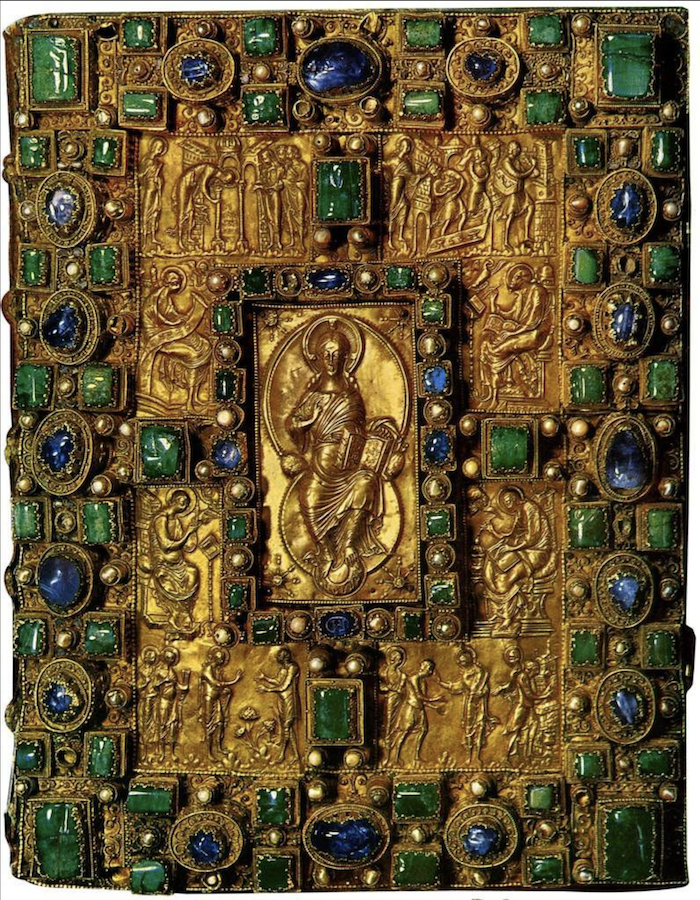
Codex Aureus of St. Emmeram (Munich, Bayerische Staatsbibliothek, Clm 14000)
Groups
- Italy, Carolingian Kingdom of
- Frankish, or Carolingian (Roman) Empire
- Francia Occidentalis (West Francia, or France), Kingdom of
Topics
Commodoties
Subjects
Regions


Subregions
- East Central Europe
- Western Southeast Europe
- South Central Europe
- Mediterranean West Europe
- Mediterranean Southwest Europe
- Atlantic West Europe
- West Central Europe



Related Events
Showing 10 events out of 42 total
Years: 868 - 879
Codex Aureus of St. Emmeram (Munich, Bayerische Staatsbibliothek, Clm 14000)
Groups
- Italy, Carolingian Kingdom of
- Frankish, or Carolingian (Roman) Empire
- Francia Occidentalis (West Francia, or France), Kingdom of
Topics
Commodoties
Subjects
Regions
Subregions
- East Central Europe
- Western Southeast Europe
- South Central Europe
- Mediterranean West Europe
- Mediterranean Southwest Europe
- Atlantic West Europe
- West Central Europe