
Michele Sanmicheli, who trained as an architect …
Years: 1530 - 1530
Michele Sanmicheli, who trained as an architect with Donato Bramante and Giuliano da Sangallo in Rome, skillfully employs classical elements in his notable Palazzo Canossa and Palazzo Bevilaqua, both of which will be constructed in the 1530s in his native Verona.
Born in San Michele, a quarter of Verona, which at the time was part of the Venetian terra ferma, Michele Sanmicheli had learned the elements of his profession from his father Giovanni and his uncle Bartolomeo, who both practiced successfully as builder-architects in Verona.
Like Jacopo Sansovino, he is a salaried official of the Republic of Venice, but unlike Sansovino, his commissions lie in Venetian territories outside Venice; he is no less distinguished as a military architect, and is employed in strengthening Venetian fortifications in Crete, Candia, Dalmatia and Corfu as well as a great fort at the Lido, guarding the sea entrance to the Venetian lagoon.
In visiting Cyprus and Crete for the Serenissima, Sanmicheli is probably the only practicing Venetian architect of the sixteenth century to have had the opportunity to see Greek architecture, a possible source for his use of Roman Doric columns without bases.
He had gone at an early age to Rome, probably to work as an assistant to Antonio da Sangallo the Elder, where he had opportunities to study classic sculpture and architecture.
He had gone in 1509 to Orvieto, where he practiced for the next two decades.
Among his earliest works were the first design of the duomo of Montefiascone, initiated in 1519, an octagonal building surmounted with a dome, and the church of Santa Maria delle Grazie.
He also designed and built the funerary chapel for the Petrucci family in the Gothic church of San Domenico in Orvieto.
Several palazzi at both places are attributed to him.
Sanmicheli was in Verona by 1527 at the latest, working on the monumental cannon-resistant city gates; he began to transform the fortifications of Verona according to the newer system of corner bastions, a system for the advancement of which he did much valuable service.
Sanmicheli builds two massively fortified and richly decorated city gates for Verona, the Porta Nuova and the Porta Palio, in which the richest possible Roman Doric is superimposed against layers of rustication.
Giorgio Vasari's impression is that "in these two gates it may truly be seen that the Venetian Senate made full use of the architect's powers and equaled the buildings and works of the ancient Romans” – the constant aim and ultimate goal of the Renaissance architects.
He also regularizes the Piazza Brà, opening up a vista to the Arena.
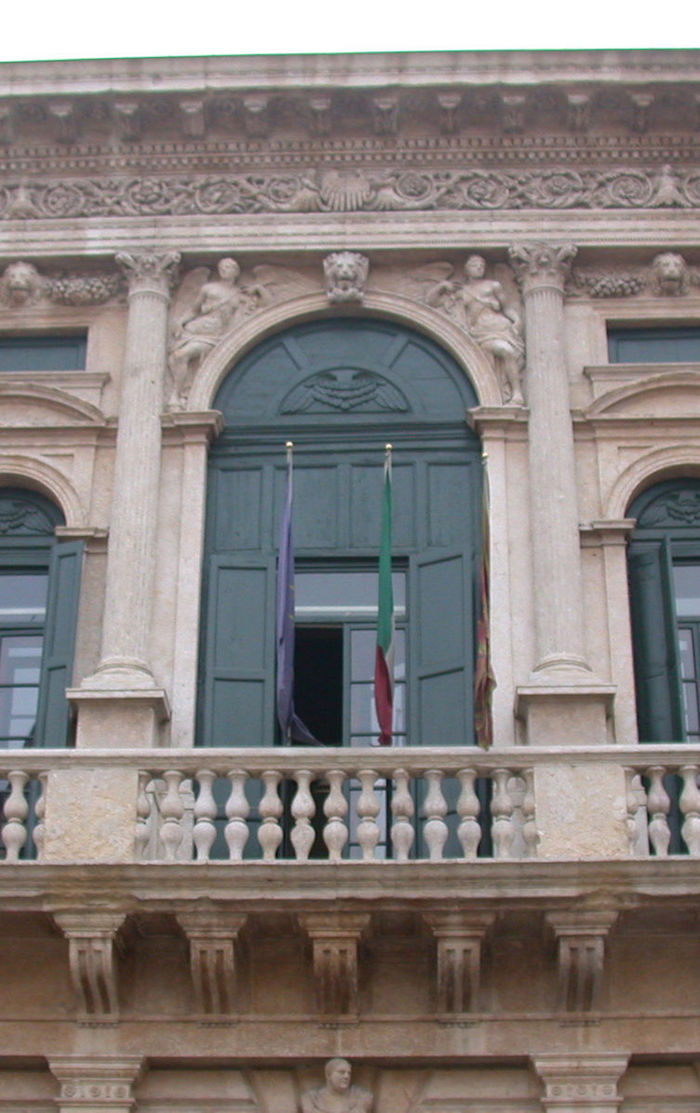
Palazzo Bevilacqua, in Verona: a richly-detailed bay of the piano nobile. (Photo taken October 2006 by MM)
Locations
People
Groups
Topics
Subjects
Regions
Subregions
Years: 1530 - 1530
Palazzo Bevilacqua, in Verona: a richly-detailed bay of the piano nobile. (Photo taken October 2006 by MM)
Locations
People
Groups
Topics
Subjects
Regions
Subregions