
Giordano Bruno—philosopher, mathematician and astronomer–is an Italian …
Years: 1591 - 1591
Giordano Bruno—philosopher, mathematician and astronomer–is an Italian Dominican friar best known as a proponent of the infinity of the universe.
His cosmological theories go beyond the Copernican model in identifying the sun as just one of an infinite number of independently moving heavenly bodies: he is the first man to have conceptualized the universe as a continuum where the stars we see at night are identical in nature to the Sun.
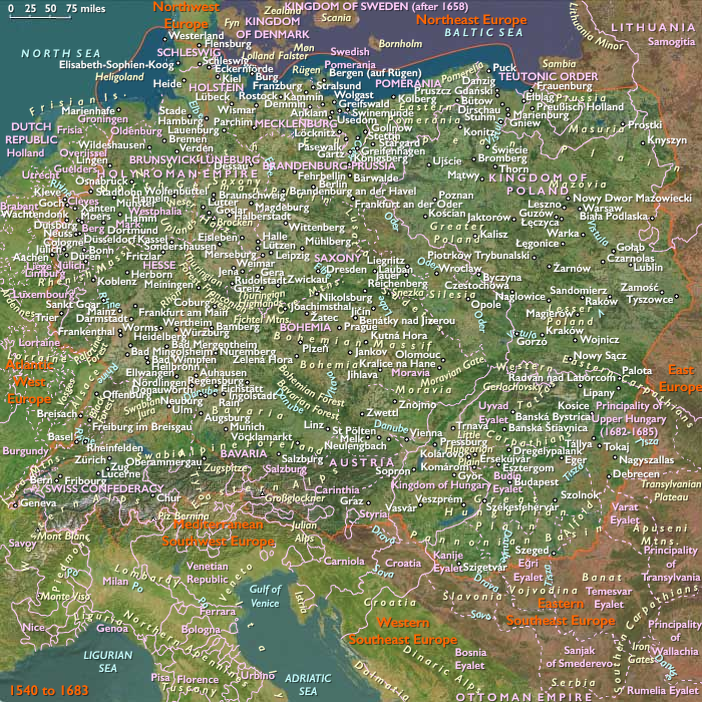
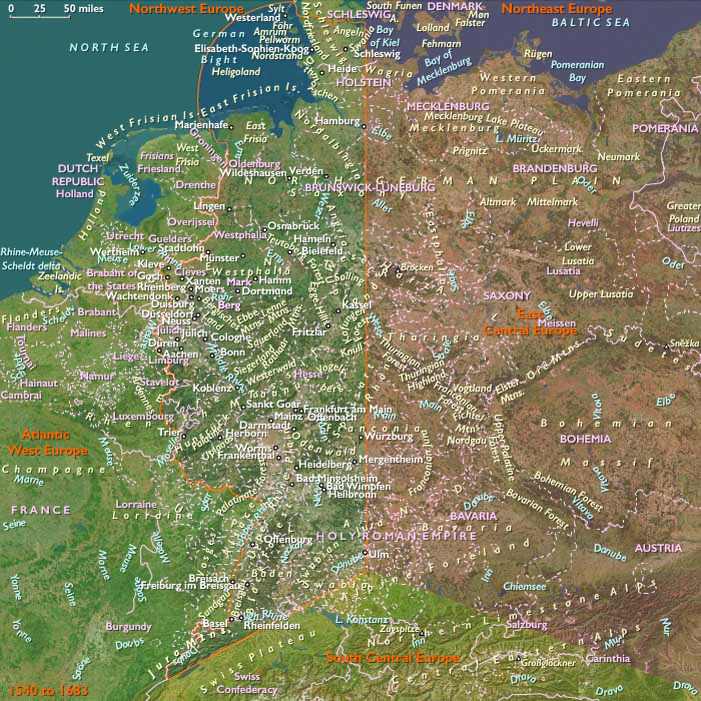
Having moved in 1586 from France, where he has fallen from favor, to Germany, where he had failed to obtain a teaching position at Marburg but been granted permission to teach at Wittenberg, where he has lectured on Aristotle for the past two years.
With a change of intellectual climate there he is no longer welcome, however, nd had gone in 1588 to Prague, where he had obtained three hundred taler from Rudolf II, but no teaching position.
Bruno had gone on to serve briefly as a professor in Helmstedt, but had had to flee again when he is excommunicated by the Lutherans, continuing the pattern of Bruno's gaining favor from lay authorities before falling foul of the ecclesiastics of whatever hue.
During this period he has produced several Latin works, dictated to his friend and secretary Girolamo Besler, including De Magia (On Magic), Theses De Magia (Theses On Magic) and De Vinculis In Genere (A General Account of Bonding).
All these appear to have been transcribed or recorded between 1589 and 1590 by Besler (or Bisler).
He also publishes De Imaginum, Signorum, Et Idearum Compositione (On The Composition of Images, Signs and Ideas, 1591).
The year 1591 finds Bruno in Frankfurt.
Apparently, during the Frankfurt Book Fair, he receives an invitation to Venice from the patrician Giovanni Mocenigo, who wishes to be instructed in the art of memory, and also hears of a vacant chair in mathematics at the University of Padua.
Apparently believing that the Inquisition might have lost some of its impetus, he returns to Italy.
He is wrong about the Inquisition.
Locations
People
Groups
- Papal States (Republic of St. Peter)
- Christians, Roman Catholic
- Lutheranism
- Inquisition, Roman
- Habsburg Monarchy, or Empire
Topics
- Protestant Reformation
- Counter-Reformation (also Catholic Reformation or Catholic Revival)
- Scientific Revolution
Subjects
Regions
Subregions
Related Events
Showing 10 events out of 34418 total
Years: 1591 - 1591
Locations
People
Groups
- Papal States (Republic of St. Peter)
- Christians, Roman Catholic
- Lutheranism
- Inquisition, Roman
- Habsburg Monarchy, or Empire
Topics
- Protestant Reformation
- Counter-Reformation (also Catholic Reformation or Catholic Revival)
- Scientific Revolution
Subjects
Regions
Subregions