
It is widely believed that Murcia's name …
Years: 1172 - 1172
It is widely believed that Murcia's name is derived from the Latin words of Myrtea or Murtea, meaning land of Myrtle (the plant is known to grow in the general area), although it may also be a derivation of the word Murtia, which would mean Murtius Village (Murtius was a common Roman name).
Other research suggests that it may owe its name to the Latin Murtae (Mulberry), which covered the regional landscape for many centuries.
The Latin name eventually changed into the Arabic Mursiya, and then, Murcia.
The city in its present location was founded with the name Madinat Mursiyah (city of Murcia) in 825 by Abd ar-Rahman II, who was then the emir of Córdoba.
Muslim planners, taking advantage of the course of the river Segura, had created a complex network of irrigation channels that make the town's agricultural existence prosperous.
After the fall of the Caliphate of Cordoba in 1031, Murcia had passed under the successive rules of the powers seated variously at Almería, Toledo and Seville.
After the fall of Almoravid empire, Muhammad Ibn Mardanis had made Murcia the capital of an independent kingdom.
At this time, Murcia is a very prosperous city, famous for its ceramics, exported to Italian towns, as well as for silk and paper industries, the first in Europe.
The coinage of Murcia is considered as model in all the continent.
The mystic Ibn Arabi (1165–1240) and the poet Ibn al-Jinan (d.1214) are born in Murcia during this period.
The twelfth century traveler and writer Muhammad al-Idrisi describes the city of Murcia as populous and strongly fortified.
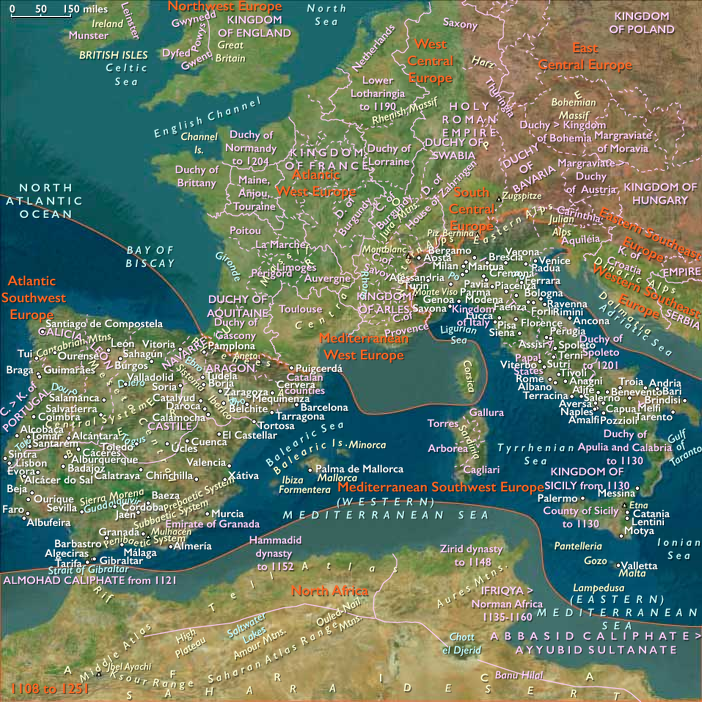
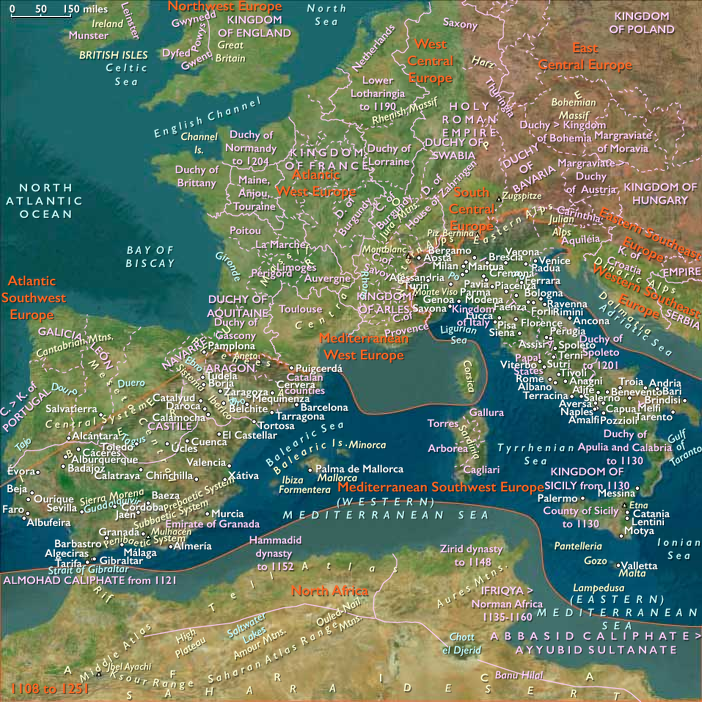
Murcia’s ruler ibn-Mardinish, at his death in 1172, advises his son to accept the suzerainty of the Almohad caliph, thereby bringing al-Andalus entirely under Almohad rule.
Murcia becomes a province of the Almohad empire, which allows it much autonomy.
Locations
Groups
Topics
Commodoties
Subjects
Regions
Subregions
Years: 1172 - 1172
Locations
Groups
Topics
Commodoties
Subjects
Regions
Subregions