
Filters:
Frederick William had become heir-presumptive to the …
Years: 1777 - 1777
Frederick William had become heir-presumptive to the throne of Prussia on his father's death in 1758, since Frederick II has no children.
Born in Berlin, the son of Prince Augustus William of Prussia (the second son of King Frederick William I of Prussia) and of Duchess Luise of Brunswick-Wolfenbüttel, his mother's elder sister, Elisabeth, is the wife of Augustus William's brother King Frederick II ("Frederick the Great").
The boy was of an easy-going and pleasure-loving disposition, averse to sustained effort of any kind, and sensual by nature.
His marriage with Elisabeth Christine of Brunswick-Wolfenbüttel, Crown Princess of Prussia, daughter of Charles I, Duke of Brunswick-Lüneburg, contracted July 14, 1765 in Charlottenburg, had been dissolved in 1769.
He then married Frederika Louisa of Hesse-Darmstadt, daughter of Ludwig IX, Landgrave of Hesse-Darmstadt on July 14, 1769 also in Charlottenburg.
Although he will have seven children by his second wife, he has an ongoing relationship with his mistress, Wilhelmine Enke (she will be created Countess Wilhelmine von Lichtenau in 1796), a woman of strong intellect and much ambition, and has five children by her—the first when she was still in her teens.
Born in Berlin, the son of Prince Augustus William of Prussia (the second son of King Frederick William I of Prussia) and of Duchess Luise of Brunswick-Wolfenbüttel, his mother's elder sister, Elisabeth, is the wife of Augustus William's brother King Frederick II ("Frederick the Great").
The boy was of an easy-going and pleasure-loving disposition, averse to sustained effort of any kind, and sensual by nature.
His marriage with Elisabeth Christine of Brunswick-Wolfenbüttel, Crown Princess of Prussia, daughter of Charles I, Duke of Brunswick-Lüneburg, contracted July 14, 1765 in Charlottenburg, had been dissolved in 1769.
He then married Frederika Louisa of Hesse-Darmstadt, daughter of Ludwig IX, Landgrave of Hesse-Darmstadt on July 14, 1769 also in Charlottenburg.
Although he will have seven children by his second wife, he has an ongoing relationship with his mistress, Wilhelmine Enke (she will be created Countess Wilhelmine von Lichtenau in 1796), a woman of strong intellect and much ambition, and has five children by her—the first when she was still in her teens.
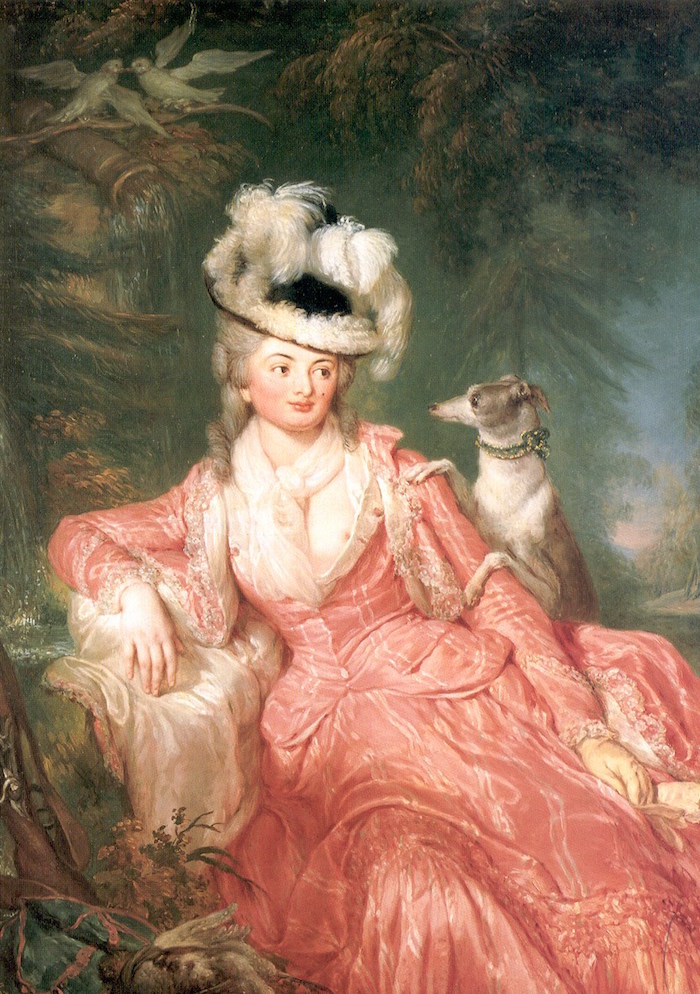
Anna Dorothea Therbusch: Portrait of Wilhelmine Encke (1776). Oil on canvas; 143 × 103 cm (56.3 × 40.6 in) Prussian Palaces and Gardens Foundation Berlin-Brandenburg
Locations
People
Groups
Topics
Subjects
Regions
Subregions
Years: 1777 - 1777
Anna Dorothea Therbusch: Portrait of Wilhelmine Encke (1776). Oil on canvas; 143 × 103 cm (56.3 × 40.6 in) Prussian Palaces and Gardens Foundation Berlin-Brandenburg
Locations
People
Groups
Topics
Subjects
Regions
Subregions