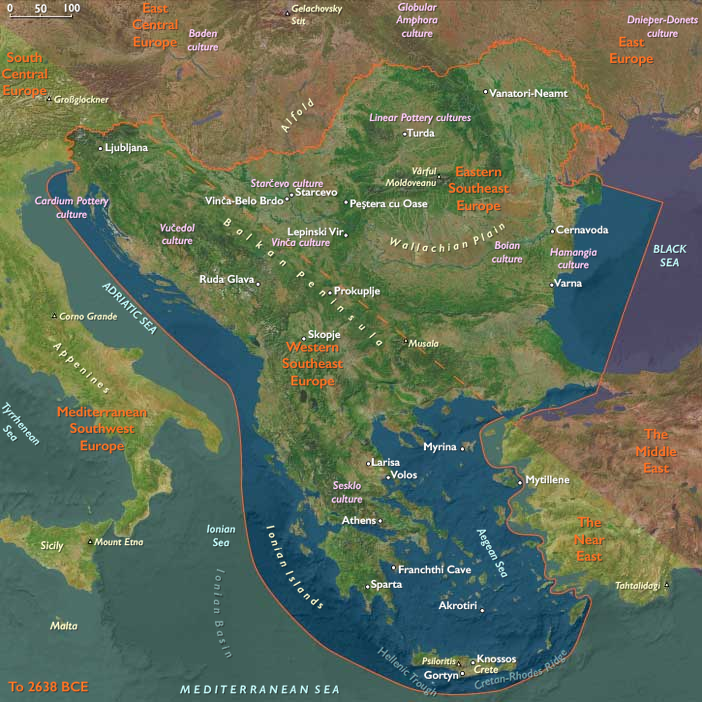
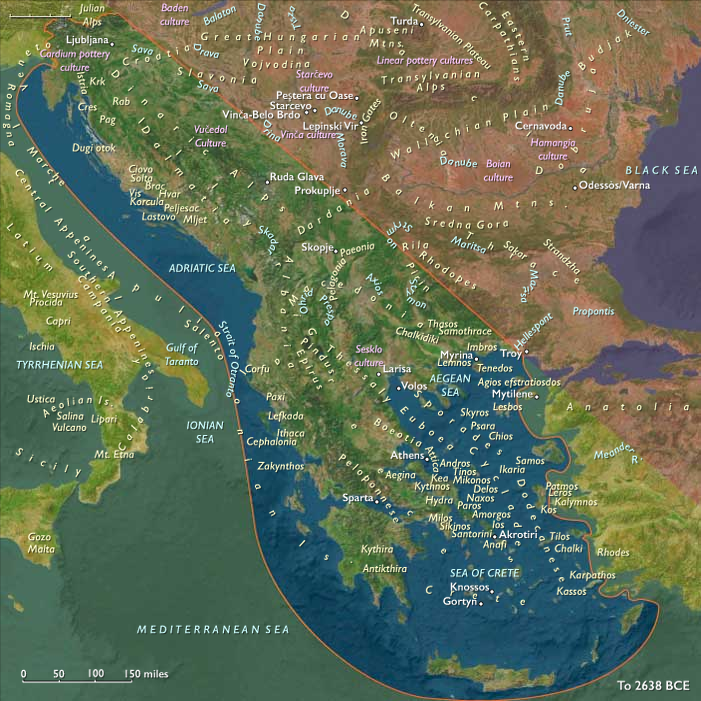
It is not known who created the …
Years: 3357BCE - 3214BCE
It is not known who created the wheel and axle, which certainly was a conscious invention and not a technological accident, dating from about 3000 BCE.
The oldest wheel publicized by archaeologists was found in 2002 in Ljubljana.
Austrian experts at the time established that the wheel was between fifty-one hundred and fifty-three hundred and fifty years old and is therefore at least a century older than those found in Switzerland and southern Germany.
The wheel was made of ash and oak and had a radius of seventy centimeters.
The axle is one hundred and twenty centimeters long and made of oak.
Locations
Groups
Topics
- Subboreal Period during the Neolithic Subpluvial
- Early Bronze Age I (Near and Middle East)
- Subboreal Period
Subjects
Regions
Subregions
Related Events
Filter results
Showing 10 events out of 68735 total
Glaciers expand from 3400 to 3200 BCE, covering plants, during a major climate shift possibly due to shift in solar activity, in what is known as the Subboreal Period during the Neolithic Subpluvial.
Atmospheric temperatures fall.
The Middle East (3357–3214 BCE): Early Writing, Sumerian Influence, and Urban Growth
Uruk and the Dawn of Writing
Between 3357 and 3214 BCE, clay tablets discovered at Uruk, inscribed with Sumerian pictorial script, became some of the earliest examples of recorded writing, dating to approximately 3300 BCE. Among these tablets is the renowned Sumerian King List, an essential historical record documenting the kings of early Sumerian civilization.
Arrival and Dominance of the Sumerians
Around 3300 BCE, the Sumerians—a group whose non-Semitic, non-Indo-European language uniquely dominated the region—likely migrated into southern Mesopotamia from areas around Anatolia. Despite their profound influence, the origins and emergence of the Sumerian civilization remain largely mysterious, contributing to ongoing scholarly intrigue.
Uruk’s Cultural and Economic Influence
The Sumerian traders and colonists from Uruk significantly influenced surrounding regions through cultural and economic exchanges, spreading the distinctive Uruk period culture. However, their long-term military control over distant colonies, such as Tell Brak, proved unsustainable, and such dominance gradually diminished.
Urbanization and Social Complexity at Uruk
Uruk itself emerged not only as one of the earliest urban centers but as the driving force behind the urbanization process during the Uruk Period (4000–3200 BCE). Over eight centuries, the city transformed from a cluster of small agricultural villages into a major urban center with established bureaucratic governance, an organized military, and a socially stratified population. Unlike other settlements averaging around ten hectares, Uruk was significantly larger and more complex.
Environmental and Agricultural Foundations
Uruk’s growth was facilitated significantly by its favorable geographic setting in the fertile alluvial plains of southern Mesopotamia along the Euphrates River. The domestication of grains native to the Zagros foothills, coupled with advanced irrigation techniques, supported diverse and productive agriculture, enabling Uruk to develop into the largest and most densely populated Sumerian settlement.
Cultural Expansion and Technological Development
This period also continued witnessing important technological advances, particularly in metallurgy, with increasing sophistication in bronze artifact production, further enhancing the region's economic and cultural dynamism.
This era signifies a transformative stage characterized by the advent of early writing, the consolidation of Sumerian cultural dominance, significant urban expansion, and technological innovation, profoundly shaping the developmental trajectory of ancient Middle Eastern civilization.
Clay tablets will be found at Uruk with Sumerian and pictorial inscriptions that are thought to be some of the earliest recorded writing, dating to approximately 3300 BCE.
These tablets include the famous Sumerian King List, a record of kings of the Sumerian civilization.
The wheel now takes two forms: a stone potters' wheel and a cartwheel made from a single solid piece of wood.
Hand-turned tournettes, or turntables, date from about 3250 in the Near East.
Many early ceramics were hand-built using a simple coiling technique in which clay was rolled into long threads that were then pinched and beaten together to form the body of a vessel.
In the coiling method of construction, the hands of the potter supply, indirectly, all of the energy required to form the main part of a piece.
Early ceramics built by coiling were often placed on mats or large leaves to allow them to be worked more conveniently.
The evidence of this lies in mat or leaf impressions left in the clay of the base of the pot.
This arrangement allowed the potter to turn the vessel under construction, rather than walk around it to add coils of clay.
The earliest forms of the potter's wheel (tournettes or slow wheels) were probably developed as an extension to this procedure.
Tournettes were turned slowly by hand or by foot while coiling a pot.
The tournette was used to fashion only a small range of vessels, suggesting that it was used by a limited number of potters.
The introduction of the slow wheel increased the efficiency of hand-powered pottery production.
These early forms of the potter’s wheel are among the first mechanical devices, and stimulate manufacture of objects for trade.
Copper is in wide use, both as tools and weapons.
The people called Sumerians, whose language, non-Semitic and non-Indo-European, becomes the prevailing language of the territory, had probably come from around Anatolia, arriving in Sumer about 3300.
The Uruk period culture exported by Sumerian traders and colonists has an effect on all surrounding peoples, who are gradually evolving their own comparable, competing economies and cultures.
Ultimately, Uruk will be unable to maintain long-distance control over colonies such as Tell Brak by military force.
Uruk, in addition to being one of the first cities, has been the main force of urbanization during the Uruk Period (4000–3200 BCE).
This period of eight hundred years has seen a shift from small, agricultural villages to a larger urban center with a full-time bureaucracy, military, and stratified society.
Although other settlements coexist with Uruk, they are generally about ten hectares while Uruk is significantly larger and more complex.
Geographic factors underpin Uruk's unprecedented growth.
The city is located in the alluvial plain area of southern Mesopotamia, on the Euphrates rivers.
Through the gradual and eventual domestication of native grains from the Zagros foothills and extensive irrigation techniques, the area supports a vast variety of edible vegetation.
This domestication of grain and its proximity to rivers has enabled Uruk's growth into the largest Sumerian settlement, in both population and area, with relative ease.
The central portion of the Indus Valley is the earliest focal point of historic civilization in India, dating from the late fourth millennium BCE.
The Early Harappan Ravi Phase of Indus Valley Civilization, named after the nearby Ravi River, begins in circa 3300 BCE; it will last until 2800 BCE.
It is related to the Hakra Phase, identified in the Ghaggar-Hakra River Valley to the west, and predates the Kot Diji Phase (2800-2600 BCE, Harappan 2), named after a site in northern Sindh, Pakistan, near Mohenjo Daro.
The Near East (3357–3214 BCE): Formation of Upper and Lower Egypt
Emergence of Proto-Writing and Unification Efforts
Around 3350 BCE, Egyptians begin employing clay, bone, and ivory tags to label storage boxes, a practice possibly representing an early form of proto-writing. Concurrently, Egyptian society sees the development and unification of regional chiefdoms into provinces along the Nile River. The unification processes occur independently within the two distinct geographical and cultural zones of Egypt—Upper Egypt (the Nile Valley) and Lower Egypt (the Nile Delta).
Distinctive Identity of Upper Egypt (Ta Shemau)
Upper Egypt, known as Ta Shemau ("the land of reeds"), is divided into twenty-two administrative districts known as nomes, stretching from modern Aswan in the south to Atfih (ancient Aphroditopolis) near present-day Cairo. The lotus flower becomes the emblematic symbol representing Upper Egypt. Its primary cultural and political hub is the city of Nekhen (later known as Hierakonpolis), patronized by the vulture goddess Nekhbet.
The formal headgear symbolizing Upper Egypt is the White Crown (Hedjet). Despite no actual crowns surviving archaeologically, artistic representations such as those on the Narmer Palette (discovered at Hierakonpolis) depict the Hedjet clearly, demonstrating its symbolic association with southern rulership. Nekhbet, often portrayed with a vulture’s head and wearing the White Crown, symbolizes divine protection over the kings of Upper Egypt. Depictions from as early as the Naqada II period in northern Nubia suggest that the tradition of the Hedjet predates Egyptian unification, perhaps indicating a southern origin later appropriated by Upper Egyptian rulers.
Distinctive Identity of Lower Egypt (Ta-Mehu)
Lower Egypt, termed Ta-Mehu ("land of papyrus"), spans the fertile but largely undeveloped Nile Delta. Divided into twenty nomes beginning at el-Lisht, Lower Egypt's emblematic symbol is the papyrus reed, and its protective deity is associated with the Red Crown (Deshret), indicative of northern royal authority. The Red Crown is stylistically characterized by a distinctive curled wire-like appendage, symbolizing the proboscis of a honeybee, and thus linked symbolically with bees as well as papyrus. Notably, no physical examples of the Red Crown have survived, leaving its precise construction—possibly of copper, reeds, cloth, or leather—entirely speculative.
In mythology, the deity Geb, god of the earth, bestows rulership of Lower Egypt upon the falcon-headed god Horus, who prominently wears the Red Crown. The Red Crown (Deshret) also symbolizes the Red Land, the harsh deserts surrounding Egypt, associated with chaos and governed by the deity Set (or Seth). Set embodies the arid desert, storms, and foreigners, and is depicted as a mysterious composite creature—the Set animal—with an elongated snout, forked tail, squared ears, and canine form, first appearing possibly in Naqada I era artifacts or definitively by the Protodynastic era.
Urbanization, Architectural Development, and Tomb Evolution
During this era, Egyptian settlements increasingly evolve into fortified, walled towns, marking significant urban developments in both Upper and Lower Egypt. Concurrently, burial practices become more sophisticated, with tomb structures designed to resemble residential houses, sometimes incorporating multiple rooms. Scholars believe these architectural developments primarily emerged from influences originating in the Delta region, gradually diffusing southward.
Hierarchical Governance and Divine Kingship
Egypt’s social and political structure continues to grow more complex. Chiefdoms consolidate into provinces, eventually crystallizing into two distinct kingdoms—Upper and Lower Egypt. Each kingdom develops distinct identities, symbols, and patron deities, gradually setting the stage for the historic unification under a single monarchy. The rulers of these proto-kingdoms legitimize their authority through divine association and symbolic regalia, setting enduring precedents for pharaonic rule.
The appearance of proto-writing, differentiated regional identities, and increasing social stratification exemplify this transformative period. Upper and Lower Egypt's dual but parallel development underpins future Egyptian civilization, laying a robust cultural and political foundation for the historical unification that soon follows.

Years: 3357BCE - 3214BCE
Locations
Groups
Topics
- Subboreal Period during the Neolithic Subpluvial
- Early Bronze Age I (Near and Middle East)
- Subboreal Period