It has taken Cotta two years to …
Years: 71BCE - 71BCE
September
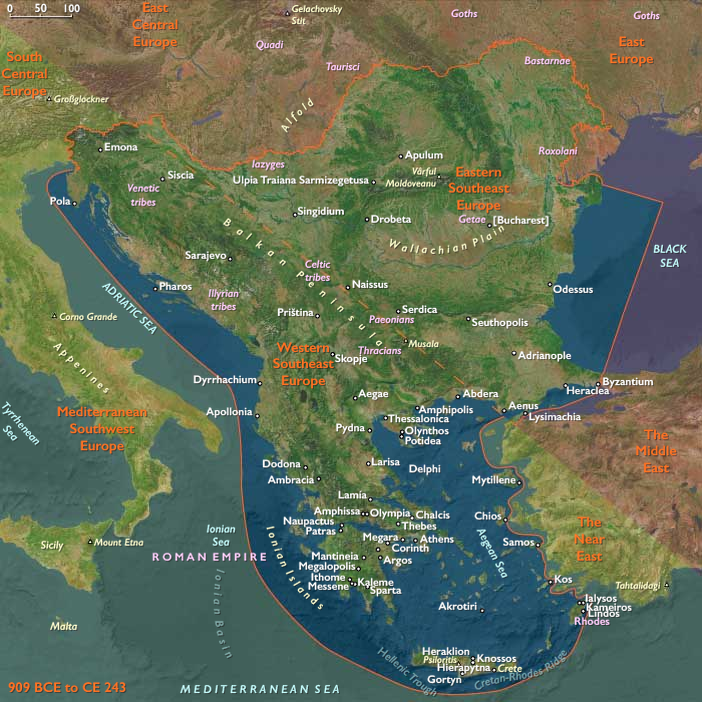
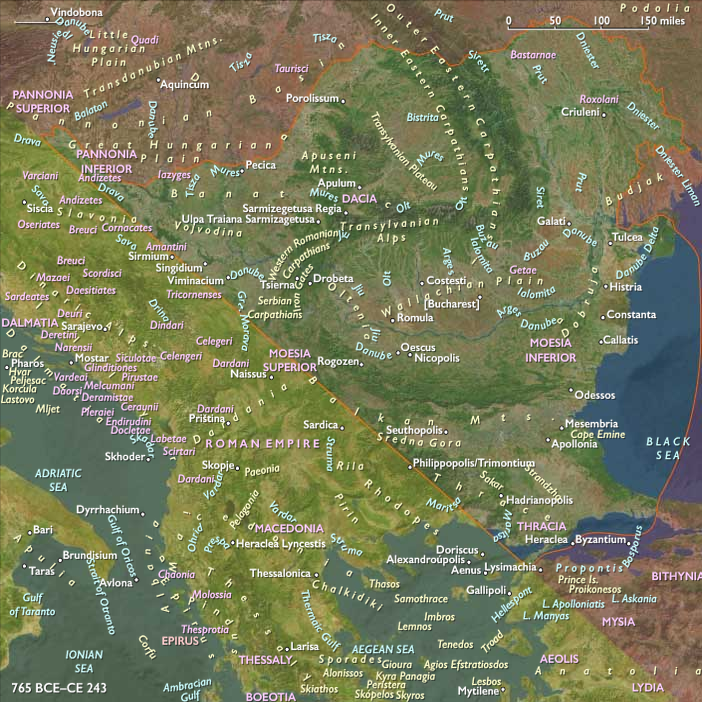
It has taken Cotta two years to complete the siege of Heraclea; he sacks the city in 71 BCE.
During this time he has been forced to dismiss one of his quaestors, P. Oppius, charging him with bribery and conspiracy.
Locations
People
Groups
Topics
- Classical antiquity
- Roman Republic, Crisis of the
- Mithridatic War, Third
- Roman-Armenian War of 72-66 BCE
Commodoties
Subjects
Regions
Subregions
Related Events
Filter results
Showing 10 events out of 62673 total
Lucullus. following the Roman occupation of eastern Pontic Cappadocia in the autumn of 71, sends his brother-in-law Appius Claudius to find Armenian allies and demand Mithridates from Tigranes.
Appius’ manner and speech offend Tigranes, the self-styled King of Kings, who for more than twenty years has been accustomed to groveling oriental court ceremony.
This is not just everday Roman frankness, but Claudian arrogance and appietas.
Tigranes refuses, stating he will prepare for war against the Republic.
Lucullus had perhaps sent young Appius with deliberate purpose, knowing full well that his manner was likely to be ill received at the court of the King of Kings.
He might have sent L. Fannius or L. Magius, both of whom had experience at the Pontic court, and his letter to Tigranes addressing him simply as King, rather than King of Kings, was almost certainly a deliberate insult of the more refined diplomatic sort.
Tigranes certainly regarded it as such.
Marcus Antonius, elected praetor in 74 BCE, had received an extraordinary commission, similar to that bestowed upon triumvir Pompey by the Gabinian law years later and on his father three decades before, to clear the Mediterranean Sea of the threat of piracy, and thereby assist the operations against Mithridates on the pretext that Knossos was backing Mithridates,
Antonius had not only failed in the task, but plundered the provinces he was supposed to protect from robbery.
He attacked the Cretans, who had made an alliance with the pirates, but had been totally defeated, most of his ships being sunk.
Diodorus Siculus states that he only saved himself by a disgraceful treaty.
As a result of this defeat he is mockingly given the byname Creticus, which means "conqueror of Crete", and also "man made of chalk", when translated from Latin.
He dies soon afterwards (72 BCE - 71 BCE) in Crete.
Most authorities agree as to his avarice and incompetence, but the biographer Plutarch describes him as friendly, honest and generous man.
Pompey has subdued the whole of Hispania by early 71 BCE.
He shows a talent for efficient organization and fair administration in the conquered province; this extends his patronage throughout Hispania and into southern Gaul.
He sets off sometime in 71 BCE for Italy, along with his army.
Crassus is meanwhile facing Spartacus to end Rome's Third Servile War.
Plutarch makes no further mention of events in the Third Servile War until the initial confrontation between Crassus and Spartacus in the spring of 71 BCE, omitting the march on Rome and the retreat to Thurii described by Appian.
However, as Plutarch describes Crassus forcing Spartacus' followers to retreat southwards from Picenum, one might infer that the rebel slaves approached Picenum from the south in early 71 BCE, implying that they withdrew from Mutina into southern or central Italy for the winter of 72–71 BCE.
Why they might do so, when there was apparently no reason for them not to escape over the Alps—Spartacus' goal according to Plutarch—is not explained.
Despite the contradictions in the classical sources regarding the events of 72 BCE, there seems to be general agreement that Spartacus and his followers were in the south of Italy in early 71 BCE.
Crassus had been rising steadily up the cursus honorum, the sequence of offices held by Roman citizens seeking political power, when ordinary Roman politics were interrupted by two events—the Third Mithridatic War and the Third Servile War.
In response to the first threat, Rome's best general, Lucius Licinius Lucullus (consul in 74 BCE), had been sent to defeat Mithridates, followed shortly by his brother Varro Lucullus (consul in 73 BCE).
Meanwhile, Pompey is fighting in Hispania against Quintus Sertorius, the last effective Marian general, without notable advantage, succeeding only when Sertorius was assassinated by one of his own commanders.
The Senate had not initially taken the slave rebellion seriously, until it became clear that Rome itself was under threat.
After several legions have been defeated and their commanders killed in battle or taken prisoner, Crassus offers to equip, train, and lead new troops, at his own expense.
The Senate, now alarmed at the apparently unstoppable rebellion occurring within Italy, gives the task of putting down the rebellion to Crassus.
Crassus is given a praetorship, and assigned six new legions in addition to the two formerly consular legions of Gellius and Lentulus, giving him an army of some forty thousand to fifty thousand trained Roman soldiers.Crassus treats his legions with harsh, even brutal, discipline, reviving the punishment of unit decimation within his army.
Appian is uncertain whether he decimated the two consular legions for cowardice when he was appointed their commander, or whether he had his entire army decimated for a later defeat (an event in which up to four thouand legionaries would have been executed).
Plutarch only mentions the decimation of fifty legionaries of one cohort as punishment after Mummius' defeat in the first confrontation between Crassus and Spartacus.
Regardless of what actually occurred, Crassus' treatment of his legions proved that "he was more dangerous to them than the enemy", and spurs them on to victory rather than running the risk of displeasing their commander.
Crassus deploys six of his legions on the borders of the region when the forces of Spartacus move northwards once again (Plutarch claims the initial battle between Crassus' legions and Spartacus' followers occurred near the Picenum region, Appian claims it occurred near the Samnium region), and detaches two legions under his legate, Mummius, to maneuver behind Spartacus, but gives them orders not to engage the rebels.
When an opportunity presents itself, Mummius disobeys, attacks the Spartacan forces, and is subsequently routed.
Despite this initial loss, Crassus engages Spartacus and defeats him, killing some six thousand of the rebels.
The tide seems to have turned in the war.
Crassus' legions are victorious in several engagements, killing thousands of the rebel slaves, and forcing Spartacus to retreat south through Lucania to the straits near Messina.
Spartacus, according to Plutarch, made a bargain with Cilician pirates to transport him and some two thousand of his men to Sicily, where he intended to incite a slave revolt and gather reinforcements.
He was betrayed, however, by the pirates, who took payment and then abandoned the rebel slaves.
Minor sources mention that there were some attempts at raft and shipbuilding by the rebels as a means to escape, but that Crassus took unspecified measures to ensure the rebels could not cross to Sicily, and their efforts were abandoned.
Spartacus' forces now retreat towards Rhegium.
Crassus' legions follow and upon arrival build fortifications across the isthmus at Rhegium, despite harassing raids from the rebel slaves.
The rebels are under siege and cut off from their supplies.
Pompey's legions, having put down the rebellion of Quintus Sertorius in Hispania, are returning at this time to Italy.
Sources disagree on whether Crassus had requested reinforcements, or whether the Senate simply took advantage of Pompey's return to Italy, but Pompey had been ordered to bypass Rome and head south to aid Crassus.
The Senate had also sent reinforcements under the command of "Lucullus", mistakenly thought by Appian to be Lucius Licinius Lucullus, commander of the forces engaged in the Third Mithridatic War at the time, but who appears to have been the proconsul of Macedonia, Marcus Terentius Varro Lucullus, the former's younger brother.
With Pompey's legions marching out of the north, and Lucullus' troops landing in Brundisium, Crassus realizes that if he does not put down the slave revolt quickly, credit for the war will go to the general who arrives with reinforcements, and thus he spurs his legions on to end the conflict quickly.
Spartacus, hearing of the approach of Pompey, attempts to negotiate with Crassus to bring the conflict to a close before Roman reinforcements arrive.
When Crassus refuses, a portion of Spartacus' forces break out of confinement and fled toward the mountains west of Petelia (modern Strongoli) in Bruttium, with Crassus' legions in pursuit.
The legions manage to catch a portion of the rebels—under the command of Gannicus and Castus—separated from the main army, killing twelve thousand, three hundred.
However, Crassus' legions also suffer losses, as some of the army of escaping slaves turns to meet the Roman forces under the command of a cavalry officer named Lucius Quinctius and the quaestor Gnaeus Tremellius Scrofa, routing them.
The rebel slaves are not, however, a professional army, and have reached their limit.
They are unwilling to flee any farther, and groups of men break away from the main force to independently attack the oncoming legions of Crassus.
With discipline breaking down, Spartacus turns his forces around and brings his entire strength to bear on the oncoming legions.
In this last stand, Spartacus' forces are finally routed completely, with the vast majority of them being killed on the battlefield.
The eventual fate of Spartacus himself is unknown, as his body was never found, but he is accounted by historians to have perished in battle along with his men.
When the fighting ends, three thousand Roman prisoners are found unharmed in Spartacus’ camp.
Although Pompey's forces do not directly engaged Spartacus' forces at any time, his legions moving in from the north are able to capture some five thousand rebels fleeing the battle, "all of whom he slew" (Plutarch, Pompey, 21:2, Crassus 11.7).
After this action, Pompey sends a dispatch to the Senate, saying that while Crassus certainly had conquered the slaves in open battle, he himself has ended the war, thus claiming a large portion of the credit and earning the enmity of Crassus.
While most of the rebel slaves are killed on the battlefield, some six thousand survivors are captured by the legions of Crassus.
All six thousand are crucified along the Appian Way from Rome to Capua.

Roman magistrate Gaius Verres had initially supported Gaius Marius and the Populares, but soon went over to the Optimates.
Sulla had made him a present of land at Beneventum, and secured him against punishment for embezzlement.
In 80 BCE, Verres was quaestor in Asia on the staff of Gnaeus Cornelius Dolabella, governor of Cilicia.
The governor and his subordinate plundered in concert until 78 BCE, when Dolabella had to stand trial at Rome.
He was convicted, mainly on the evidence of Verres, who thus secured a pardon for himself.
In 74, by lavish use of bribes, Verres secured the city praetorship, and abused his authority to further the political ends of his party.
As a reward, he was then sent as governor to Sicily, the breadbasket of the Roman Republic and a particularly rich province thanks to its central position in the Mediterranean making it a commercial crossroads.
The people are for the most part prosperous and contented, but under Verres, the island experiences more misery and desolation than during the time of the First Punic or the recent servile wars.
The wheat-growers and the revenue collectors are ruined by exorbitant imposts or by the iniquitous canceling of contracts.
Temples and private houses are robbed of their works of art and the rights of Roman citizens are disregarded.
Another major charge leveled against Verres during his Sicilian tenure is that, during the time of the Third Servile War against Spartacus, he had used the emergency to raise cash.
He would, allegedly, pick key slaves of wealthy landowners and charge them with plotting to join Spartacus' revolt or otherwise causing sedition in the province.
Having done so, he would sentence the slave to death by crucifixion, and then lay a broad hint that a sizable bribe from the slave's owner could expunge the charge and sentence.
Other times he would name nonexistent slaves, charging that the landowner held a slave that was suspected of plotting rebellion and that the owner was actively hiding him.
When the owner, quite understandably, could not produce the slave (which he didn't own), Verres would throw him in prison until a bribe could be paid for the landowner's release.
Crassus defeats Spartacus, but in his march towards Rome, Pompey encounters the remnants of Spartacus' army; he captures five thousand of them and claims the credit for finishing the revolt, which infuriates Crassus.
Back in Rome, Pompey is wildly popular.
On December 31, 71 BCE, he is given a triumph for his victories in Hispania—like his first, it is granted extralegally.
To his admirers, he is the most brilliant general of the age, evidently favored by the gods and a possible champion of the people's rights.
He had successfully faced down Sulla and his Senate; he or his influence might restore the traditional plebian rights and privileges lost under Sulla's dictatorship.
Pompey is therefore allowed to bypass another ancient Roman tradition; at only thirty-five years of age and while not even a senator, he is elected consul by an overwhelming majority vote.
Years: 71BCE - 71BCE
September
Locations
People
Groups
Topics
- Classical antiquity
- Roman Republic, Crisis of the
- Mithridatic War, Third
- Roman-Armenian War of 72-66 BCE