
Eli Whitney's cotton gin has rejuvenated the …
Years: 1810 - 1810
Eli Whitney's cotton gin has rejuvenated the plantation slavery industry and therefore an important if unintended cause of the American Civil War in the early 1860s.
Slavery had been on the decline before the invention of the cotton gin; many slaveholders had even given away their slaves, including George Washington
The cotton gin has transformed Southern agriculture and the national economy.
Southern cotton finds ready markets in Europe and in the burgeoning textile mills of New England.
Cotton exports from the U.S. had boomed after the cotton gin's appearance—from less than five hundred thousand pounds (two hundred and thirty thousand kilograms) in 1793 to ninety-three million pounds by 1810.
Cotton is a staple that can be stored for long periods and shipped long distances, unlike most agricultural products.
It will soon become the chief export of the United States, representing over half the value of the country's exports from 1820 to 1860.
Paradoxically, the cotton gin, a labor-saving device, helps preserve slavery in the U.S.
Before the 1790s, slave labor was primarily employed in growing rice, tobacco, and indigo, none of which were especially profitable any longer.
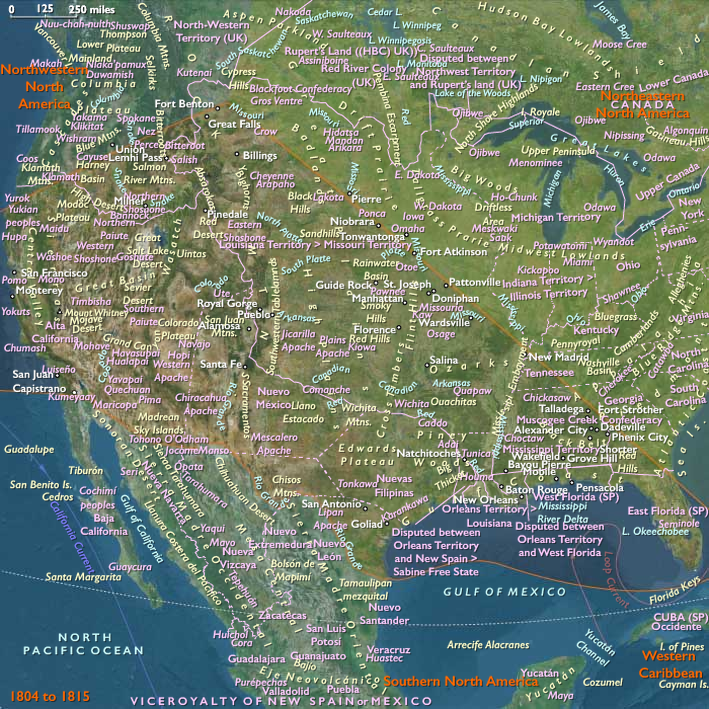
Neither was cotton, due to the difficulty of seed removal, but with the gin, growing cotton with slave labor has become highly profitable—the chief source of wealth in the American South, and the basis of frontier settlement from Georgia to Texas.
"King Cotton" has become a dominant economic force, and slavery is sustained as a key institution of Southern society.
People
Groups
- Texas, Spanish
- West Florida
- Georgia, State of (U.S.A.)
- Mississippi, Territory of (U.S.A.)
- United States of America (US, USA) (Washington DC)
- Orleans, Territory of (U.S.A.)
- Louisiana, Territory of (U.S.A.)
- West Florida, Republic of
Topics
Commodoties
Subjects
Regions

Subregions
Related Events
Showing 10 events out of 21600 total
Years: 1810 - 1810
People
Groups
- Texas, Spanish
- West Florida
- Georgia, State of (U.S.A.)
- Mississippi, Territory of (U.S.A.)
- United States of America (US, USA) (Washington DC)
- Orleans, Territory of (U.S.A.)
- Louisiana, Territory of (U.S.A.)
- West Florida, Republic of
Topics
Commodoties
Subjects
Regions
Subregions